
Review the key concepts, formulae, and examples before starting your quiz.
🔑Concepts
The volume of any pyramid or cone is exactly one-third of the volume of a prism or cylinder with the same base area and vertical height. This relationship is defined by the formula .
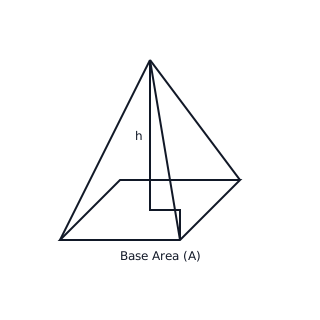
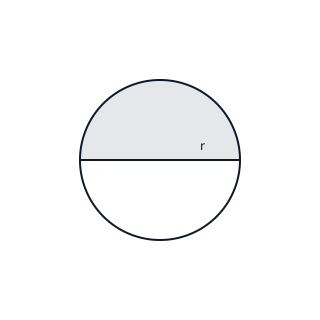
For spheres and hemispheres, the volume depends solely on the radius . A hemisphere is exactly half of a sphere. Capacity refers to the volume of liquid a container can hold, often requiring conversion: .
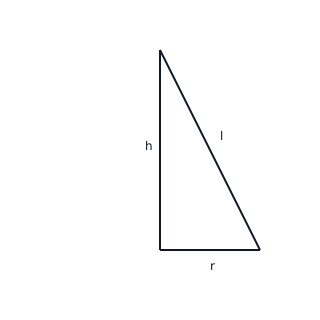
In right cones, the vertical height , radius , and slant height form a right-angled triangle. Applying the Pythagorean theorem allows us to find if only and are given: .
Complex or 'composite' shapes are solved by decomposing the object into simpler solids (e.g., a cylinder topped with a hemisphere) and summing their individual volumes.
📐Formulae
💡Examples
Problem 1:
A cone has a radius of and a slant height of . Calculate its volume in terms of .
Solution:
-
Find the vertical height using Pythagoras:
-
Use the volume formula:
Explanation:
First, the vertical height is calculated using the relationship between the radius, height, and slant height. Then, the volume formula for a cone is applied.
Problem 2:
A hemispherical bowl has a diameter of . Find the capacity of the bowl in liters (rounded to 2 decimal places).
Solution:
-
Radius .
-
Calculate volume of the hemisphere:
-
Convert to liters:
Explanation:
The radius is half the diameter. The volume of a hemisphere is calculated, and then the result is divided by to convert from cubic centimeters to liters.
Problem 3:
Calculate the volume of a square-based pyramid with a base side length of and a vertical height of .
Solution:
-
Calculate the base area :
-
Calculate the volume:
Explanation:
The area of the square base is found first, then multiplied by the height and divided by according to the pyramid volume formula.
Problem 4:
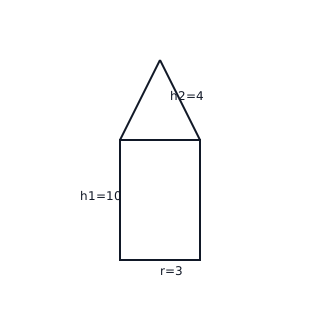
A composite solid consists of a cylinder of radius and height with a cone of the same radius and a vertical height of attached to the top. Calculate the total volume of the solid.
Solution:
Explanation:
First, calculate the volume of the cylindrical base. Then, calculate the volume of the conical top. The total volume is the sum of these two parts.
Problem 5:
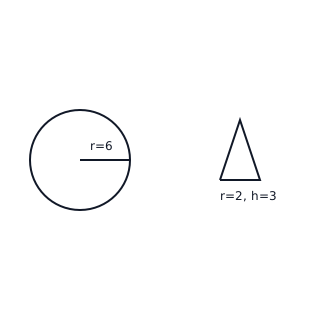
A glass sphere has a radius of . It is melted down to cast several small solid cones, each with a radius of and a height of . How many such cones can be made?
Solution:
Explanation:
Find the total volume of glass available from the sphere. Then find the volume required for one cone. Divide the total volume by the volume of one cone to find the quantity.