krit.club logo

Geometry and Trigonometry - Metric conversions

Grade 10IB

Review the key concepts, formulae, and examples before starting your quiz.

🔑Concepts

•

The metric system is a decimal-based system of measurement. Length conversions use powers of 10. To convert from a larger unit to a smaller unit, multiply by the conversion factor; to convert from a smaller unit to a larger unit, divide by the conversion factor.

Flowchart showing metric length conversions between km, m, cm, and mm.
•

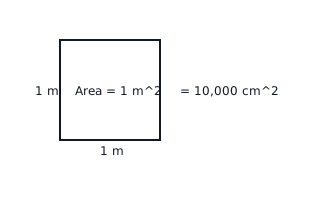
Area conversions use the square of the linear conversion factor. For example, since 1 m=100 cm1 \text{ m} = 100 \text{ cm}, then 1 m2=(100)2 cm2=10,000 cm21 \text{ m}^2 = (100)^2 \text{ cm}^2 = 10,000 \text{ cm}^2. Common units include hectares (1 ha=10,000 m21 \text{ ha} = 10,000 \text{ m}^2).

A square illustrating area conversion from square meters to square centimeters.
•

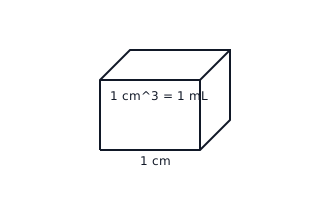
Volume and capacity are related: 1 cm31 \text{ cm}^3 is equivalent to 1 mL1 \text{ mL}. Large volumes are often measured in cubic meters (1 m3=1,000,000 cm3=1,000 L1 \text{ m}^3 = 1,000,000 \text{ cm}^3 = 1,000 \text{ L}).

A cube representing 1 cubic centimeter which equals 1 milliliter.
•

Mass conversions in the metric system use the gram as the base unit. Common units are milligrams (mg), grams (g), kilograms (kg), and tonnes (t). 1 t=1,000 kg1 \text{ t} = 1,000 \text{ kg} and 1 kg=1,000 g1 \text{ kg} = 1,000 \text{ g}.

📐Formulae

1 km=1,000 m1 \text{ km} = 1,000 \text{ m}

1 m=100 cm=1,000 mm1 \text{ m} = 100 \text{ cm} = 1,000 \text{ mm}

1 cm2=100 mm21 \text{ cm}^2 = 100 \text{ mm}^2

1 m2=10,000 cm21 \text{ m}^2 = 10,000 \text{ cm}^2

1 ha=10,000 m21 \text{ ha} = 10,000 \text{ m}^2

1 m3=1,000,000 cm31 \text{ m}^3 = 1,000,000 \text{ cm}^3

1 L=1,000 mL1 \text{ L} = 1,000 \text{ mL}

1 m3=1,000 L=1 kL1 \text{ m}^3 = 1,000 \text{ L} = 1 \text{ kL}

💡Examples

Problem 1:

Convert 4.25 km4.25 \text{ km} into centimeters (cmcm).

Solution:

4.25×1,000×100=425,000 cm4.25 \times 1,000 \times 100 = 425,000 \text{ cm}

Explanation:

First, convert kilometers to meters by multiplying by 1,0001,000 (4,250 m4,250 \text{ m}). Then, convert meters to centimeters by multiplying by 100100.

Problem 2:

Calculate the area of a field in hectares (haha) if its area is 25,000 m225,000 \text{ m}^2.

Solution:

25,00010,000=2.5 ha\frac{25,000}{10,000} = 2.5 \text{ ha}

Explanation:

Since 1 ha=10,000 m21 \text{ ha} = 10,000 \text{ m}^2, we divide the total square meters by 10,00010,000 to find the value in hectares.

Problem 3:

A water tank has a volume of 0.8 m30.8 \text{ m}^3. Find its capacity in liters (LL).

Solution:

0.8×1,000=800 L0.8 \times 1,000 = 800 \text{ L}

Explanation:

There are 1,000 liters1,000 \text{ liters} in 1 cubic meter1 \text{ cubic meter}. Therefore, multiply the volume in m3m^3 by 1,0001,000.

Problem 4:

Convert 750 mm2750 \text{ mm}^2 to  cm2\text{ cm}^2.

Solution:

750102=750100=7.5 cm2\frac{750}{10^2} = \frac{750}{100} = 7.5 \text{ cm}^2

Explanation:

To convert from mm2mm^2 to cm2cm^2, divide by the square of the linear conversion factor (102=10010^2 = 100).

Problem 5:

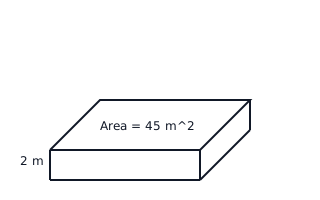
A rectangular swimming pool has a base area of 45 m245 \text{ m}^2 and a depth of 2 m2 \text{ m}. Calculate the volume of the pool in liters (LL).

A 3D representation of a rectangular pool with area 45 and depth 2.

Solution:

  1. Calculate volume in  m3\text{ m}^3: V=Area×depthV = \text{Area} \times \text{depth} V=45×2=90 m3V = 45 \times 2 = 90 \text{ m}^3
  2. Convert m3\text{m}^3 to liters using the factor 1 m3=1,000 L1 \text{ m}^3 = 1,000 \text{ L}: 90×1,000=90,000 L90 \times 1,000 = 90,000 \text{ L}

Explanation:

First, the volume is found in cubic meters by multiplying the base area by height. Since 1 m31 \text{ m}^3 holds 1,0001,000 liters, we multiply the result by 1,0001,000.

Problem 6:

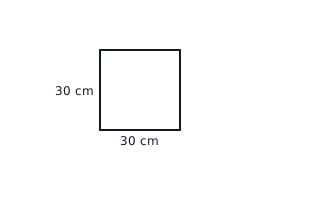
Convert the area of a square tile with side length 30 cm30 \text{ cm} into square meters (m2\text{m}^2).

A square tile with sides of 30 cm.

Solution:

  1. Calculate area in cm2\text{cm}^2: A=30×30=900 cm2A = 30 \times 30 = 900 \text{ cm}^2
  2. Convert to m2\text{m}^2 by dividing by 10,00010,000 (since 1 m2=1002 cm21 \text{ m}^2 = 100^2 \text{ cm}^2): A=90010,000=0.09 m2A = \frac{900}{10,000} = 0.09 \text{ m}^2

Explanation:

To convert square units, you must divide by the square of the linear conversion factor. Since there are 100 cm100 \text{ cm} in 1 m1 \text{ m}, there are 10,000 cm210,000 \text{ cm}^2 in 1 m21 \text{ m}^2.