
Review the key concepts, formulae, and examples before starting your quiz.
🔑Concepts
The perpendicular bisector of a chord always passes through the center of the circle. This implies that any line from the center that bisects a chord must be perpendicular to it.
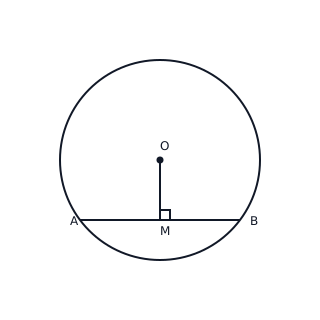
The distance of a chord from the center is the length of the perpendicular segment from the center to the chord. In a circle, equal chords are equidistant from the center.
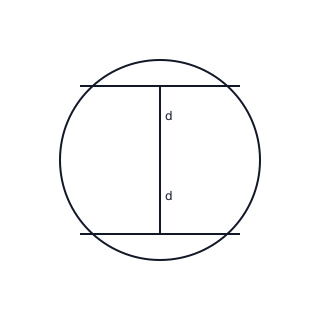
A right-angled triangle is formed by the radius (), the distance from the center (), and half the chord length (). Applying the Pythagorean theorem: .
If two chords are not equal in length, the longer chord is closer to the center of the circle than the shorter chord.
📐Formulae
💡Examples
Problem 1:
A chord of length cm is at a distance of cm from the center of a circle. Find the radius of the circle.
Solution:
Let cm and cm. The radius can be found using the Pythagorean theorem on the triangle formed by the radius, the distance from the center, and half the chord.
Explanation:
We use the property that the perpendicular from the center bisects the chord into two cm segments. This creates a right-angled triangle with sides cm and cm, with the radius as the hypotenuse.
Problem 2:
A circle has a radius of cm. Calculate the length of a chord that is cm away from the center.
Solution:
Given cm and cm. Let be half the length of the chord.
The total length of the chord :
Explanation:
Applying the Pythagorean theorem allows us to find half the chord length. We must multiply by at the end because the perpendicular from the center bisects the chord.
Problem 3:
Two parallel chords of lengths cm and cm lie on opposite sides of the center of a circle of radius cm. Find the distance between the two chords.
Solution:
First, find the distance of each chord from the center.
For the cm chord ():
For the cm chord ():
Since the chords are on opposite sides of the center, the distance between them is:
Explanation:
We calculate the perpendicular distance from the center for both chords independently. Because they are on opposite sides of the center, we add the distances to find the total gap between them.
Problem 4:
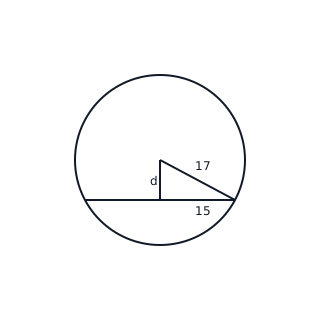
A chord of length cm is drawn in a circle of radius cm. Find the distance of the chord from the center of the circle.
Solution:
- Let cm and cm.
- Half the length of the chord is cm.
- Using Pythagoras' theorem:
- cm.
Explanation:
Since the perpendicular from the center bisects the chord, we form a right triangle with legs and , and hypotenuse . Solving for gives the distance.
Problem 5:
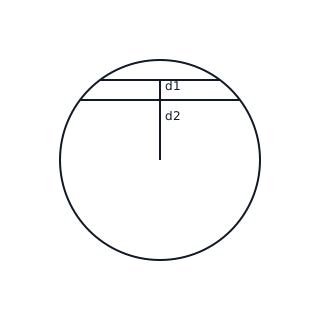
Two parallel chords of length cm and cm lie on the same side of the center of a circle with radius cm. Calculate the distance between the two chords.
Solution:
- For the cm chord: cm.
- For the cm chord: cm.
- Since they are on the same side, the distance between them is cm.
Explanation:
We find the distance of each chord from the center separately using the radius and half-chord lengths. Subtracting these distances gives the gap between the parallel lines.