
Review the key concepts, formulae, and examples before starting your quiz.
🔑Concepts
The Pythagorean theorem states that in a right-angled triangle, the square of the hypotenuse (the side opposite the right angle) is equal to the sum of the squares of the other two sides. This is expressed as , where is the hypotenuse.
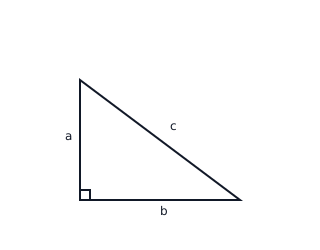
The Converse of the Pythagorean Theorem allows us to determine if a triangle is right-angled. If the side lengths satisfy the condition , the triangle must contain a right angle () opposite side .
Pythagorean triples are sets of three positive integers that satisfy the theorem. Common examples include , , and .
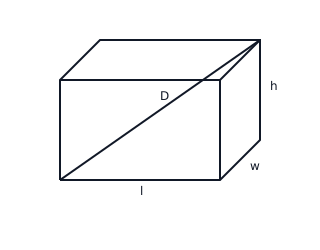
In 3D geometry, the theorem can be extended to find the space diagonal of a rectangular prism (cuboid). The distance from one corner to the opposite corner is given by .
📐Formulae
💡Examples
Problem 1:
A 13m long ladder is leaning against a vertical wall. The base of the ladder is 5m away from the wall on horizontal ground. How high up the wall does the ladder reach?
Solution:
Step 1: Identify the parts of the triangle. The ladder is the hypotenuse (), and the distance from the wall is one leg (). We need to find the height (). Step 2: Use the rearranged formula . Step 3: Substitute the values: . Step 4: Calculate the squares: . Step 5: Subtract: . Step 6: Solve the square root: .
Explanation:
In this real-world application, the wall and the ground form a angle. Since we are looking for one of the shorter sides (the height), we subtract the square of the known side from the square of the hypotenuse.
Problem 2:
Determine if a triangle with side lengths 7cm, 24cm, and 25cm is a right-angled triangle.
Solution:
Step 1: Identify the longest side as the potential hypotenuse () and the other two as legs (). Step 2: Calculate : . Step 3: Calculate : . Step 4: Compare the results: Since (), the condition is met.
Explanation:
This uses the Converse of the Pythagorean theorem. Because the square of the longest side equals the sum of the squares of the other two sides, the triangle must be right-angled.
Problem 3:
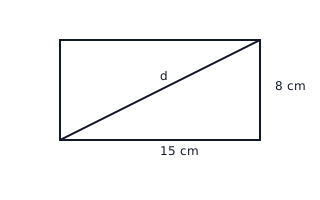
Calculate the length of the diagonal of a rectangle with a length of and a width of .
Solution:
- Let the diagonal be , length , and width .
- Apply the Pythagorean theorem:
- Substitute the values:
- Solve for :
Explanation:
A rectangle's diagonal splits it into two identical right-angled triangles. We use the length and width as the two shorter sides to find the hypotenuse.
Problem 4:
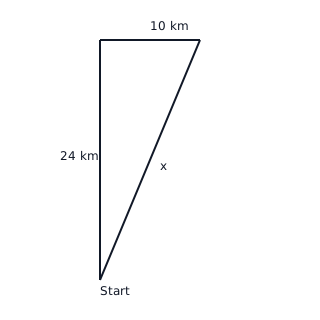
A ship travels due North and then due East. What is the direct distance from the starting point to the final position?
Solution:
- The path forms a right-angled triangle where the legs are and .
- Let the direct distance be :
Explanation:
The northward and eastward paths are perpendicular to each other, creating a right angle. The direct distance is the hypotenuse of the triangle formed.