
Review the key concepts, formulae, and examples before starting your quiz.
🔑Concepts
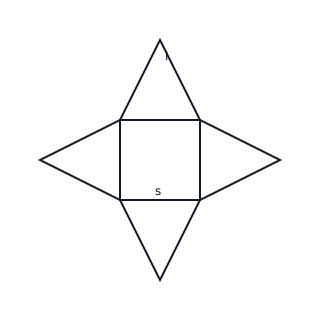
A net is a 2D pattern that can be folded to form a 3D shape. For a square-based pyramid, the net consists of a central square base and four congruent triangles representing the lateral faces. The total surface area is the sum of the area of the base () and the area of the four triangular faces ().
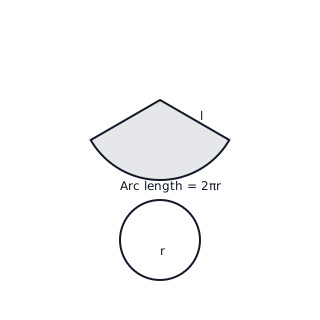
The net of a cone is composed of a circular base and a sector of a larger circle. The radius of this sector is equal to the slant height () of the cone, and the arc length of the sector is equal to the circumference of the cone's base ().
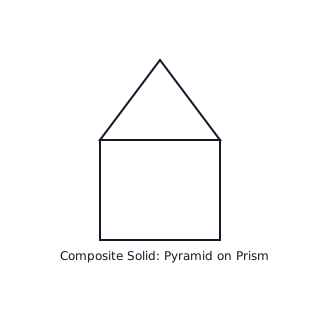
Compound 3D shapes are formed by combining two or more simple solids. To find the total surface area, you must calculate the area of all exposed surfaces while excluding any 'internal' faces where the solids meet.
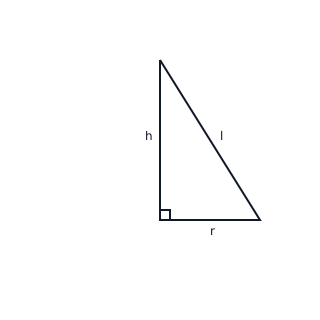
The slant height () of a cone or pyramid is often found using the Pythagorean theorem, relating the vertical height () and the distance from the center to the edge (the radius for a cone or for a square pyramid): .
📐Formulae
💡Examples
Problem 1:
A square-based pyramid has a base side length of and a slant height of . Draw the net and calculate its total surface area.
Solution:
Explanation:
The net consists of one square and four identical triangles with base and height . We sum the area of the base and the four lateral faces.
Problem 2:
A cone has a radius of and a vertical height of . Find the slant height and the area of the sector required for its net.
Solution:
Explanation:
First, we use the Pythagorean theorem to find the slant height (), which is the radius of the sector in the net. Then, we use the curved surface area formula to find the area of that sector.
Problem 3:
A compound shape is formed by a cylinder of radius and height , with a hemisphere placed on one end. What is the total surface area of the combined shape? (Leave answer in terms of )
Solution:
Explanation:
In a compound shape, we only count the exterior surfaces. The net would include one circle (the base of the cylinder), one rectangle (the curved surface of the cylinder), and the curved surface of the hemisphere. The interface where the hemisphere meets the cylinder is hidden and not included.
Problem 4:
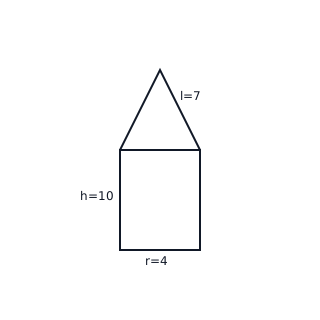
A compound shape consists of a cylinder with a radius of and a height of , with a cone of the same radius and a slant height of attached to the top. Calculate the total surface area of this compound shape in terms of .
Solution:
- Identify the exposed surfaces:
- The circular base of the cylinder: .
- The curved surface of the cylinder: .
- The curved surface of the cone: .
- (The face where they meet is internal and not counted).
- Total Surface Area = .
Explanation:
The total surface area of a compound shape only includes the exterior surfaces. We sum the cylinder's base, the cylinder's lateral area, and the cone's lateral area.
Problem 5:
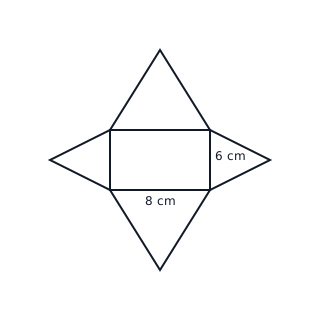
Calculate the total surface area of a rectangular pyramid whose base dimensions are by , and the slant height of the triangles meeting the side is , while the slant height of the triangles meeting the side is .
Solution:
- Area of the base: .
- Area of the two triangles with base : .
- Area of the two triangles with base : .
- Total Surface Area = .
Explanation:
For a rectangular pyramid, there are two pairs of congruent triangular faces with different slant heights. We calculate the area of the base and all four triangles and sum them.