
Review the key concepts, formulae, and examples before starting your quiz.
🔑Concepts
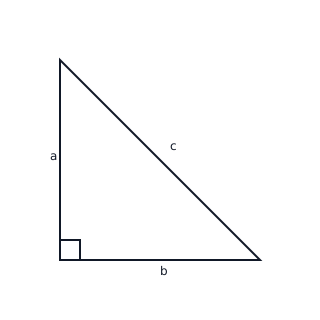
The Converse of Pythagoras' Theorem states that if the square of the longest side () is equal to the sum of the squares of the other two sides (), then the triangle is right-angled.
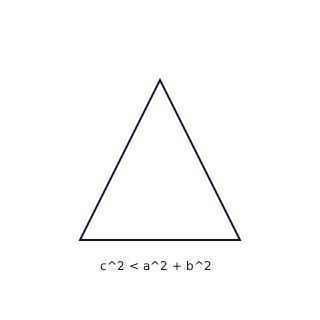
Triangles can be classified by comparing to . If , the angle opposite the longest side is acute (), making the triangle acute-angled.
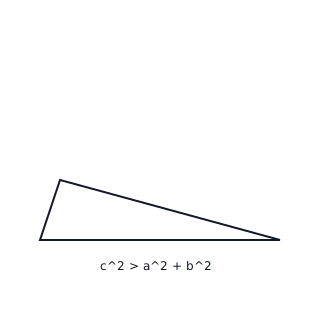
If , the angle opposite the longest side is obtuse (), making the triangle obtuse-angled.
A Pythagorean triple is a set of three positive integers such that . Common triples include , , and .
📐Formulae
💡Examples
Problem 1:
Determine the type of triangle with side lengths , , and .
Solution:
- Identify the longest side: . The other sides are and .
- Calculate : .
- Calculate : .
- Compare: Since , then .
Explanation:
Because the square of the longest side is exactly equal to the sum of the squares of the other two sides, the triangle satisfies the converse of Pythagoras' theorem and is a right-angled triangle.
Problem 2:
Classify a triangle with sides , , and .
Solution:
- Longest side . .
- .
- .
- Compare: , so .
Explanation:
Since the square of the longest side is greater than the sum of the squares of the shorter sides, the angle opposite the side is greater than , making it an obtuse-angled triangle.
Problem 3:
A triangle has sides , , and . Is it acute, right, or obtuse?
Solution:
- Longest side . .
- .
- .
- Compare: , so .
Explanation:
Since the square of the longest side is less than the sum of the squares of the other two sides, the triangle is an acute-angled triangle.
Problem 4:
Determine if a triangle with side lengths , , and is acute, obtuse, or right-angled.
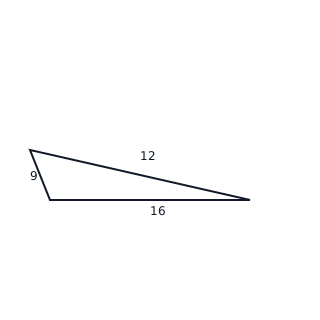
Solution:
Since (), the triangle is obtuse-angled.
Explanation:
To classify the triangle, compare the square of the longest side to the sum of the squares of the two shorter sides. Because the square of the longest side is greater, the angle opposite it is greater than .
Problem 5:
Verify if the set of side lengths , , and forms a right-angled triangle.
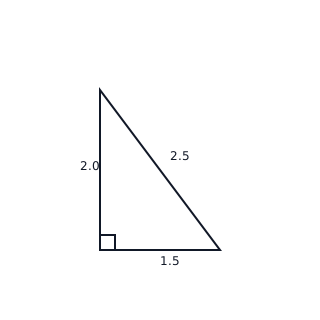
Solution:
Since (), the triangle is right-angled.
Explanation:
When the sum of the squares of the two shorter sides exactly equals the square of the longest side, the Converse of Pythagoras' Theorem confirms the triangle contains a angle.