krit.club logo

Geometry and Trigonometry - Sine rule and cosine rule, including applications-extended

Grade 10IB

Review the key concepts, formulae, and examples before starting your quiz.

🔑Concepts

•

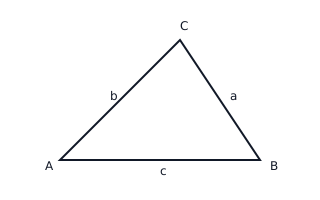
The Sine Rule relates the sides of a triangle to the sines of its opposite angles. Use it when you know a matching 'side-angle pair' and one other piece of information (AAS or SSA). It is given by asin⁡A=bsin⁡B=csin⁡C\frac{a}{\sin A} = \frac{b}{\sin B} = \frac{c}{\sin C}.

A standard triangle ABC with sides a, b, c opposite to angles A, B, C respectively.
•

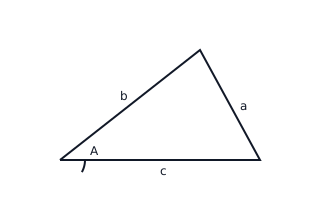
The Cosine Rule is used to find a third side when two sides and the included angle (SAS) are known, or to find an angle when all three sides (SSS) are known. For finding a side: a2=b2+c2−2bccos⁡Aa^2 = b^2 + c^2 - 2bc \cos A. For finding an angle: cos⁡A=b2+c2−a22bc\cos A = \frac{b^2 + c^2 - a^2}{2bc}.

Triangle illustrating the SAS configuration where side a is opposite to angle A, with adjacent sides b and c.
•

The Ambiguous Case of the Sine Rule (SSA) occurs when you are given two sides and a non-included acute angle. Depending on the lengths, there may be no triangle, one right-angled triangle, two possible triangles (one acute, one obtuse), or one unique triangle.
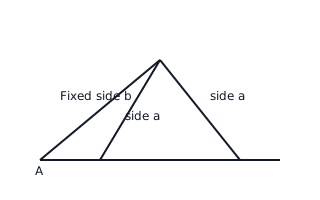
Diagram showing the ambiguous case where side 'a' can swing to form two different triangles with the same angle A and side b.
•

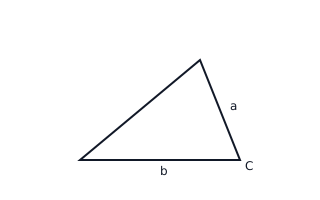
The Area of any Triangle can be calculated using the sine function if two sides and the included angle (SAS) are known. The formula is Area=12absin⁡C\text{Area} = \frac{1}{2}ab \sin C.

Triangle showing sides a and b meeting at angle C for area calculation.
•

In Applications of Trigonometry, Bearings are measured clockwise from North and expressed as three-digit figures (e.g., 045∘045^\circ). Problems often involve combining bearings with the Sine or Cosine rules to find distances or directions between points.
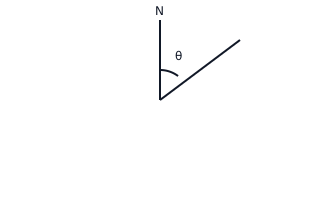
Bearing diagram showing an angle theta measured clockwise from the North line.

📐Formulae

Sine Rule (for sides): asin⁡A=bsin⁡B=csin⁡C\text{Sine Rule (for sides): } \frac{a}{\sin A} = \frac{b}{\sin B} = \frac{c}{\sin C}

Sine Rule (for angles): sin⁡Aa=sin⁡Bb=sin⁡Cc\text{Sine Rule (for angles): } \frac{\sin A}{a} = \frac{\sin B}{b} = \frac{\sin C}{c}

Cosine Rule (for sides): a2=b2+c2−2bccos⁡A\text{Cosine Rule (for sides): } a^2 = b^2 + c^2 - 2bc \cos A

Cosine Rule (for angles): cos⁡A=b2+c2−a22bc\text{Cosine Rule (for angles): } \cos A = \frac{b^2 + c^2 - a^2}{2bc}

Area of a Triangle: Area=12absin⁡C\text{Area of a Triangle: } \text{Area} = \frac{1}{2}ab \sin C

💡Examples

Problem 1:

In triangle ABCABC, side b=7 cmb = 7 \text{ cm}, side c=10 cmc = 10 \text{ cm}, and angle A=40∘A = 40^\circ. Find the length of side aa to 2 decimal places.

Solution:

Using the Cosine Rule: a2=b2+c2−2bccos⁡Aa^2 = b^2 + c^2 - 2bc \cos A a2=72+102−2(7)(10)cos⁡40∘a^2 = 7^2 + 10^2 - 2(7)(10) \cos 40^\circ a2=49+100−140(0.7660)a^2 = 49 + 100 - 140(0.7660) a2=149−107.24a^2 = 149 - 107.24 a2=41.76a^2 = 41.76 a=41.76≈6.46 cma = \sqrt{41.76} \approx 6.46 \text{ cm}

Explanation:

Since we are given two sides and the included angle (SAS), we apply the Cosine Rule to find the opposite side.

Problem 2:

In triangle PQRPQR, PQ=8 cmPQ = 8 \text{ cm}, angle P=45∘P = 45^\circ, and angle Q=60∘Q = 60^\circ. Find the length of side QRQR (side pp).

Solution:

First, find angle RR: R=180∘−(45∘+60∘)=75∘R = 180^\circ - (45^\circ + 60^\circ) = 75^\circ Using the Sine Rule: psin⁡P=rsin⁡R\frac{p}{\sin P} = \frac{r}{\sin R} psin⁡45∘=8sin⁡75∘\frac{p}{\sin 45^\circ} = \frac{8}{\sin 75^\circ} p=8×sin⁡45∘sin⁡75∘p = \frac{8 \times \sin 45^\circ}{\sin 75^\circ} p=8×0.70710.9659≈5.86 cmp = \frac{8 \times 0.7071}{0.9659} \approx 5.86 \text{ cm}

Explanation:

We use the angle sum property to find the third angle, then apply the Sine Rule to relate the known side and its opposite angle to the unknown side and its opposite angle.

Problem 3:

Find the area of a triangular garden with sides 12 m12 \text{ m} and 15 m15 \text{ m} and an included angle of 110∘110^\circ.

Solution:

Area=12absin⁡C\text{Area} = \frac{1}{2}ab \sin C Area=12×12×15×sin⁡110∘\text{Area} = \frac{1}{2} \times 12 \times 15 \times \sin 110^\circ Area=90×0.9397\text{Area} = 90 \times 0.9397 Area≈84.57 m2\text{Area} \approx 84.57 \text{ m}^2

Explanation:

To find the area when two sides and the included angle are given, the trigonometric area formula is the most direct method.

Problem 4:

A surveyor stands at point AA and measures the distance to two landmarks, BB and CC. AB=150 mAB = 150 \text{ m} and AC=210 mAC = 210 \text{ m}. The angle between the lines of sight to BB and CC is 55∘55^\circ. Calculate the distance between the two landmarks.
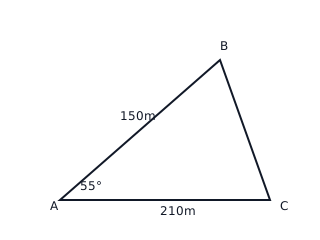
Triangle with sides 150m and 210m and an included angle of 55 degrees.

Solution:

a2=b2+c2−2bccos⁡Aa^2 = b^2 + c^2 - 2bc \cos A BC2=2102+1502−2(210)(150)cos⁡55∘BC^2 = 210^2 + 150^2 - 2(210)(150) \cos 55^\circ BC2=44100+22500−63000(0.5736)BC^2 = 44100 + 22500 - 63000(0.5736) BC2=66600−36136.8BC^2 = 66600 - 36136.8 BC2=30463.2BC^2 = 30463.2 BC=30463.2≈174.54 mBC = \sqrt{30463.2} \approx 174.54 \text{ m}

Explanation:

Since we are given two sides and the included angle (SAS), we use the Cosine Rule to find the unknown opposite side BCBC.

Problem 5:

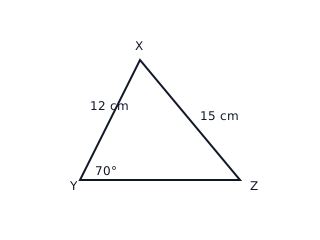
In △XYZ\triangle XYZ, the length of XY=12 cmXY = 12 \text{ cm}, XZ=15 cmXZ = 15 \text{ cm}, and ∠XYZ=70∘\angle XYZ = 70^\circ. Find the size of ∠XZY\angle XZY.

Triangle XYZ where XY is 12, XZ is 15 and angle Y is 70 degrees.

Solution:

sin⁡Zz=sin⁡Yy\frac{\sin Z}{z} = \frac{\sin Y}{y} sin⁡Z12=sin⁡70∘15\frac{\sin Z}{12} = \frac{\sin 70^\circ}{15} sin⁡Z=12×sin⁡70∘15\sin Z = \frac{12 \times \sin 70^\circ}{15} sin⁡Z=12×0.939715\sin Z = \frac{12 \times 0.9397}{15} sin⁡Z=0.7518\sin Z = 0.7518 Z=sin⁡−1(0.7518)≈48.7∘Z = \sin^{-1}(0.7518) \approx 48.7^\circ

Explanation:

We use the Sine Rule because we have a known side-angle pair (15 cm15 \text{ cm} and 70∘70^\circ) and another side (12 cm12 \text{ cm}) to find its opposite angle.