
Geometry and Trigonometry - Geometric transformations: translation, reflection, rotation, and enlargement
Review the key concepts, formulae, and examples before starting your quiz.
🔑Concepts
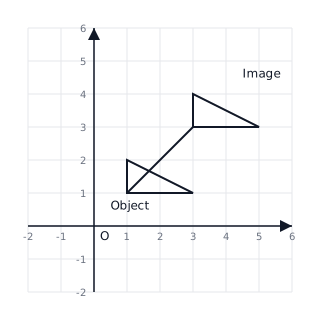
Translation: Moving a shape without rotating, resizing, or flipping it. Every point in the object moves the same distance in the same direction, defined by a translation vector . The image is congruent to the object.
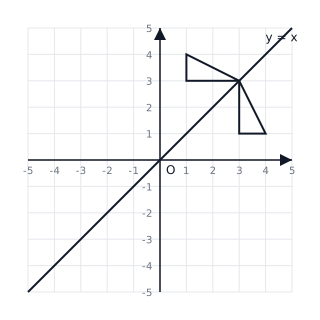
Reflection: Creating a mirror image of a shape across a 'mirror line'. Common lines include the -axis, -axis, or lines like . Points on the object and their corresponding points on the image are equidistant from the reflection line.
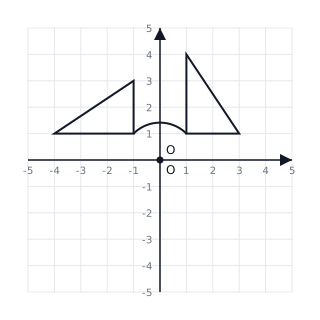
Rotation: Turning a shape around a fixed point called the 'center of rotation' by a specific angle and direction (clockwise or anti-clockwise). The orientation of the shape changes, but its size remains identical.
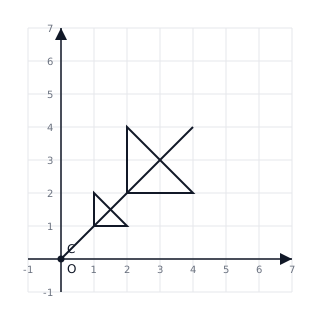
Enlargement: Scaling a shape from a 'center of enlargement' by a scale factor . If , the shape gets larger; if , it gets smaller. Enlargement produces similar shapes where angles are preserved but side lengths change.
📐Formulae
Translation: using vector
Reflection in -axis:
Reflection in -axis:
Reflection in :
Rotation clockwise about :
Rotation anti-clockwise about :
Rotation about :
Scale Factor:
Enlargement from origin :
💡Examples
Problem 1:
Triangle has vertices , , and . Apply a translation using the vector and find the new coordinates of the vertices.
Solution:
- Identify the -shift and -shift from the vector: , .
- Add the shifts to each vertex:
- The translated vertices are , , and .
Explanation:
To translate a point, we add the top value of the vector to the -coordinate and the bottom value to the -coordinate.
Problem 2:
A square has a vertex at . It undergoes an enlargement with a scale factor centered at the origin . Determine the coordinates of the image vertex . If the original square had an area of , what is the area of the enlarged square?
Solution:
- For the coordinates: Use the rule . .
- For the area: The area of an enlarged shape is the original area multiplied by the scale factor squared (). .
Explanation:
When the center of enlargement is the origin, we simply multiply coordinates by . Note that while side lengths increase by , area increases by .
Problem 3:
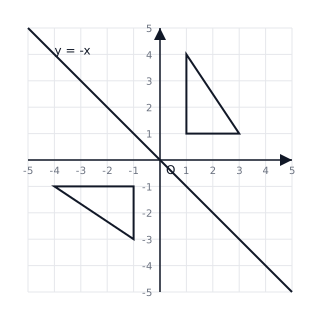
A triangle with vertices , , and is reflected in the line . Determine the coordinates of the image vertices , , and .
Solution:
The rule for reflection in the line is . Applying this to the vertices: Therefore, the new vertices are , , and .
Explanation:
To reflect a point across the line , we swap the and coordinates and then multiply both by . This results in a mirror image located in the third quadrant if the original was in the first.
Problem 4:
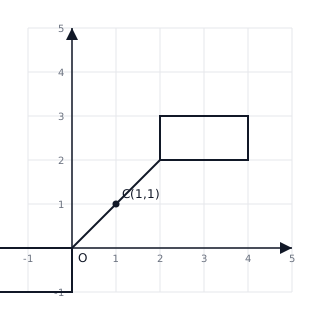
Rectangle has vertices at , , , and . It undergoes a rotation of about the point . Find the coordinates of the new vertex .
Solution:
- Find the vector from the center of rotation to point :
- A rotation reverses the vector:
- Add this vector to the center of rotation : The coordinates of are .
Explanation:
A rotation of about any point is equivalent to a point reflection. The formula for the image is . For point and center , we get .