krit.club logo

Geometry and Trigonometry - Trigonometric identities and equations

Grade 10IB

Review the key concepts, formulae, and examples before starting your quiz.

🔑Concepts

•

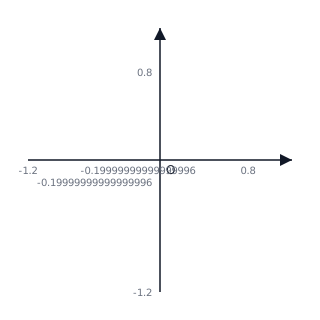
The fundamental trigonometric identity sin⁡2θ+cos⁡2θ=1\sin^2 \theta + \cos^2 \theta = 1 is derived from the Pythagorean theorem applied to a unit circle, where the coordinates of any point on the circle are (cos⁡θ,sin⁡θ)(\cos \theta, \sin \theta).

Unit circle showing the relationship between sine, cosine and the hypotenuse of 1.
•

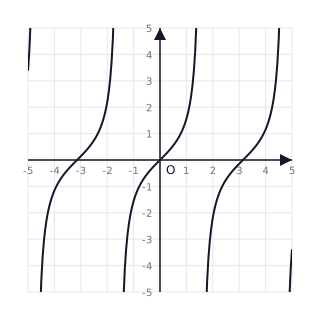
The tangent identity tan⁡θ=sin⁡θcos⁡θ\tan \theta = \frac{\sin \theta}{\cos \theta} relates the slope of the terminal ray to the sine and cosine values. It is undefined when cos⁡θ=0\cos \theta = 0.

Graph of the tangent function showing vertical asymptotes.
•

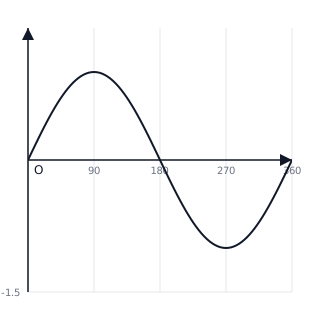
Trigonometric equations are solved by isolating the trigonometric ratio and finding all possible angles within a specified domain (e.g., 0∘≤θ≤360∘0^\circ \le \theta \le 360^\circ).

Sine curve intersected by a horizontal line y=0.5 to show multiple solutions.
•

Complementary angle identities state that sin⁡(90∘−θ)=cos⁡θ\sin(90^\circ - \theta) = \cos \theta. This is visually represented by the two non-right angles in a right-angled triangle.
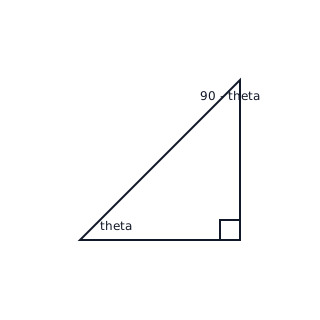
Right triangle showing complementary angles theta and 90 minus theta.

📐Formulae

sin⁡2θ+cos⁡2θ=1\sin^2 \theta + \cos^2 \theta = 1

tan⁡θ=sin⁡θcos⁡θ\tan \theta = \frac{\sin \theta}{\cos \theta}

sin⁡θ=cos⁡(90∘−θ)\sin \theta = \cos(90^\circ - \theta)

cos⁡θ=sin⁡(90∘−θ)\cos \theta = \sin(90^\circ - \theta)

tan⁡2θ+1=sec⁡2θ\tan^2 \theta + 1 = \sec^2 \theta

💡Examples

Problem 1:

Simplify the expression: (sin⁡θ+cos⁡θ)2−2sin⁡θcos⁡θ(\sin \theta + \cos \theta)^2 - 2\sin \theta \cos \theta.

Solution:

(sin⁡θ+cos⁡θ)2−2sin⁡θcos⁡θ(\sin \theta + \cos \theta)^2 - 2\sin \theta \cos \theta =(sin⁡2θ+cos⁡2θ+2sin⁡θcos⁡θ)−2sin⁡θcos⁡θ= (\sin^2 \theta + \cos^2 \theta + 2\sin \theta \cos \theta) - 2\sin \theta \cos \theta =sin⁡2θ+cos⁡2θ= \sin^2 \theta + \cos^2 \theta =1= 1

Explanation:

Expand the squared binomial using the identity (a+b)2=a2+2ab+b2(a+b)^2 = a^2 + 2ab + b^2. Then, subtract the 2sin⁡θcos⁡θ2\sin \theta \cos \theta term. Finally, apply the Pythagorean identity sin⁡2θ+cos⁡2θ=1\sin^2 \theta + \cos^2 \theta = 1.

Problem 2:

Solve for θ\theta in the range 0∘≤θ≤90∘0^\circ \le \theta \le 90^\circ for the equation: 2sin⁡θ−3=02\sin \theta - \sqrt{3} = 0.

Solution:

2sin⁡θ−3=02\sin \theta - \sqrt{3} = 0 2sin⁡θ=32\sin \theta = \sqrt{3} sin⁡θ=32\sin \theta = \frac{\sqrt{3}}{2} θ=sin⁡−1(32)\theta = \sin^{-1}\left(\frac{\sqrt{3}}{2}\right) θ=60∘\theta = 60^\circ

Explanation:

Isolate the sin⁡θ\sin \theta term by adding 3\sqrt{3} to both sides and then dividing by 22. Use the inverse sine function to find the angle whose sine is 32\frac{\sqrt{3}}{2}.

Problem 3:

Given cos⁡θ=45\cos \theta = \frac{4}{5} where θ\theta is an acute angle, find the value of tan⁡θ\tan \theta without finding θ\theta.

Solution:

sin⁡2θ+cos⁡2θ=1\sin^2 \theta + \cos^2 \theta = 1 sin⁡2θ+(45)2=1\sin^2 \theta + \left(\frac{4}{5}\right)^2 = 1 sin⁡2θ+1625=1\sin^2 \theta + \frac{16}{25} = 1 sin⁡2θ=1−1625=925\sin^2 \theta = 1 - \frac{16}{25} = \frac{9}{25} sin⁡θ=925=35\sin \theta = \sqrt{\frac{9}{25}} = \frac{3}{5} tan⁡θ=sin⁡θcos⁡θ=3/54/5=34\tan \theta = \frac{\sin \theta}{\cos \theta} = \frac{3/5}{4/5} = \frac{3}{4}

Explanation:

First, use the Pythagorean identity to find sin⁡θ\sin \theta. Since θ\theta is acute, sin⁡θ\sin \theta is positive. Then, use the quotient identity tan⁡θ=sin⁡θcos⁡θ\tan \theta = \frac{\sin \theta}{\cos \theta} to calculate the tangent.

Problem 4:

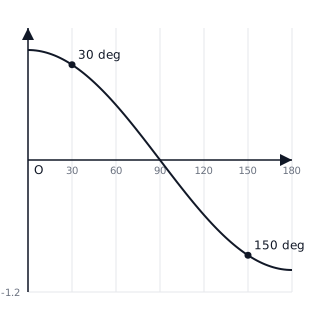
Solve the equation 4cos⁡2θ−3=04\cos^2 \theta - 3 = 0 for 0∘≤θ≤180∘0^\circ \le \theta \le 180^\circ.

Cosine curve from 0 to 180 degrees showing intersections at 30 and 150 degrees.

Solution:

  1. Isolate cos⁡2θ\cos^2 \theta: 4cos⁡2θ=34\cos^2 \theta = 3 cos⁡2θ=34\cos^2 \theta = \frac{3}{4}
  2. Take the square root of both sides: cos⁡θ=±34=±32\cos \theta = \pm \sqrt{\frac{3}{4}} = \pm \frac{\sqrt{3}}{2}
  3. Find θ\theta for cos⁡θ=32\cos \theta = \frac{\sqrt{3}}{2}: θ=cos⁡−1(32)=30∘\theta = \cos^{-1}\left(\frac{\sqrt{3}}{2}\right) = 30^\circ
  4. Find θ\theta for cos⁡θ=−32\cos \theta = -\frac{\sqrt{3}}{2} in the given range: θ=180∘−30∘=150∘\theta = 180^\circ - 30^\circ = 150^\circ Final answers: θ=30∘,150∘\theta = 30^\circ, 150^\circ.

Explanation:

We first algebraicly isolate the cosine squared term, then solve for cosine. Since the cosine is squared, we must consider both positive and negative roots, leading to two solutions within the first and second quadrants.

Problem 5:

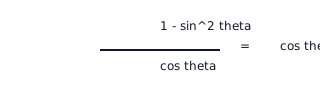
Prove the identity 1−sin⁡2θcos⁡θ=cos⁡θ\frac{1 - \sin^2 \theta}{\cos \theta} = \cos \theta.

Visual algebraic substitution showing the identity simplification.

Solution:

  1. Start with the left-hand side (LHS): LHS=1−sin⁡2θcos⁡θLHS = \frac{1 - \sin^2 \theta}{\cos \theta}
  2. Use the Pythagorean identity sin⁡2θ+cos⁡2θ=1\sin^2 \theta + \cos^2 \theta = 1, which implies 1−sin⁡2θ=cos⁡2θ1 - \sin^2 \theta = \cos^2 \theta: LHS=cos⁡2θcos⁡θLHS = \frac{\cos^2 \theta}{\cos \theta}
  3. Simplify the fraction by canceling cos⁡θ\cos \theta: LHS=cos⁡θLHS = \cos \theta
  4. Compare with the right-hand side (RHS): LHS=RHSLHS = RHS The identity is proven.

Explanation:

The core of this proof relies on substituting the numerator using the rearranged Pythagorean identity and then simplifying the resulting rational expression.