
Review the key concepts, formulae, and examples before starting your quiz.
🔑Concepts
A quadrilateral is a four-sided polygon. The sum of its interior angles is always . Parallelograms are a special class of quadrilaterals where both pairs of opposite sides are parallel and equal in length.
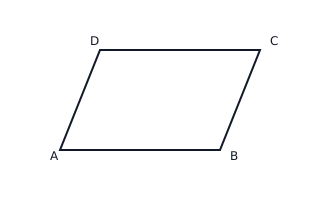
A rectangle is a parallelogram with four right angles (). Its diagonals are equal in length and bisect each other.

A rhombus is a parallelogram with four equal sides. Its diagonals bisect each other at right angles () and bisect the interior angles.
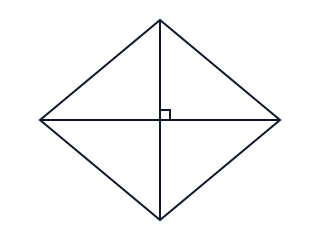
A kite is a quadrilateral with two pairs of adjacent sides equal. One diagonal is the perpendicular bisector of the other.

📐Formulae
💡Examples
Problem 1:
In a quadrilateral , the interior angles are given as , , , and . Calculate the value of and the size of the largest angle.
Solution:
The sum of the interior angles of a quadrilateral is . The largest angle is :
Explanation:
We use the angle sum property of quadrilaterals to set up a linear equation and solve for the unknown variable .
Problem 2:
A trapezium has parallel sides of length and . If the perpendicular distance between these sides is , find the area of the trapezium.
Solution:
Using the area formula for a trapezium:
Explanation:
Substitute the given lengths of the parallel sides ( and ) and the height () into the area formula.
Problem 3:
In a rhombus , the diagonals and have lengths and respectively. Find the length of one side of the rhombus.
Solution:
The diagonals of a rhombus bisect each other at . Let the intersection be . In right-angled triangle , using Pythagoras' theorem:
Explanation:
We use the property that diagonals of a rhombus are perpendicular bisectors of each other to create a right-angled triangle and then apply the Pythagorean theorem.
Problem 4:
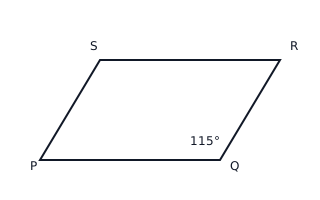
In the parallelogram shown, . Find the measures of , , and .
Solution:
- In a parallelogram, consecutive angles are supplementary (add up to ).
- Opposite angles are equal.
Final values: , , .
Explanation:
We use the properties of parallelograms: adjacent angles are supplementary because they are co-interior angles between parallel lines, and opposite angles are congruent.
Problem 5:
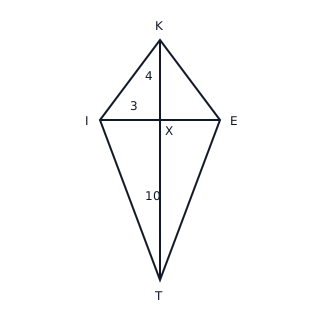
A kite has diagonals and that intersect at point . If cm, cm, and cm, calculate the lengths of the sides and .
Solution:
- In a kite, diagonals intersect at . This creates four right-angled triangles.
- In , use Pythagoras' theorem:
- In , use Pythagoras' theorem:
Side , Side .
Explanation:
The diagonals of a kite are perpendicular. By treating the intersection as the origin of four right-angled triangles, we can find the side lengths using the Pythagorean theorem.