
Review the key concepts, formulae, and examples before starting your quiz.
🔑Concepts
A tessellation (or tiling) is a pattern of shapes that covers a plane without any gaps or overlaps. In a regular tessellation, the sum of the interior angles of the polygons meeting at any vertex must exactly equal . This explains why only regular triangles, squares, and hexagons can form regular tessellations.
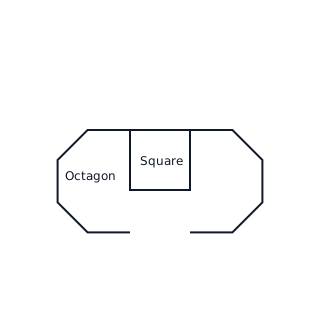
Semi-regular (or Archimedean) tessellations are formed by two or more types of regular polygons. Every vertex in the tiling must be identical, meaning the same sequence of polygons surrounds each point. For example, a common semi-regular tessellation uses squares and octagons.
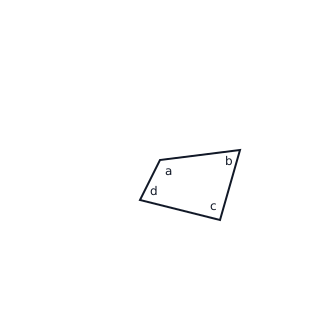
Every quadrilateral, whether regular or irregular, can tessellate. This is because the sum of the interior angles of any quadrilateral is . By rotating and translating the quadrilateral, the four different angles () can be brought together at each vertex.
Non-regular tessellations can be created using transformations such as translation, reflection, and rotation on a basic tiling unit (like a square or rectangle) to create interlocking 'Escher-style' shapes.
📐Formulae
💡Examples
Problem 1:
Explain why a regular pentagon cannot form a regular tessellation.
Solution:
- Calculate the interior angle of a regular pentagon ():
- Check if is a divisor of :
- Since is not an integer, the pentagons will either overlap or leave a gap.
Explanation:
For a regular polygon to tessellate, the interior angle must divide perfectly so that a whole number of polygons meet at a vertex.
Problem 2:
A semi-regular tessellation is formed by two regular octagons and one other regular polygon meeting at each vertex. Identify the third polygon.
Solution:
- Find the interior angle of a regular octagon ():
- Let the interior angle of the unknown polygon be . The sum of angles at the vertex must be :
- A regular polygon with an interior angle of is a square.
Explanation:
In semi-regular tessellations, the sum of all interior angles of the polygons meeting at a single vertex must equal .
Problem 3:
Calculate the interior angle of a regular hexagon and show that it can form a regular tessellation.
Solution:
- Calculate the interior angle for :
- Divide by the interior angle:
- Since is an integer, exactly hexagons meet at each vertex without gaps.
Explanation:
Because is a factor of , regular hexagons can tile the plane perfectly.
Problem 4:
Determine if a regular dodecagon (12-sided polygon) can form a regular tessellation. Support your answer by calculating the interior angle.
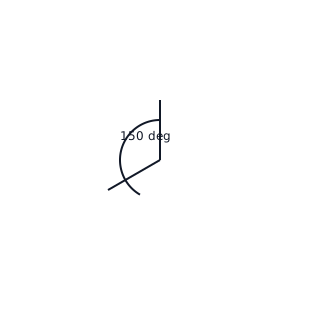
Solution:
Since is not an integer, a regular dodecagon cannot form a regular tessellation as there would be a gap of if two dodecagons meet, or an overlap if three meet.
Explanation:
For a regular polygon to tessellate, its interior angle must be a factor of . Since does not divide evenly, a gap is left.
Problem 5:
A semi-regular tessellation is made of regular triangles and regular hexagons. If two triangles and two hexagons meet at each vertex in the order (3, 6, 3, 6), verify that they form a valid tessellation at the vertex.
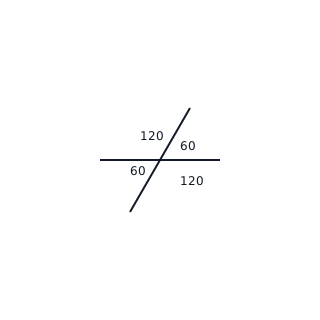
Solution:
Since the sum is exactly , the combination forms a valid tessellation.
Explanation:
A tiling is valid if the sum of interior angles at any vertex is exactly . Here, the combination of two triangles and two hexagons satisfies this condition.