
Geometry and Trigonometry - Surface area and volume of prisms, cylinders, pyramids, cones, and spheres
Review the key concepts, formulae, and examples before starting your quiz.
🔑Concepts
A prism is a 3D shape with a constant cross-section. The volume is calculated by multiplying the area of the base () by the height (). For a cylinder, which is a circular prism, the base area is .
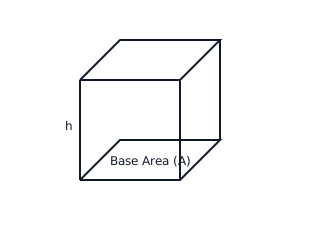
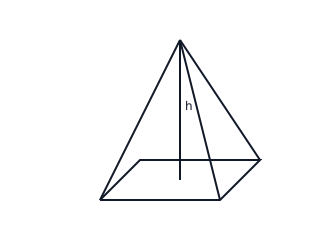
Pyramids and cones share a common property: their volume is exactly one-third of the volume of a prism or cylinder with the same base and height ().
The surface area of a sphere is , which is exactly four times the area of its great circle. The volume is .
Slant height () vs. Vertical height (): In cones and pyramids, the slant height is the distance from the apex down the face to the edge. They are related to the radius or base segment by the Pythagorean theorem: .
📐Formulae
Volume of a Prism:
Surface Area of a Rectangular Prism:
Volume of a Cylinder:
Total Surface Area of a Cylinder:
Volume of a Cone:
Total Surface Area of a Cone: (where is slant height)
Volume of a Pyramid:
Volume of a Sphere:
Surface Area of a Sphere:
💡Examples
Problem 1:
A right cone has a base radius of cm and a slant height of cm. Calculate the volume of the cone. (Leave your answer in terms of )
Solution:
- Identify the given values: cm, cm.
- We need the vertical height for the volume formula. Use the Pythagorean theorem: .
- .
- cm.
- Apply the volume formula: .
- .
- cm.
Explanation:
To find the volume of a cone, the vertical height is required. Since only the slant height and radius were provided, the first step was to form a right triangle and solve for before substituting all values into the cone volume formula.
Problem 2:
Calculate the total surface area of a cylinder with a diameter of cm and a height of cm. Use .
Solution:
- Find the radius: cm.
- Identify the height: cm.
- Use the Surface Area formula: .
- Calculate the area of the two circular bases: cm.
- Calculate the lateral surface area: cm.
- Add the parts together: cm.
Explanation:
The total surface area of a cylinder includes the top and bottom circles plus the rectangular side. By using the radius (half the diameter), we calculate these parts separately and sum them for the final result.
Problem 3:
A metal sphere has a radius of cm. It is melted down and recast into a solid cylinder with a radius of cm. Calculate the height of the cylinder.
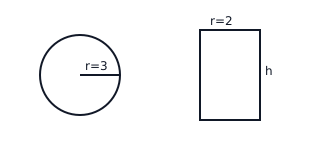
Solution:
Explanation:
Since the sphere is recast into a cylinder, the volume remains constant. We calculate the sphere's volume first, then set it equal to the cylinder's volume formula to solve for the unknown height.
Problem 4:
Find the total surface area of a solid hemisphere with a radius of cm. (Use )
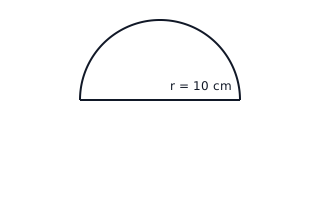
Solution:
Explanation:
A solid hemisphere has two surfaces: the curved top and the flat circular base. The total area is the sum of half the sphere's surface area plus the area of the circular base.