
Geometry and Trigonometry - Circle parts: radius, diameter, arc, sector, and segment-extended
Review the key concepts, formulae, and examples before starting your quiz.
🔑Concepts
The fundamental parts of a circle include the radius (), which is the distance from the center to the edge, and the diameter (), which is twice the radius and passes through the center.
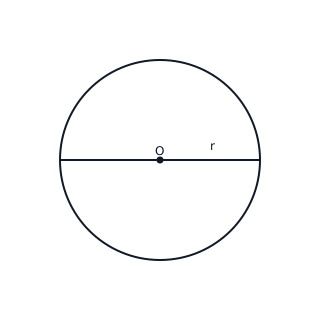
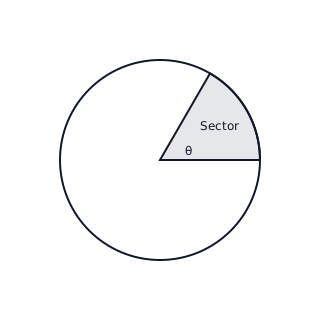
An arc is a portion of the circumference, while a sector is a 'pie-slice' region bounded by two radii and an arc. The central angle determines their size relative to the whole circle.
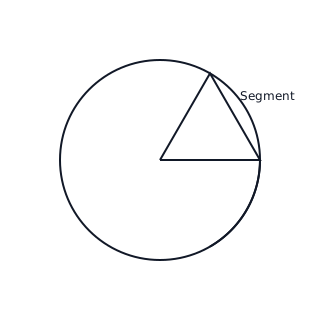
A segment is the region between a chord and the corresponding arc. Its area is calculated by subtracting the area of the triangle formed by the radii and the chord from the area of the sector.
For extended problems, remember that the perimeter of a sector includes the arc length PLUS two radii: .
📐Formulae
💡Examples
Problem 1:
A sector of a circle has a radius of cm and a central angle of . Calculate the length of the arc.
Solution:
Explanation:
Substitute the values and into the arc length formula. Simplify the fraction and solve.
Problem 2:
Find the area of a sector with a radius of cm and a central angle of .
Solution:
Explanation:
The sector represents a quarter of the circle since . Multiply this fraction by the total area of the circle.
Problem 3:
Calculate the area of the segment formed by a chord in a circle of radius cm where the central angle is .
Solution:
Explanation:
First, find the area of the sector. Then, calculate the area of the triangle formed by the two radii and the chord using the formula . Subtract the triangle area from the sector area.
Problem 4:
A silver pendant is shaped like a sector of a circle with a radius of cm and a central angle of . Find the total perimeter of the pendant. (Take )
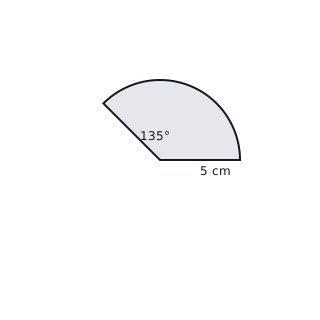
Solution:
- Calculate Arc Length ():
- Calculate Total Perimeter ():
Explanation:
To find the total perimeter of a sector, you must add the curved arc length to the two straight radii that bound the shape.
Problem 5:
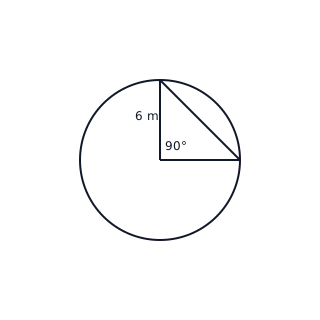
A circular garden has a radius of m. A straight path is built as a chord that subtends an angle of at the center. Find the area of the smaller segment created by this path.
Solution:
- Area of Sector:
- Area of Triangle:
- Area of Segment:
Explanation:
The segment area is the difference between the sector area and the area of the triangle formed by the center and the chord endpoints.