
Review the key concepts, formulae, and examples before starting your quiz.
🔑Concepts
A tangent to a circle is a straight line that touches the circle at exactly one point, called the point of tangency. The radius of the circle drawn to this point is always perpendicular () to the tangent line.
Two tangents drawn to a circle from the same external point are equal in length. This creates a kite shape with the radii, where the line connecting the external point to the center bisects the angle between the tangents.
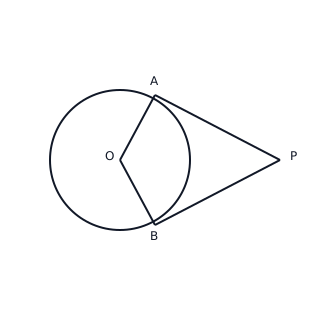
The angle between a tangent and a chord through the point of contact is equal to the angle in the alternate segment. This is known as the Alternate Segment Theorem.
If two circles touch each other externally, the distance between their centers is equal to the sum of their radii (). If they touch internally, the distance is the difference of their radii ().
📐Formulae
💡Examples
Problem 1:
A tangent is drawn from an external point to a circle with center and radius . If the length of the tangent is , calculate the distance of point from the center .
Solution:
- In , the radius is perpendicular to the tangent , so .
- Use the Pythagorean theorem: .
- Substitute the values: .
- .
- .
Explanation:
Since the radius is perpendicular to the tangent at the point of contact, we form a right-angled triangle. We then apply the Pythagorean theorem to find the hypotenuse .
Problem 2:
Two tangents and are drawn to a circle with center from an external point . If , find the measure of .
Solution:
- In quadrilateral , and (tangent-radius property).
- The sum of angles in a quadrilateral is , so .
- In , (radii of the same circle), making it an isosceles triangle.
- Therefore, .
- .
Explanation:
First, we find the central angle using the fact that the angles of a quadrilateral sum to . Then, we use the properties of an isosceles triangle formed by the two radii to find the base angle.
Problem 3:
Find the value of in the following subtraction problem involving distances from a tangent point:
Solution:
So, .
Explanation:
This is a simple vertical arithmetic subtraction to determine a remaining segment length on a line tangent to a circle.
Problem 4:
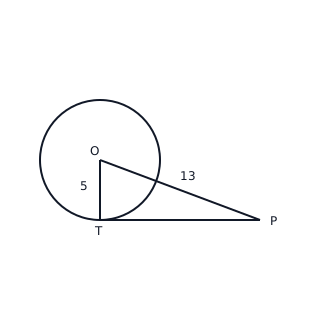
In the given figure, is a tangent to a circle with center at point . If and , find the length of the tangent segment .
Solution:
- Since is a tangent at , according to the tangent-radius theorem.
- is a right-angled triangle. By Pythagoras' theorem:
- Substitute the known values:
- Solve for : Therefore, the length of the tangent is .
Explanation:
The radius drawn to the point of tangency is always perpendicular to the tangent line, allowing the use of the Pythagorean theorem to find missing side lengths in the resulting right triangle.
Problem 5:
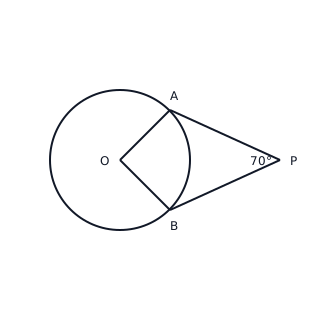
Two tangents and are drawn to a circle with center from an external point . If the angle between the tangents , find the measure of the central angle .
Solution:
- In the quadrilateral , and because radii are perpendicular to tangents at the point of contact.
- The sum of angles in a quadrilateral is :
- Substitute the known values:
- Calculate : Therefore, .
Explanation:
Because the angles at the points of tangency are both , the angle between the tangents and the angle at the center are supplementary (they add up to ).