krit.club logo

Geometry and Trigonometry - Enlargement around a given point-extended

Grade 10IB

Review the key concepts, formulae, and examples before starting your quiz.

🔑Concepts

•

An enlargement is a transformation that changes the size of an object while preserving its shape. It is defined by a center of enlargement (a,b)(a, b) and a scale factor kk. If k>1k > 1, the image is larger and on the same side of the center. If 0<k<10 < k < 1, the image is smaller (a reduction) and on the same side of the center.
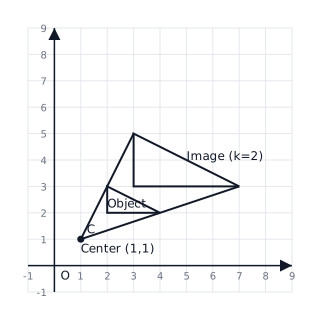
A coordinate plane showing a small triangle and its enlargement by a scale factor of 2 from a center point at (1,1).
•

Negative scale factors (k<0k < 0) result in an image that is inverted and located on the opposite side of the center of enlargement. For example, k=−1k = -1 produces a rotation of 180∘180^{\circ} about the center without changing the size of the object.

•

The relationship between the coordinates of the object (x,y)(x, y) and the image (x′,y′)(x', y') relative to center (a,b)(a, b) is given by x′=a+k(x−a)x' = a + k(x - a) and y′=b+k(y−b)y' = b + k(y - b). Geometrically, this means the vector from the center to the image is kk times the vector from the center to the object.

•

Area scale factor: If the linear scale factor is kk, then the area of the image is k2k^2 times the area of the original shape. This applies even if kk is negative, as area is always positive.

📐Formulae

k=length of image sidelength of object sidek = \frac{\text{length of image side}}{\text{length of object side}}

k=distance from center to image pointdistance from center to object pointk = \frac{\text{distance from center to image point}}{\text{distance from center to object point}}

New Coordinate (x′,y′)=(a+k(x−a),b+k(y−b))\text{New Coordinate } (x', y') = (a + k(x - a), b + k(y - b))

Area of Image=k2×Area of Object\text{Area of Image} = k^2 \times \text{Area of Object}

💡Examples

Problem 1:

Triangle ABCABC has vertices A(2,2)A(2, 2), B(4,2)B(4, 2), and C(2,5)C(2, 5). Enlarge the triangle by a scale factor of k=2k = 2 using the center of enlargement (1,1)(1, 1). Find the coordinates of the image A′B′C′A'B'C'.

Solution:

Using the formula (x′,y′)=(a+k(x−a),b+k(y−b))(x', y') = (a + k(x - a), b + k(y - b)) where (a,b)=(1,1)(a, b) = (1, 1) and k=2k = 2: For A(2,2)A(2, 2): x′=1+2(2−1)=3x' = 1 + 2(2 - 1) = 3, y′=1+2(2−1)=3⇒A′(3,3)y' = 1 + 2(2 - 1) = 3 \Rightarrow A'(3, 3) For B(4,2)B(4, 2): x′=1+2(4−1)=7x' = 1 + 2(4 - 1) = 7, y′=1+2(2−1)=3⇒B′(7,3)y' = 1 + 2(2 - 1) = 3 \Rightarrow B'(7, 3) For C(2,5)C(2, 5): x′=1+2(2−1)=3x' = 1 + 2(2 - 1) = 3, y′=1+2(5−1)=9⇒C′(3,9)y' = 1 + 2(5 - 1) = 9 \Rightarrow C'(3, 9)

Explanation:

We calculate the horizontal and vertical distances from the center to each vertex, multiply those distances by the scale factor, and add them back to the center's coordinates.

Problem 2:

A square has an area of 25 cm225 \text{ cm}^2. It is enlarged with a scale factor of k=−3k = -3. Calculate the area of the enlarged image.

Solution:

Area of Image=k2×Area of Object\text{Area of Image} = k^2 \times \text{Area of Object} Area=(−3)2×25\text{Area} = (-3)^2 \times 25 Area=9×25=225 cm2\text{Area} = 9 \times 25 = 225 \text{ cm}^2

Explanation:

Even though the scale factor is negative (indicating the image is inverted), the area scale factor is always k2k^2, which is positive.

Problem 3:

A point P(6,8)P(6, 8) is mapped to P′(4,5)P'(4, 5) by an enlargement with center (2,2)(2, 2). Determine the scale factor kk.

Solution:

Distance from center to PP in xx-direction: 6−2=46 - 2 = 4 Distance from center to P′P' in xx-direction: 4−2=24 - 2 = 2 k=Image distanceObject distance=24=0.5k = \frac{\text{Image distance}}{\text{Object distance}} = \frac{2}{4} = 0.5

Explanation:

The scale factor can be found by comparing the displacement of the image from the center to the displacement of the original point from the center.

Problem 4:

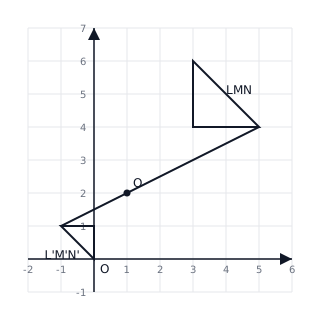
A triangle with vertices L(3,4)L(3, 4), M(5,4)M(5, 4), and N(3,6)N(3, 6) is enlarged with a scale factor of k=−0.5k = -0.5 using the center of enlargement O(1,2)O(1, 2). Calculate the coordinates of the image L′M′N′L'M'N'.

Negative enlargement from center (1,2) with k=-0.5, showing the inverted and smaller image triangle.

Solution:

Using the formula (x′,y′)=(a+k(x−a),b+k(y−b))(x', y') = (a + k(x - a), b + k(y - b)) with (a,b)=(1,2)(a, b) = (1, 2) and k=−0.5k = -0.5: For L(3,4)L(3, 4): x′=1+(−0.5)(3−1)=1−1=0x' = 1 + (-0.5)(3 - 1) = 1 - 1 = 0 y′=2+(−0.5)(4−2)=2−1=1y' = 2 + (-0.5)(4 - 2) = 2 - 1 = 1 L′(0,1)L'(0, 1)

For M(5,4)M(5, 4): x′=1+(−0.5)(5−1)=1−2=−1x' = 1 + (-0.5)(5 - 1) = 1 - 2 = -1 y′=2+(−0.5)(4−2)=2−1=1y' = 2 + (-0.5)(4 - 2) = 2 - 1 = 1 M′(−1,1)M'(-1, 1)

For N(3,6)N(3, 6): x′=1+(−0.5)(3−1)=1−1=0x' = 1 + (-0.5)(3 - 1) = 1 - 1 = 0 y′=2+(−0.5)(6−2)=2−2=0y' = 2 + (-0.5)(6 - 2) = 2 - 2 = 0 N′(0,0)N'(0, 0)

Explanation:

Since the scale factor is negative, the image appears on the opposite side of the center (1, 2) and is inverted. Because ∣k∣<1|k| < 1, the image is smaller than the original triangle.

Problem 5:

A rectangle has corners at (1,1)(1, 1), (3,1)(3, 1), (3,2)(3, 2), and (1,2)(1, 2). It is enlarged by a scale factor k=3k = 3 about the center (0,0)(0, 0). Compare the area of the original rectangle to the area of the image.
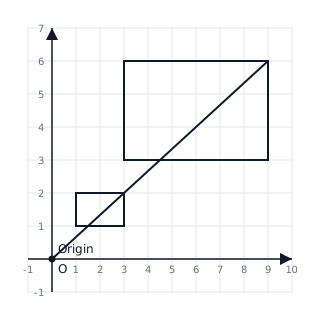
Rectangle enlarged from origin with scale factor 3, showing the area increase.

Solution:

  1. Area of Original: Width=3−1=2\text{Width} = 3 - 1 = 2, Height=2−1=1\text{Height} = 2 - 1 = 1. Area=2×1=2 units2\text{Area} = 2 \times 1 = 2 \text{ units}^2.
  2. New coordinates: (1,1)→(3,3)(1, 1) \to (3, 3) (3,1)→(9,3)(3, 1) \to (9, 3) (3,2)→(9,6)(3, 2) \to (9, 6) (1,2)→(3,6)(1, 2) \to (3, 6)
  3. Area of Image: Width=9−3=6\text{Width} = 9 - 3 = 6, Height=6−3=3\text{Height} = 6 - 3 = 3. Area=6×3=18 units2\text{Area} = 6 \times 3 = 18 \text{ units}^2.
  4. Ratio: 182=9\frac{18}{2} = 9, which is k2k^2 (32=93^2 = 9).

Explanation:

The area increases by the square of the linear scale factor. Here, k=3k=3, so the area increases by a factor of 9.