
Review the key concepts, formulae, and examples before starting your quiz.
🔑Concepts
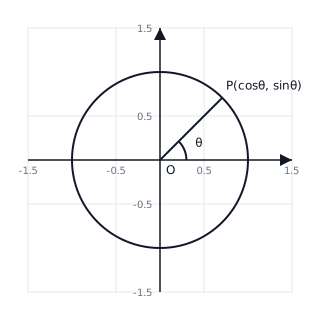
The Unit Circle: A circle with a radius of centered at the origin . For any point on the circle, and , where is the angle measured counter-clockwise from the positive -axis.
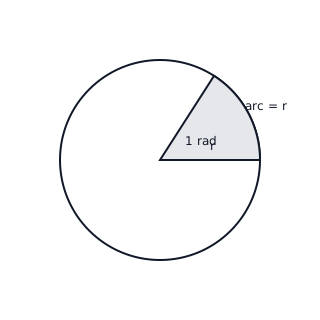
Radian Measure: One radian is the measure of the central angle subtended by an arc equal in length to the radius of the circle. Since the circumference of a circle is , there are radians in a full circle ().
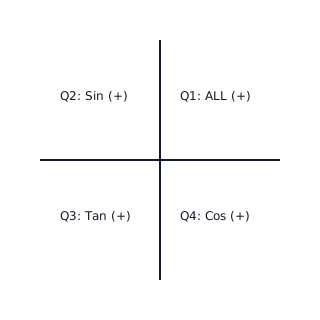
Quadrants and Signs: The signs of , , and vary by quadrant. In Quadrant I, all are positive. In Quadrant II, only is positive. In Quadrant III, only is positive. In Quadrant IV, only is positive (CAST rule).
Standard Values: Radians are often expressed in terms of . Key angles include (), (), (), and ().
📐Formulae
💡Examples
Problem 1:
Convert into radians, leaving your answer in terms of .
Solution:
Explanation:
To convert from degrees to radians, multiply the degree measure by and simplify the fraction.
Problem 2:
A sector of a circle has a radius of cm and a central angle of radians. Find the exact arc length of the sector.
Solution:
Explanation:
Using the formula , substitute and . The units remain in cm.
Problem 3:
If a point on the unit circle has an -coordinate of and is in the first quadrant, find the -coordinate.
Solution:
Explanation:
Since the point lies on the unit circle, it must satisfy . We solve for and choose the positive root because the point is in the first quadrant.
Problem 4:
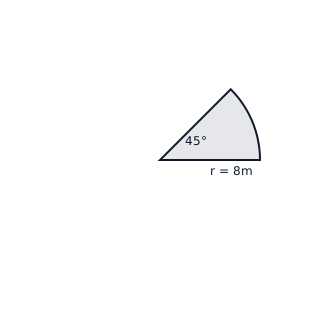
Calculate the area of a sector with a radius of m and a central angle of . Give your answer in terms of .
Solution:
- Convert the angle to radians:
- Use the area formula :
- The area is .
Explanation:
To use the area formula , the angle must be in radians. is equivalent to . Plugging values into the formula yields the result.
Problem 5:
A point on the unit circle lies in the second quadrant. If its -coordinate is , find the exact value of its -coordinate and the angle in radians.
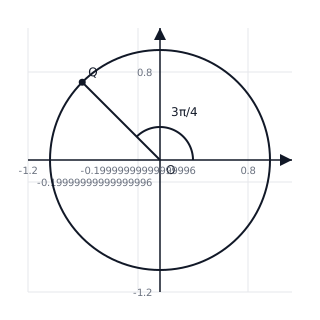
Solution:
- Use . Since :
- Since is in the second quadrant, must be negative:
- Find : The reference angle for is . In Quadrant II:
Explanation:
Coordinates on the unit circle follow the Pythagorean identity. The sign of the -coordinate is determined by the quadrant (negative in Quadrant II).