
Review the key concepts, formulae, and examples before starting your quiz.
🔑Concepts
The -intercept of a line is the point where the graph of the line intersects the -axis. At this point, the -coordinate is always . For a line represented by the equation , the -intercept is and the coordinate is .
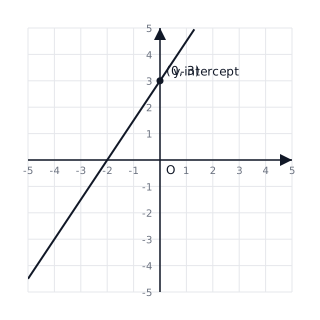
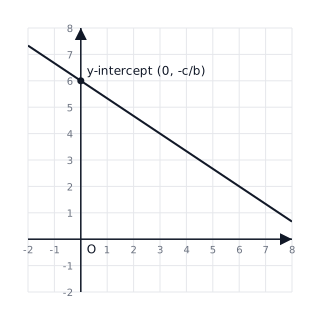
For the general linear equation , the -intercept can be found by setting and solving for . This results in , or .
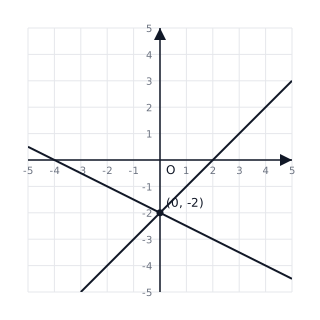
If two lines have the same -intercept, they intersect at the same point on the -axis. This common point is if both lines are expressed in the form and .
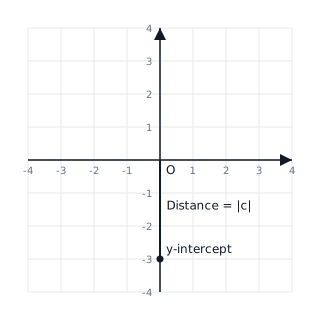
The distance from the origin to the -intercept is given by . This represents the vertical displacement of the line from the origin at .
📐Formulae
💡Examples
Problem 1:
Find the -intercept of the line given by the equation . Express the answer as a coordinate.
Solution:
Given equation: . To find the -intercept, we set : Therefore, the -intercept is .
Explanation:
At the -intercept, the value of is zero. By substituting into the linear equation, we isolate the variable to find its specific value on the -axis.
Problem 2:
A line passes through the points and . Determine the -intercept of this line.
Solution:
Step 1: Find the slope () using the formula : Step 2: Use the slope-intercept form and substitute point : The -intercept is , or the point .
Explanation:
First, the slope is calculated. Then, using one of the given points and the slope, we solve for the constant in , which represents the -intercept.
Problem 3:
Find the area of the triangle formed by the line and the coordinate axes.
Solution:
Step 1: Find the -intercept (set ): The -intercept is at . Step 2: Find the -intercept (set ): The -intercept is at . Step 3: Calculate area of triangle where is :
Explanation:
The and intercepts provide the base and height of the right-angled triangle formed with the origin. The -intercept provides the vertical height from the origin.
Problem 4:
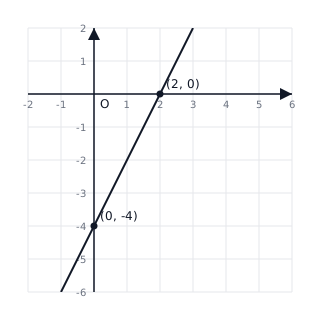
Identify the -intercept and the slope of the line shown in the graph, given it passes through and .
Solution:
- From the graph, the line crosses the -axis at the point . Therefore, the -intercept is .
- To find the slope (), use the formula with points and .
- .
- Thus, the -intercept is and the slope is .
Explanation:
The -intercept is the -coordinate where . Visually, this is the point where the line 'hits' the vertical axis.
Problem 5:
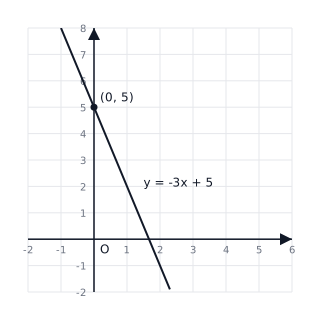
A line has a -intercept of and is parallel to the line . Write the equation of this line and sketch it.
Solution:
- Parallel lines have equal slopes. The slope of is .
- The given -intercept is , so .
- Using the slope-intercept form , the equation is .
- The line passes through and has a downward slope.
Explanation:
Since the lines are parallel, we inherit the slope. The -intercept provides the specific vertical starting point for our new line.