
Review the key concepts, formulae, and examples before starting your quiz.
🔑Concepts
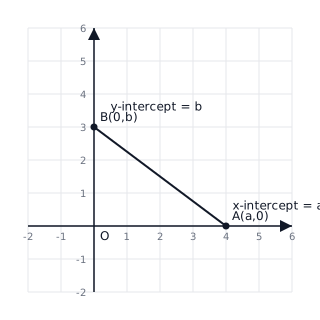
The intercept form of a line is given by , where is the -intercept (the distance from the origin to the point where the line crosses the -axis) and is the -intercept (the distance from the origin to the point where the line crosses the -axis).
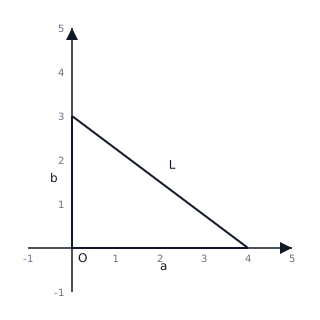
A line segment of length intercepted between the coordinate axes forms a right-angled triangle with the origin. Using Pythagoras theorem, the relationship is .
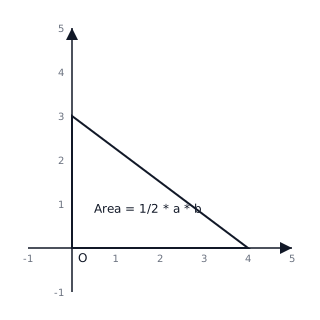
The area of the triangle formed by the line and the coordinate axes is calculated as .
If a line passes through the midpoint of the segment intercepted between the axes, then the intercepts are and .
📐Formulae
💡Examples
Problem 1:
Find the intercepts made by the line on the coordinate axes. Also, find the area of the triangle formed by this line with the axes.
Solution:
Given equation: Divide both sides by to make the right side equal to : This can be written as: Comparing with , we get: -intercept -intercept Area of triangle =
Explanation:
To find the intercepts, we transform the equation into the form . The denominators and represent the intercepts. The area is calculated using the product of the magnitudes of these intercepts.
Problem 2:
Find the equation of a line that passes through the point such that the -intercept is twice the -intercept.
Solution:
Let the -intercept be . Given that the -intercept . The equation of the line in intercept form is: Substitute : Multiply the entire equation by : Since the line passes through , substitute and : Now, find : Substitute and back into the intercept form: Alternatively, in general form:
Explanation:
We use the relationship between and to reduce the equation to one variable, then use the given point to solve for that variable.
Problem 3:
A straight line passes through the point and the portion of the line intercepted between the axes is bisected at this point. Find the equation of the line and its length between the axes.
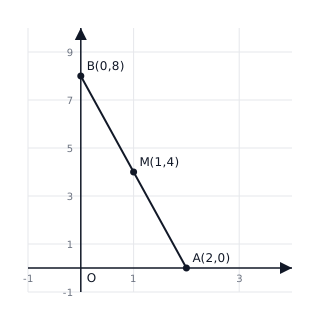
Solution:
- Let the equation of the line be .
- The intercepts are and .
- The midpoint of the segment is .
- Given the midpoint is , we have:
- The equation is , which simplifies to .
- Length units.
Explanation:
We use the midpoint formula because the problem states the segment between the axes is bisected at the given point. This directly gives us the values of the intercepts.
Problem 4:
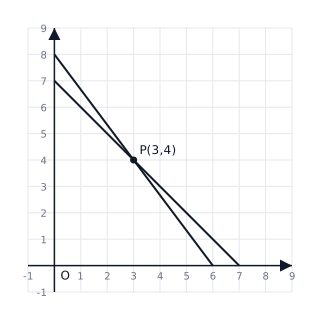
Find the equation of the line that passes through the point and the sum of its intercepts on the axes is .
Solution:
- Let the intercepts be and . We are given , so .
- The equation is .
- Since it passes through :
- Multiplying by :
- Factorizing the quadratic:
- Case 1:
- Case 2:
Explanation:
We express one intercept in terms of the other using the sum condition and then substitute the coordinates of the given point to solve for .