
Review the key concepts, formulae, and examples before starting your quiz.
🔑Concepts
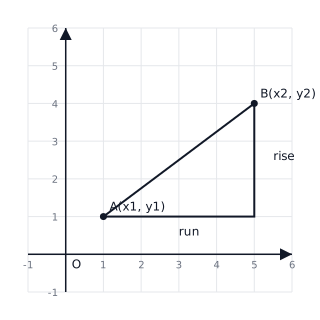
The slope of a line is a measure of its steepness and direction. It is defined as the ratio of the vertical change ('rise') to the horizontal change ('run') between any two points on the line. For a line passing through and , the slope is .
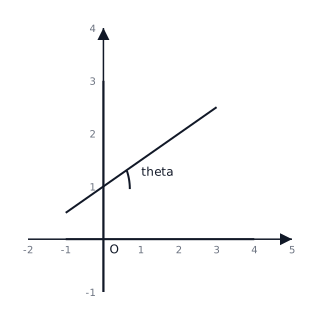
The slope of a line is also equal to the tangent of the angle that the line makes with the positive direction of the -axis (measured counter-clockwise). Thus, . If the line is horizontal, and . If the line is vertical, and the slope is undefined.
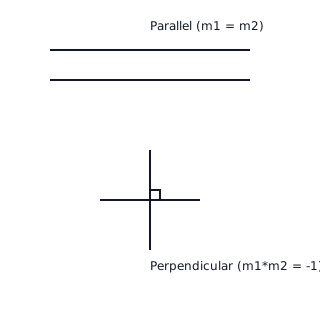
Two non-vertical lines are parallel if and only if their slopes are equal (). They are perpendicular if and only if the product of their slopes is ().
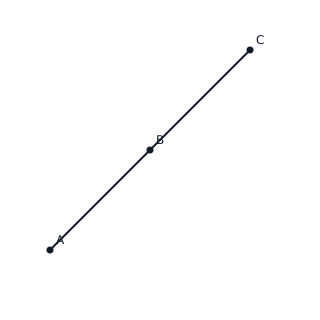
Three points , and are collinear if the slope of segment is equal to the slope of segment . This implies all three points lie on the same straight line.
📐Formulae
indices where
💡Examples
Problem 1:
Find the slope of a line passing through the points and .
Solution:
Given points: and . Using the slope formula: The slope is .
Explanation:
We apply the standard coordinate slope formula by substituting the given coordinates, ensuring the subtraction of negative numbers is handled correctly.
Problem 2:
If the line joining and is perpendicular to the line joining and , find the value of .
Solution:
First, find the slope of line (): Next, find the slope of line (): Since the lines are perpendicular, : The value of is .
Explanation:
For perpendicular lines, the product of slopes is . We calculate both slopes and solve the resulting algebraic equation for the unknown variable .
Problem 3:
Show that the points , , and are collinear using the concept of slope.
Solution:
Calculate the slope of (): Calculate the slope of (): Since , and is a common point, the points and lie on the same straight line.
Explanation:
Collinearity is proven when the slope between consecutive pairs of points is the same, indicating they follow the same path.
Problem 4:
A line passes through the point and is parallel to the line joining and . Find the slope of the line and its inclination .
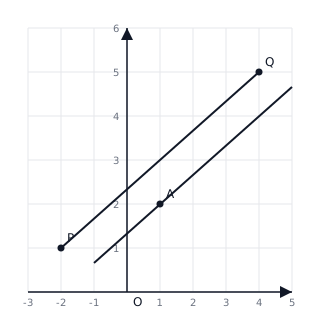
Solution:
- First, find the slope of the line :
- Since the required line is parallel to , its slope is the same:
- To find the inclination :
Explanation:
Parallel lines have identical slopes. We calculate the slope of the known line segment and apply that value to the line passing through point A.
Problem 5:
Find the value of such that the line joining the points and is perpendicular to the line joining and . Represent these lines graphically.
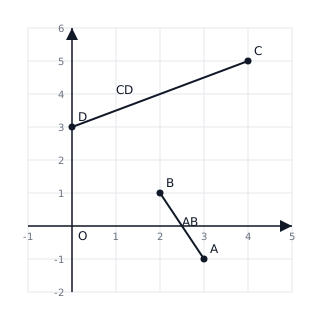
Solution:
-
First, calculate the slope () of line :
-
Next, calculate the slope () of line :
-
Since line is perpendicular to line , the product of their slopes must be :
-
Simplify the equation:
Thus, the value of is .
Explanation:
The concept of perpendicularity in coordinate geometry states that if two lines are perpendicular, the product of their slopes is (). We find the expressions for the slopes of both lines using the formula and solve for the unknown coordinate.