
Review the key concepts, formulae, and examples before starting your quiz.
🔑Concepts
The -coordinate (abscissa) of a point represents its perpendicular distance from the -axis. If the point lies to the right of the -axis, is positive; if to the left, is negative.
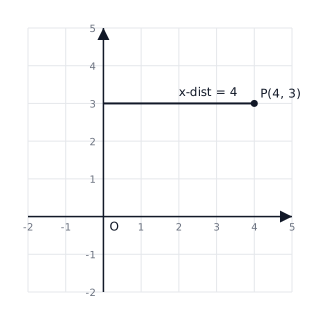
The -coordinate (ordinate) of a point represents its perpendicular distance from the -axis. If the point is above the -axis, is positive; if below, is negative.
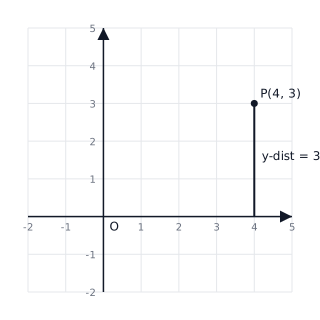
For any point , the absolute value is the distance from the -axis and is the distance from the -axis. In Quadrant IV, for example, and .
Points lying on the axes have one distance equal to zero. A point on the -axis has a perpendicular distance of from the -axis, hence its coordinates are .
📐Formulae
💡Examples
Problem 1:
Find the coordinates of a point which lies in the third quadrant, such that its perpendicular distance from the -axis is units and its perpendicular distance from the -axis is units.
Solution:
- In the third quadrant, both the -coordinate and -coordinate are negative.
- The perpendicular distance from the -axis is the absolute value of the -coordinate: . Since it is in the third quadrant, .
- The perpendicular distance from the -axis is the absolute value of the -coordinate: . Since it is in the third quadrant, .
- Therefore, the coordinates are .
Explanation:
The distance from an axis determines the magnitude of the coordinate belonging to the other axis. The quadrant determines the sign.
Problem 2:
A point is at a distance of units from the -axis and lies on the -axis to the left of the origin. Find its coordinates.
Solution:
- Since the point lies on the -axis, its -coordinate must be .
- The distance from the -axis is units, which means .
- Since the point is to the left of the origin, the -coordinate must be negative, so .
- The coordinates are .
Explanation:
Points on the -axis always have an ordinate of . Distance from the -axis gives the abscissa.
Problem 3:
If the perpendicular distance of a point from the -axis is units and from the -axis is units, and the point lies in the second quadrant, find the value of .
Solution:
- In the second quadrant, and .
- Distance from -axis . Since , .
- Distance from -axis . Since , .
- We need to find :
Explanation:
The coordinates are found using the quadrant signs and distances, then substituted into the linear expression.
Problem 4:
Identify the coordinates of a point that lies in the fourth quadrant such that its perpendicular distance from the -axis is units and its perpendicular distance from the -axis is units. Calculate the value of .
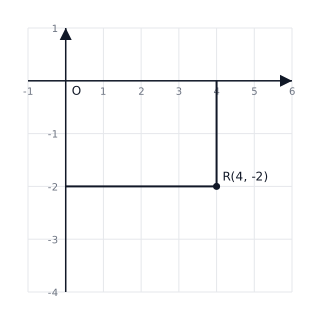
Solution:
- In the fourth quadrant, the -coordinate is positive and the -coordinate is negative.
- Perpendicular distance from the -axis is . Since , .
- Perpendicular distance from the -axis is . Since , .
- The coordinates of point are .
- Calculate : .
Explanation:
We use the quadrant signs (Quadrant IV: ) and the definition of coordinates as distances from the axes to locate the point.
Problem 5:
A point is located such that it is units away from the -axis and units away from the -axis. If it lies on the positive -axis, find its coordinates and its distance from a point .
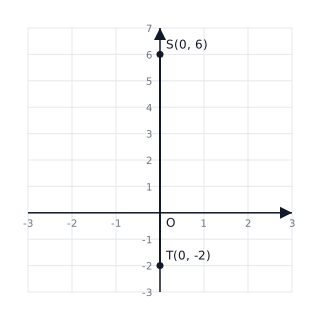
Solution:
- Distance from the -axis is , so the -coordinate is . The point lies on the -axis.
- Distance from the -axis is . Since it lies on the positive -axis, .
- Coordinates of are .
- Distance from to along the -axis is units.
Explanation:
When a point is on an axis, one of its perpendicular distances is zero. Here, the point lies on the vertical axis, and we calculate the linear distance between two points on the same axis.