
Review the key concepts, formulae, and examples before starting your quiz.
🔑Concepts
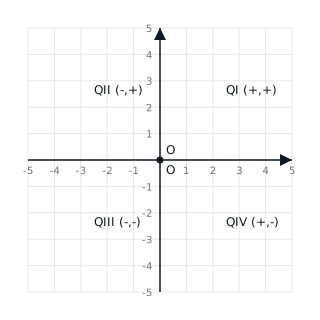
The Cartesian plane is divided into four quadrants by the intersection of the horizontal -axis and vertical -axis at the origin . In Quadrant I, both and are positive; in Quadrant II, is negative and is positive; in Quadrant III, both are negative; and in Quadrant IV, is positive and is negative.
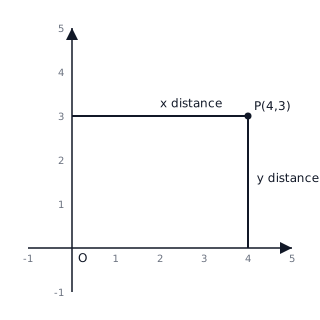
The location of any point is defined by its signed distances from the axes. The -coordinate (abscissa) represents the perpendicular distance from the -axis, while the -coordinate (ordinate) represents the perpendicular distance from the -axis.
Points lying on the axes do not belong to any quadrant. Any point on the -axis has an ordinate of (form ), and any point on the -axis has an abscissa of (form ).
Reflection of a point in the origin results in a point . This transformation is equivalent to a rotation of around the origin.
📐Formulae
💡Examples
Problem 1:
A point is at a distance of units from the -axis and units from the -axis. If the point lies in the third quadrant, find its coordinates.
Solution:
- In the third quadrant, both and coordinates are negative.
- The distance from the -axis represents the absolute value of the -coordinate. So, (since it is in the 3rd quadrant).
- The distance from the -axis represents the absolute value of the -coordinate. So, .
- Therefore, the coordinates of point are .
Explanation:
Distance from axes translates to coordinate values, and the quadrant determines the signs.
Problem 2:
Find the area of the triangle formed by the points , , and .
Solution:
- Plotting the points: is the origin. lies on the -axis. lies on the -axis.
- This forms a right-angled triangle where the base is the segment and the height is the segment .
- Base units.
- Height units.
Explanation:
When vertices lie on the axes, the lengths of the base and height are simply the non-zero coordinate values.
Problem 3:
If the point is reflected in the -axis to get and then is reflected in the -axis to get , find the coordinates of .
Solution:
- Reflection of in the -axis: The -coordinate stays the same, and the -coordinate changes sign. So, .
- Reflection of in the -axis: The -coordinate stays the same, and the -coordinate changes sign. So, .
- Note: This is equivalent to a single reflection of the original point through the origin.
Explanation:
Reflecting across the -axis changes the sign of ; reflecting across the -axis changes the sign of .
Problem 4:
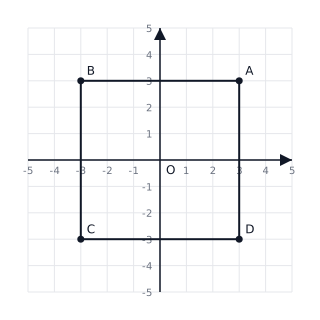
A square has its center at the origin and its sides are parallel to the axes. If the coordinates of vertex are , find the coordinates of the other vertices and calculate the area of the square.
Solution:
- Since the sides are parallel to the axes and the center is , the vertices must be symmetric about the axes.
- Given is in Quadrant I.
- (reflecting across the -axis) is .
- (reflecting across the -axis) is .
- (reflecting across the -axis) is .
- The side length units.
- sq. units.
Explanation:
Because the square is centered at the origin with sides parallel to the axes, the distance from the origin to each side along the axes is equal. The vertices are .
Problem 5:
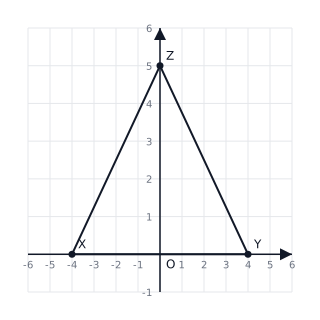
Plot the points , , and . Identify the shape formed by joining these points and find its area.
Solution:
- Plot and on the -axis.
- Plot on the -axis.
- Joining forms a triangle.
- units.
- units.
- sq. units.
Explanation:
The base of the triangle lies on the -axis, and the vertex lies on the -axis, making the segment the perpendicular height.