
Review the key concepts, formulae, and examples before starting your quiz.
🔑Concepts
The slope-intercept form of a linear equation is written as , where represents the slope (steepness) and represents the -intercept (the point where the line crosses the -axis).
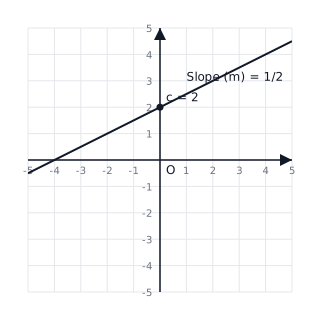
The slope is defined as the 'rise over run', calculated as . It represents the rate of change of with respect to .
If two lines are parallel, their slopes are equal (). If two lines are perpendicular, the product of their slopes is ().
The -intercept can be found by setting in the equation and solving for , giving the point where the line crosses the horizontal axis.
📐Formulae
💡Examples
Problem 1:
Convert the equation into slope-intercept form and find the slope and -intercept.
Solution:
Given: Step 1: Isolate the term: Step 2: Divide every term by : Comparing with , we find: Slope -intercept
Explanation:
To transform the general form to slope-intercept form, we solve for so that the coefficient of is .
Problem 2:
Find the equation of a line that passes through the point and is parallel to the line .
Solution:
- The given line is . Its slope .
- Since the required line is parallel, its slope must also be .
- Use the point-slope form with and point :
Explanation:
Parallel lines share the same slope. Once the slope is identified, we use the coordinates of the given point to find the new -intercept.
Problem 3:
Determine if the line passing through and is perpendicular to the line .
Solution:
Step 1: Find the slope of the line passing through and : Step 2: Identify the slope of the line : Step 3: Check the product of the slopes: Since the product is , the lines are perpendicular.
Explanation:
The condition for perpendicularity is that the product of the slopes of the two lines must be .
Problem 4:
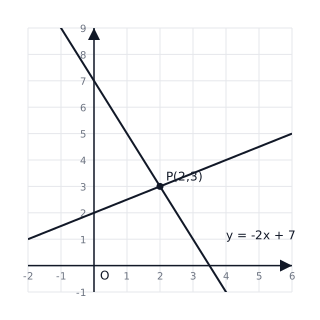
Find the equation of a line that passes through the point and is perpendicular to the line . Express the answer in the slope-intercept form .
Solution:
-
First, convert the given line into slope-intercept form: The slope of this line () is .
-
For a perpendicular line, the product of slopes is . Thus, : .
-
Use the point-slope form with and point : .
Explanation:
To find a perpendicular line, we determine the negative reciprocal of the original slope. We then apply the point-slope formula and rearrange it into the required format.
Problem 5:
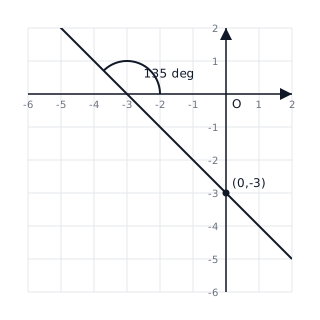
Determine the equation of the line that makes an angle of with the positive direction of the -axis and has a -intercept of .
Solution:
-
The slope is given by . .
-
The -intercept () is given as .
-
Substituting and into the slope-intercept form : .
Explanation:
The angle of inclination directly provides the slope using the tangent function. Combined with the -intercept, the equation is formed by direct substitution into the standard slope-intercept formula.