
Review the key concepts, formulae, and examples before starting your quiz.
🔑Concepts
The Cartesian Plane consists of two mutually perpendicular number lines: the horizontal -axis and the vertical -axis. Their intersection point is the origin . These axes divide the plane into four regions called quadrants: Quadrant I , Quadrant II , Quadrant III , and Quadrant IV . Points on the axes themselves do not belong to any quadrant.
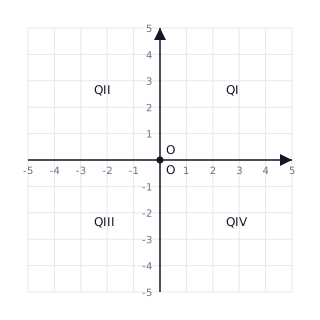
For any point , the -coordinate (abscissa) represents the perpendicular distance from the -axis, and the -coordinate (ordinate) represents the perpendicular distance from the -axis. If a point lies on the -axis, its ordinate is always , i.e., . If a point lies on the -axis, its abscissa is always , i.e., .
Horizontal and vertical distances between points can be calculated by looking at the change in coordinates. For two points with the same ordinate and , the distance is . For two points with the same abscissa and , the distance is .
Symmetry across axes: The reflection of a point about the -axis is . The reflection of about the -axis is . The reflection about the origin is .
📐Formulae
💡Examples
Problem 1:
Find the area of a triangle whose vertices are , , and .
Solution:
- Identify the base: The points and lie on the -axis. Length of base units.
- Identify the height: The vertex lies on the -axis. The vertical distance from the origin (which lies on the base ) to point is the height. Height units.
- Calculate the area:
Explanation:
Since two vertices lie on the -axis, the segment connecting them is the base. The -coordinate of the third vertex represents the height relative to the -axis.
Problem 2:
Three vertices of a rectangle are , , and . Find the coordinates of the fourth vertex and the area of the rectangle.
Solution:
- Analyze coordinates: For a rectangle, opposite sides are parallel and equal.
- and form a horizontal line (same -coordinate).
- and form a vertical line (same -coordinate).
- Find : The vertex must have the same -coordinate as and the same -coordinate as to complete the rectangle. Coordinates of .
- Calculate dimensions: Length units. Breadth units.
- Calculate area:
Explanation:
In a rectangle, vertices follow a specific symmetry. By aligning the and coordinates of the given points, the missing vertex and side lengths are determined.
Problem 3:
Determine which quadrant or axis the following points lie in: , , , and .
Solution:
- : Since the -coordinate is , the point lies on the negative -axis.
- : Since the -coordinate is , the point lies on the positive -axis.
- : Both and are negative. This point lies in Quadrant III.
- : is positive and is negative. This point lies in Quadrant IV.
Explanation:
Points with a zero coordinate lie on the axes, while non-zero coordinates determine the quadrant based on the sign of the abscissa and ordinate.
Problem 4:
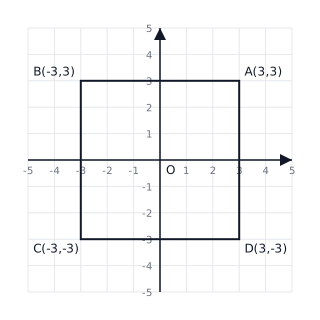
A square has its center at the origin and its sides are parallel to the axes. If the coordinates of vertex are , find the coordinates of the other three vertices and calculate the perimeter of the square.
Solution:
- Since the sides are parallel to the axes and the center is at , the square is symmetric across both axes.
- Given is in Quadrant I, the other vertices are found by reflecting across the axes.
- (reflection of across -axis) = .
- (reflection of across -axis) = .
- (reflection of across -axis) = .
- The side length is the distance between and , which is units.
- units.
Explanation:
In a square centered at the origin with sides parallel to the axes, the vertices will have coordinates . Here, and .
Problem 5:
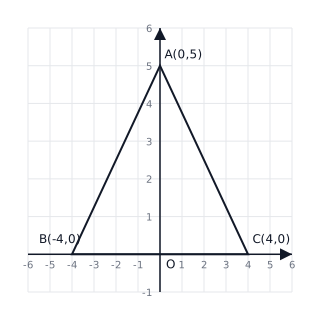
Find the area of the figure formed by joining the points , , and .
Solution:
- Plot the points on the Cartesian plane. and lie on the -axis, while lies on the -axis.
- The figure is a triangle.
- The base lies on the -axis. units.
- The height is the perpendicular distance from vertex to the base (the -axis). Since is at , the height units.
- .
Explanation:
Since two vertices lie on the x-axis and the third on the y-axis, the height of the triangle is simply the y-coordinate of the vertex on the y-axis.