
Review the key concepts, formulae, and examples before starting your quiz.
🔑Concepts
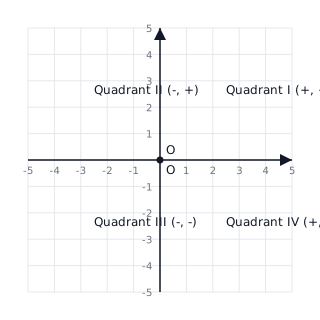
The Cartesian Plane is divided into four regions called quadrants by the intersection of the horizontal -axis and the vertical -axis at the origin . In the first quadrant (), both and are positive; in the second (), and ; in the third (), both are negative; and in the fourth (), and .
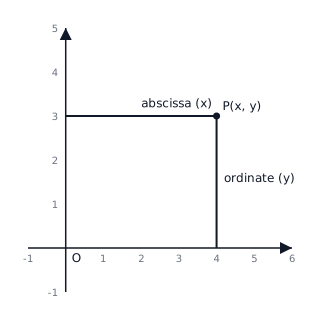
Any point on the plane is represented by an ordered pair . The first number , the abscissa, denotes the perpendicular distance from the -axis. The second number , the ordinate, denotes the perpendicular distance from the -axis. For any point on the -axis, , and for any point on the -axis, .
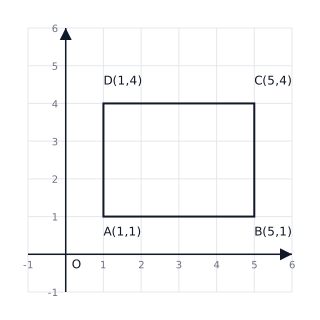
Advanced geometry problems often involve calculating areas of shapes formed by connecting plotted points. The area of a rectangle with sides parallel to the axes is the product of the absolute differences of the coordinates: . For triangles, the base and height are determined using the fixed coordinate distances between vertices.
Points on a plane can be used to describe reflections. A point reflected across the -axis becomes . If reflected across the -axis, it becomes . Reflection through the origin changes the signs of both coordinates to .
Linear relationships can be visualized by plotting solutions of an equation like . These points will always lie on a straight line. Horizontal lines are represented by , while vertical lines are represented by .
📐Formulae
where is the abscissa and is the ordinate.
💡Examples
Problem 1:
Plot the points , , , and on a Cartesian plane. Identify the figure formed and calculate its area.
Solution:
- Plotting the points: is in Quadrant I, is in Quadrant II, is in Quadrant III, and is in Quadrant IV.
- Joining the points in order forms a square.
- The length of side is the horizontal distance: units.
- The length of side is the vertical distance: units.
- Since all sides are equal and perpendicular, the figure is a square.
- Area calculation:
Explanation:
We use the absolute difference between coordinates to find the lengths of the sides of the geometric figure formed on the grid.
Problem 2:
Determine the coordinates of a point that lies in the second quadrant, is units away from the -axis and units away from the -axis.
Solution:
- In the second quadrant, the -coordinate is negative and the -coordinate is positive.
- The distance from the -axis corresponds to the absolute value of the -coordinate: . Since it is in the second quadrant, .
- The distance from the -axis corresponds to the absolute value of the -coordinate: . Since it is in the second quadrant, .
- Therefore, the coordinates are .
Explanation:
The distance from an axis is the absolute value of the opposite coordinate. Quadrant signs determine if the value is positive or negative.
Problem 3:
Find the area of a triangle whose vertices are , , and .
Solution:
- Vertex is the origin.
- Vertex lies on the -axis. The length of the base is units.
- Vertex lies on the -axis. The length of the height is units.
- The triangle is a right-angled triangle because the and axes are perpendicular.
- Area calculation:
Explanation:
When vertices lie on the axes, the lengths from the origin act as the base and height for the area formula.
Problem 4:
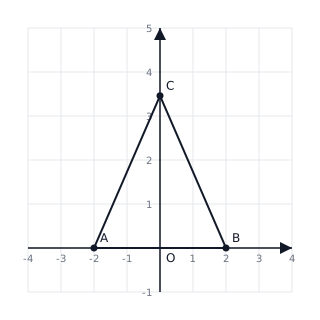
Points , , and are vertices of a triangle. Show that the triangle is equilateral and find its area.
Solution:
- Plot the points: and lie on the -axis. lies on the -axis.
- Calculate side lengths: units. Using Pythagoras on (where is origin): . Similarly, .
- Since , the triangle is equilateral.
- Area = sq units.
Explanation:
We use the coordinates to determine side lengths. Since the base lies on the -axis, the -coordinate of the third vertex serves as the altitude.
Problem 5:
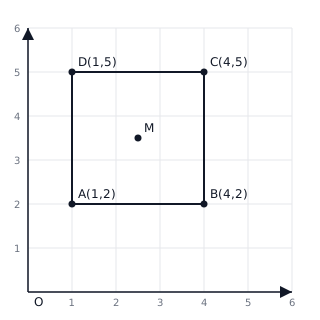
A square has two of its vertices at and . If the square lies entirely in the first quadrant, find the coordinates of the other two vertices and the coordinates of the center of the square.
Solution:
- The side length is the distance between and : .
- Since it is a square and lies in the first quadrant, we move units vertically up from both points.
- Vertex .
- Vertex .
- The center is the midpoint of diagonal : , .
- Center .
Explanation:
Since the segment joining and is horizontal, the vertical sides must have the same length. We add the side length to the -coordinates to stay in the first quadrant.