
Review the key concepts, formulae, and examples before starting your quiz.
🔑Concepts
The -intercept is the point where the graph of a linear equation intersects the -axis. At this point, the -coordinate is always . For any line given by the general form , the -intercept is found by substituting into the equation, resulting in or .
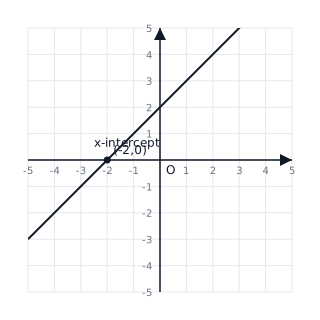
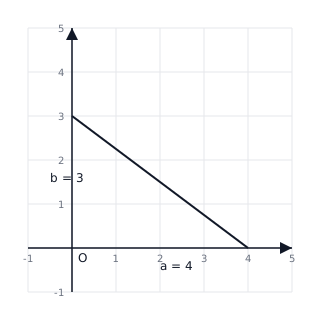
In the intercept form of a linear equation, , the constant '' represents the -intercept and '' represents the -intercept. This form allows for quick identification of the points where the line crosses the axes without additional calculation.
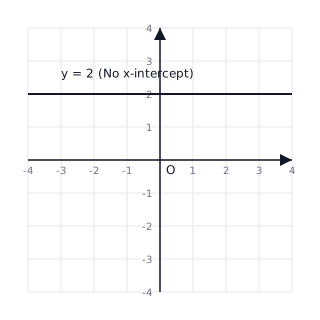
Lines that are parallel to the -axis, defined by the equation (where ), do not have an -intercept because they never intersect the -axis. Conversely, a vertical line has exactly one -intercept at the point and is parallel to the -axis.
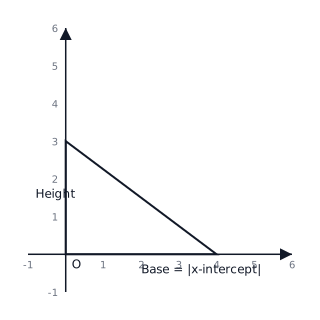
The -intercept is a critical value for calculating the area of the right-angled triangle formed between the line and the coordinate axes. The length of the base of this triangle is the absolute value of the -intercept, , and the height is the absolute value of the -intercept, .
📐Formulae
💡Examples
Problem 1:
Find the -intercept of the linear equation .
Solution:
To find the -intercept, we set in the given equation: The -intercept is , and the coordinates are .
Explanation:
By setting , we isolate the point where the line must cross the horizontal axis.
Problem 2:
Determine the -intercept of a line that passes through the points and .
Solution:
First, find the equation of the line. The slope is: Using point-slope form : To find the -intercept, set : The -intercept is or .
Explanation:
We first derive the linear equation using the two-point formula and then solve for by setting .
Problem 3:
Find the area of the triangle formed by the line and the coordinate axes.
Solution:
Find the -intercept (set ): Find the -intercept (set ): The vertices of the triangle are , , and .
Explanation:
The -intercept and -intercept provide the lengths of the base and height of a right-angled triangle formed with the origin.
Problem 4:
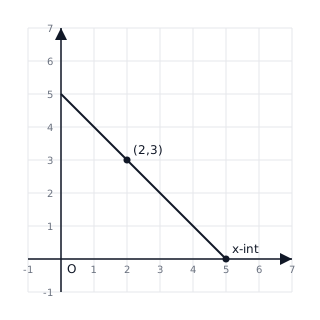
Determine the value of if the line passes through the point . Use this to find the -intercept.
Solution:
Substitute the coordinates into the equation: Since the equation is in the form , the -intercept is .
Explanation:
By substituting a known point into the intercept form equation, we can solve for the missing intercept parameter . In this form, directly represents the -intercept.
Problem 5:
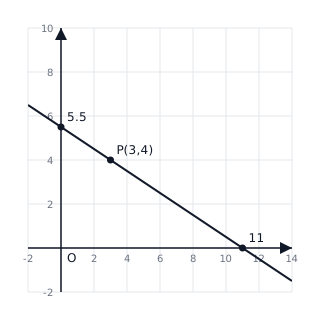
A line passes through the point and has its -intercept twice the value of its -intercept. Find the equation of the line and its -intercept.
Solution:
- Let the -intercept be . According to the problem, the -intercept is .
- Use the intercept form of a line:
- Substitute :
- Multiply the entire equation by to simplify:
- Since the line passes through , substitute and into the equation:
- Calculate the -intercept:
- The equation of the line is .
Explanation:
In this problem, we use the intercept form of the linear equation . By relating the two intercepts and using a given point on the line, we can solve for the specific values of the intercepts and the equation itself.