
Review the key concepts, formulae, and examples before starting your quiz.
🔑Concepts
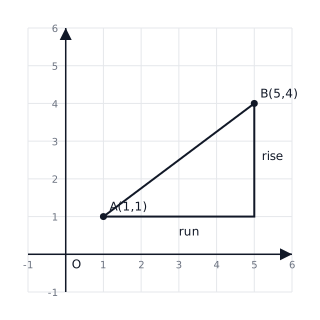
The slope (or gradient) of a line measures its steepness and direction. For a line passing through and , the slope is the ratio of 'rise' to 'run'. A line rising to the right has a positive slope (), while a line falling to the right has a negative slope ().
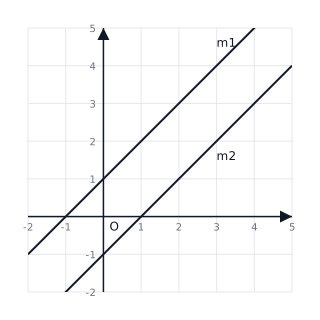
Parallel lines have identical slopes () because they maintain the same angle of inclination with the positive -axis. Conversely, if two lines have the same slope, they must be parallel (or coincident).
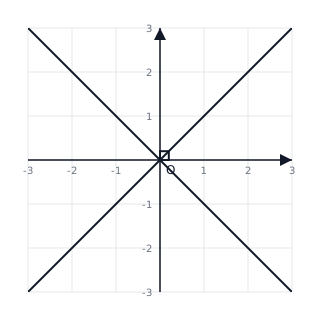
The slopes of perpendicular lines are negative reciprocals of each other, meaning . This property allows us to find the slope of a line that meets another at a angle.
The slope of a horizontal line (-axis or parallel to it) is always because the change in is zero. The slope of a vertical line (-axis or parallel to it) is undefined because the change in is zero, leading to division by zero.
📐Formulae
💡Examples
Problem 1:
Find the slope of the line passing through the points and .
Solution:
Let and . Using the slope formula: So, the slope of the line is .
Explanation:
We apply the standard slope formula by substituting the given coordinates and simplifying the fraction.
Problem 2:
Check if the points , , and are collinear using the property of slope.
Solution:
First, find the slope of (): Next, find the slope of (): Since , the slopes are equal.
Explanation:
If the slope of equals the slope of , then the segments have the same direction and share point , meaning and lie on the same line.
Problem 3:
A line passes through and . Another line is perpendicular to . Find the slope of .
Solution:
First, calculate the slope of (): Since , the product of their slopes must be : Thus, the slope of is .
Explanation:
The product of slopes of perpendicular lines is . We find the first slope and then take its negative reciprocal.
Problem 4:
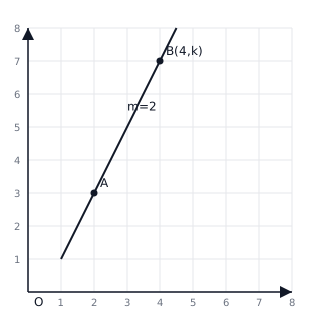
Line passes through the points and . If line is parallel to line which has a slope of , find the value of .
Solution:
- Since is parallel to , their slopes must be equal: .
- Use the slope formula for points and :
- Substitute the known slope:
- Solve for :
Explanation:
Parallel lines share the same slope. By setting the slope calculated from the coordinates equal to the given slope of the parallel line, we can solve for the unknown coordinate.
Problem 5:
Determine the value of such that the line through and is perpendicular to the line passing through and .
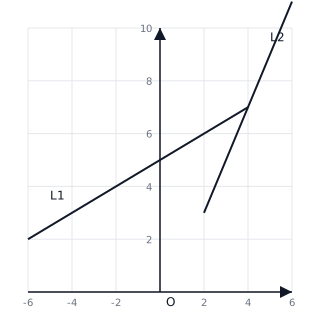
Solution:
- Let be the slope of the line through and :
- Let be the slope of the line through and :
- Since the lines are perpendicular, :
- Solve for :
Explanation:
First, find the slope of the second line. Use the perpendicularity condition (product of slopes is -1) to determine the required slope for the first line, then solve for the unknown coordinate.