
Review the key concepts, formulae, and examples before starting your quiz.
🔑Concepts
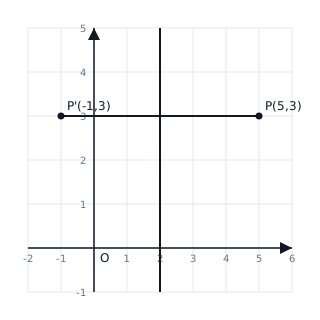
Reflection in Horizontal and Vertical Lines: The reflection of a point in the line results in the image . Similarly, the reflection in the line results in the image . This happens because the line of reflection is the perpendicular bisector of the segment connecting the point and its image.
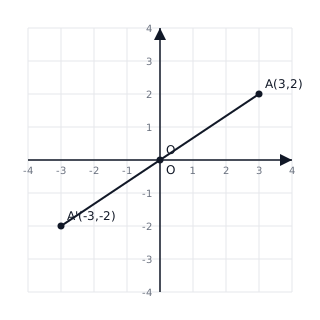
Reflection in the Origin: A point reflected in the origin results in . This is equivalent to a rotation of about the origin. The origin acts as the midpoint between the point and its image.
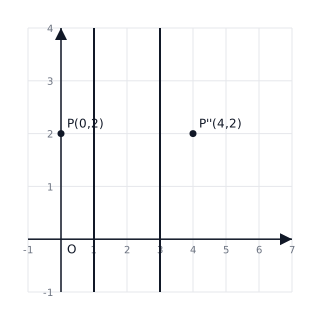
Successive Reflections: If a point is reflected in two parallel lines and separated by distance , the net result is a translation of in the direction perpendicular to the lines.
Invariant Points: A point is called invariant with respect to a line of reflection if it lies on that line. For reflection in , any point is invariant.
📐Formulae
(Reflection in -axis)
(Reflection in -axis)
(Reflection in Origin)
(Reflection in line )
(Reflection in line )
💡Examples
Problem 1:
Find the coordinates of the image of point after reflection in the line .
Solution:
Given point and line of reflection where . The formula for reflection in is . Substituting the values: So, the image is .
Explanation:
In a reflection across a vertical line , the vertical distance from the axis remains zero (the -coordinate is unchanged), and the horizontal distance from the line is preserved on the opposite side.
Problem 2:
A point is reflected in the -axis to . is then reflected in the line to . Find the coordinates of .
Solution:
Step 1: Reflection of in the -axis. Using , we get . Step 2: Reflection of in the line . Using , where : Therefore, .
Explanation:
Successive reflections are applied one after the other. The first transformation maps the original point to an intermediate image, which then serves as the 'object' for the second transformation.
Problem 3:
Find the point on the -axis such that the distance is minimum, where and .
Solution:
To minimize where is on the -axis (line ):
- Reflect point in the -axis to get .
- The shortest distance is the straight line connecting and .
- Find the equation of line : Slope . Equation: .
- Point lies on the -axis, so . . Point is .
Explanation:
This is an application of Heron's Principle. Reflecting one point makes the path a single straight line, which is the shortest distance between two points.
Problem 4:
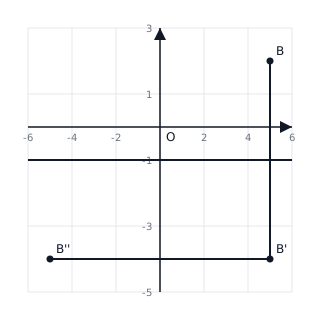
A point is reflected in the line to get . Then is reflected in the -axis to get . Find the coordinates of .
Solution:
- Reflection of in : Using with :
- Reflection of in the -axis: Using :
Explanation:
We first use the formula for reflection across a horizontal line to find , then apply the standard -axis reflection rule to the intermediate result.
Problem 5:
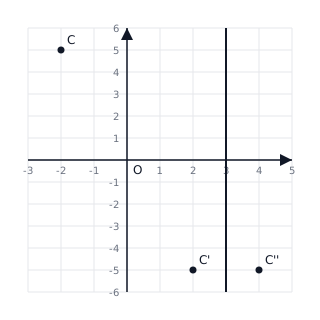
Find the reflection of the point in the origin, followed by a reflection in the line .
Solution:
- Reflection of in the origin :
- Reflection of in the line : Using with :
Explanation:
Origin reflection changes signs of both coordinates. Reflection in modifies the -coordinate based on the distance from the vertical line while keeping the -coordinate constant.