
Review the key concepts, formulae, and examples before starting your quiz.
🔑Concepts
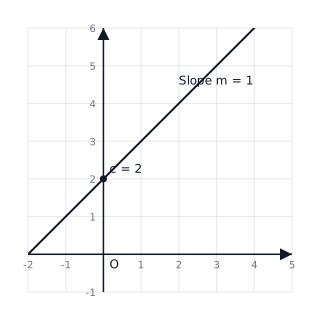
The Slope-Intercept Form of a line is given by , where represents the slope (gradient) and represents the -intercept, which is the point where the line crosses the vertical axis.
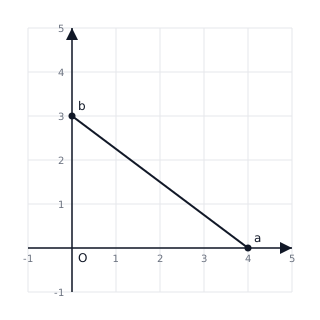
The Intercept Form of a line is . Here, is the -intercept (where the line crosses the -axis) and is the -intercept (where the line crosses the -axis).
The General Form can represent any straight line. To find its slope, rearrange it to , where .
Horizontal and Vertical Lines: A horizontal line has the form (slope ), while a vertical line has the form (slope is undefined).
📐Formulae
💡Examples
Problem 1:
Find the equation of a line passing through the point with a slope of .
Solution:
Given: Point Slope Using the point-slope form:
Explanation:
We apply the point-slope formula by substituting the given coordinates and the slope, then simplify to the general form .
Problem 2:
Find the equation of the line passing through the points and .
Solution:
Given: First, find the slope : Now, use the point-slope form with point :
Explanation:
First, we calculate the slope using the two-point slope formula. Then, we use one of the points and the calculated slope in the point-slope equation.
Problem 3:
Convert the general equation into intercept form and find the intercepts on the axes.
Solution:
Given equation: Move the constant term to the right side: Divide the entire equation by to make the right side equal to : Comparing with , we get: -intercept -intercept
Explanation:
To convert to intercept form, we isolate the constant and divide by it so the right side is . The denominators of and then represent the intercepts.
Problem 4:
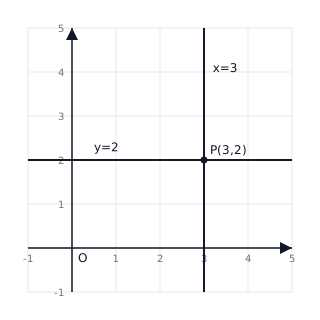
Find the equation of the line that passes through the point and is parallel to the -axis. Also, find the equation of a line passing through the same point that is parallel to the -axis.
Solution:
- For a line parallel to the -axis, the -coordinate remains constant for all points on the line. Since it passes through , the equation is .
- For a line parallel to the -axis, the -coordinate remains constant. Since it passes through , the equation is .
Explanation:
A horizontal line has a slope . Substituting into gives . A vertical line has an undefined slope and takes the form .
Problem 5:
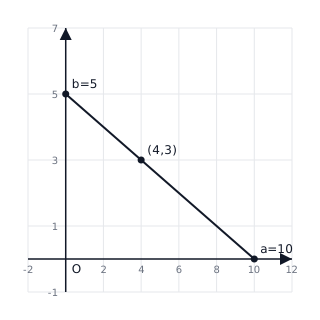
A line passes through the point and its -intercept is twice its -intercept. Find the equation of the line.
Solution:
Let the -intercept be . Then the -intercept is . The intercept form is . Substituting : Multiply by : Since it passes through : Thus . The equation is , or .
Explanation:
We use the intercept form and the given ratio to reduce the equation to one unknown variable , then solve using the given point.