
Review the key concepts, formulae, and examples before starting your quiz.
🔑Concepts
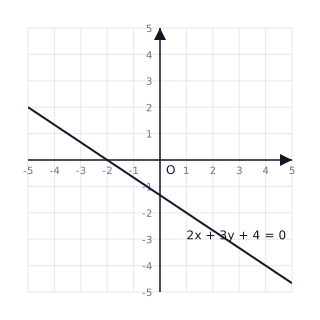
The General Form represents a straight line on a Cartesian plane. The coefficients and determine the orientation (slope), while determines the position relative to the origin.
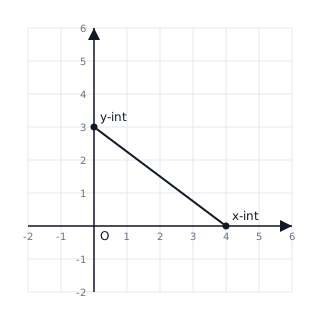
The x-intercept is the point where the line crosses the x-axis (), calculated as . The y-intercept is where it crosses the y-axis (), calculated as .
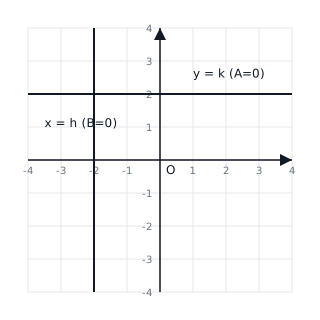
The slope of the line is given by . If , the line is vertical (parallel to the y-axis). If , the line is horizontal (parallel to the x-axis).
The region formed by the line and the coordinate axes always creates a right-angled triangle. The area is , where base and height are the absolute values of the intercepts.
📐Formulae
💡Examples
Problem 1:
Express the equation in the general form and find its slope and y-intercept.
Solution:
Given equation: To convert to general form, move to the left side: Comparing with , we get: Slope y-intercept
Explanation:
The general form requires all terms on one side. Slope and intercept are derived by rearranging the equation into or using the ratio of coefficients.
Problem 2:
Find the value of if the line passes through the point .
Solution:
If the point lies on the line , it must satisfy the equation. Substitute and into the equation:
Explanation:
Any point on a line satisfies the algebraic equation of that line. Substitution allows us to solve for unknown parameters.
Problem 3:
Determine the area of the triangle formed by the line and the coordinate axes.
Solution:
First, find the intercepts: For x-intercept, put : So, the base of the triangle is units. For y-intercept, put : So, the height of the triangle is units. Area of triangle =
Explanation:
The line intersects the x-axis at and the y-axis at , forming a right-angled triangle with the origin .
Problem 4:
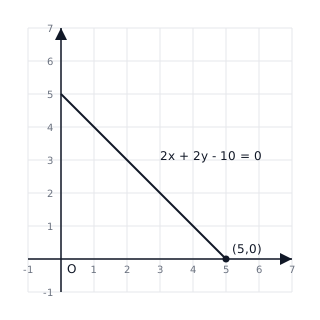
Determine the value of if the line has an x-intercept of .
Solution:
- At the x-intercept, the value of is .
- Substitute and into the equation .
- .
Explanation:
Since the line passes through the point , we substitute these coordinates into the general equation to solve for the unknown coefficient .
Problem 5:
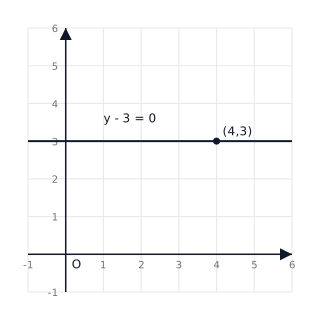
A line passes through the point and is parallel to the x-axis. Express its equation in the form .
Solution:
- A line parallel to the x-axis has a slope .
- The equation of such a line is of the form .
- Since it passes through , the y-coordinate must be everywhere on the line.
- So, .
- Rearranging into : .
Explanation:
Lines parallel to the x-axis have no term (coefficient ). The equation is simply equals the y-coordinate of the given point.