
Review the key concepts, formulae, and examples before starting your quiz.
🔑Concepts
The Pythagorean Theorem states that in a right-angled triangle, the square of the hypotenuse (the side opposite the right angle) is equal to the sum of the squares of the other two sides. This is expressed as .
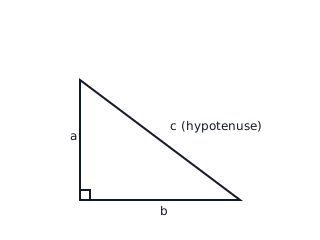
The Converse of the Pythagorean Theorem is used to determine if a triangle is right-angled. If the side lengths satisfy , then the angle opposite the longest side is exactly .
Pythagorean triples are sets of three positive integers that perfectly satisfy the theorem, such as , , and .
The distance between two points and on a coordinate plane is an application of the theorem, where the distance is the hypotenuse of a right triangle with legs and .
📐Formulae
💡Examples
Problem 1:
A ladder is leaning against a wall. The base of the ladder is meters away from the wall, and the ladder reaches a height of meters up the wall. How long is the ladder?
Solution:
- Identify the given sides: The base distance ( m) and the height ( m) are the legs of a right triangle.
- We need to find the length of the ladder, which is the hypotenuse ().
- Apply the formula:
- Substitute the values:
- Calculate:
- Solve for : meters.
Explanation:
Since the wall and the ground form a angle, we treat the ladder as the hypotenuse. We square both known sides, sum them, and take the square root to find the total length.
Problem 2:
Determine if a triangle with side lengths cm, cm, and cm is a right-angled triangle.
Solution:
- Identify the longest side: . The other sides are and .
- Calculate the square of the longest side: .
- Calculate the sum of the squares of the shorter sides: .
- Compare the results: .
- Conclusion: Since , the triangle is not a right-angled triangle.
Explanation:
Using the Converse of the Pythagorean Theorem, we check if the relationship holds true. Because the sum of the squares of the legs does not equal the square of the longest side, the triangle does not contain a right angle.
Problem 3:
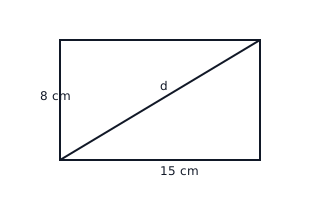
Calculate the length of the diagonal of a rectangle that has a width of cm and a length of cm.
Solution:
Explanation:
A rectangle's diagonal splits it into two right-angled triangles. We use the width and length as the two legs ( and ) to find the hypotenuse ().
Problem 4:
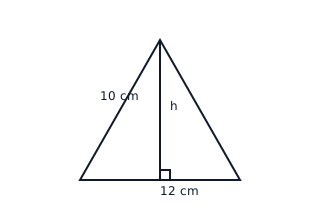
An isosceles triangle has two equal sides of length cm and a base of cm. Find the perpendicular height () of the triangle.
Solution:
The height bisects the base into two segments of .
Explanation:
In an isosceles triangle, the altitude (height) to the base creates two congruent right-angled triangles. The base of each right triangle is half the total base (). We then solve for the missing leg.