
Geometry and Measurement - Surface Area and Volume of Prisms, Pyramids, Cones, Spheres, and Compound Solids
Review the key concepts, formulae, and examples before starting your quiz.
🔑Concepts
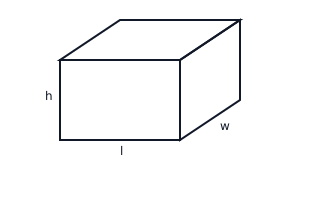
A prism is a 3D solid with a constant cross-section. To find the volume, calculate the area of this cross-section and multiply it by the length or height. For a rectangular prism, the surface area is the sum of the areas of its six rectangular faces.
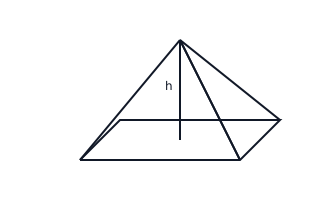
A pyramid's volume is exactly one-third of the volume of a prism with the same base area and height. The slant height () is used to calculate the surface area of the triangular faces, while the vertical height () is used for the volume.
For a cone, the slant height is the distance from the apex to any point on the circumference of the base. It forms a right-angled triangle with the vertical height and radius , satisfying .
Compound solids are formed by joining two or more basic 3D shapes. To find the total volume, add the volumes of the individual components. To find the total surface area, add the external surface areas, ensuring any overlapping faces are subtracted.
📐Formulae
💡Examples
Problem 1:
Calculate the volume of a cone with a radius of cm and a vertical height of cm. Use .
Solution:
Explanation:
Substitute the given radius and height into the volume formula for a cone.
Problem 2:
A sphere has a surface area of . Find its radius. (Take )
Solution:
Explanation:
We use the surface area formula for a sphere and solve for the unknown variable by rearranging the equation.
Problem 3:
A compound solid consists of a cylinder of radius cm and height cm, topped with a hemisphere of the same radius. Calculate the total volume of the solid.
Solution:
Explanation:
The total volume is the sum of the volume of the cylinder and the volume of the hemisphere. A hemisphere is half of a sphere.
Problem 4:
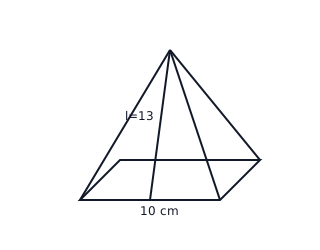
A square-based pyramid has a base side length of cm and a slant height of cm. Calculate the total surface area of the pyramid.
Solution:
Explanation:
The total surface area consists of the square base and four identical isosceles triangles. We use the slant height for the triangle area, not the vertical height.
Problem 5:
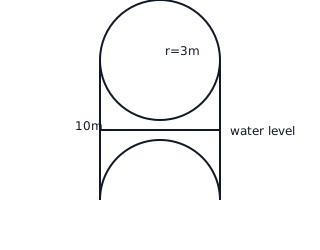
A cylindrical tank has a radius of m and a height of m. It is half-filled with water. Calculate the volume of the water in terms of .
Solution:
Explanation:
First, find the total capacity of the cylinder using the volume formula. Since it is half-filled, divide the total volume by 2.