
Review the key concepts, formulae, and examples before starting your quiz.
🔑Concepts
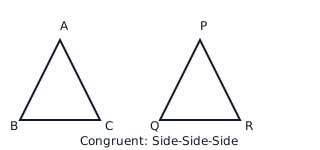
Congruent figures are identical in shape and size. Two triangles are congruent if they satisfy one of the four criteria: SSS (Side-Side-Side), SAS (Side-Angle-Side), ASA (Angle-Side-Angle), or RHS (Right angle-Hypotenuse-Side). In congruent shapes, all corresponding sides and angles are equal.
Similar figures have the same shape but different sizes. One figure is an enlargement of the other by a scale factor . For similarity, corresponding angles must be equal, and corresponding sides must be in the same ratio. For triangles, common criteria include AA (Angle-Angle), SAS (ratio of two sides and equal included angle), or SSS (ratio of all three sides).
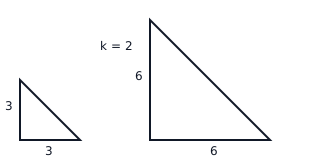
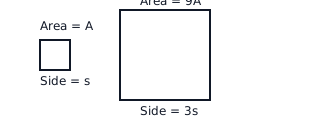
When two shapes are similar with a linear scale factor , the ratio of their areas is and the ratio of their volumes is . If side lengths double, the area quadruples and the volume increases by eight times.
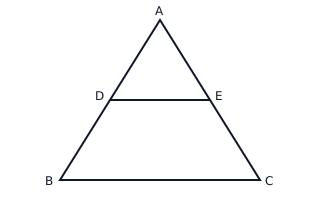
In similar triangles formed by parallel lines (the 'Ladder' or 'A-frame' theorem), the smaller triangle is similar to the larger triangle because they share a common angle and have corresponding angles created by the parallel lines.
📐Formulae
💡Examples
Problem 1:
In and , , , , , and . Determine if the triangles are similar and find the scale factor.
Solution:
We check the ratio of the corresponding sides: and . Since two sides are in the same proportion and the included angle is equal (), the triangles are similar by similarity. The scale factor is .
Explanation:
To prove similarity using , we must show that the ratio of two pairs of sides is equal and the angle between those sides is identical.
Problem 2:
Two similar rectangles have a scale factor of . If the area of the smaller rectangle is , find the area of the larger rectangle.
Solution:
The scale factor . The ratio of the areas is : Let be the area of the larger rectangle:
Explanation:
When objects are similar, the ratio of their areas is the square of the ratio of their corresponding linear dimensions.
Problem 3:
In and , , , , , , and . Are the triangles congruent?
Solution:
Comparing the sides of the two triangles: All three corresponding sides are equal. Therefore, by the congruence criterion.
Explanation:
Congruence requires all corresponding parts to be equal. is one of the standard rules to prove that two triangles are identical in size and shape.
Problem 4:
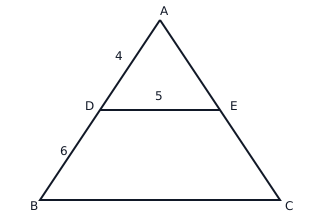
In the diagram provided, is parallel to . Given , , and , calculate the length of .
Solution:
- Identify the similar triangles: because is common and (corresponding angles).
- Find the total length of side :
- Set up the ratio of corresponding sides:
- Substitute the known values:
- Solve for :
Explanation:
Since the lines are parallel, the triangles are similar by AA criterion. The scale factor is determined by comparing the full side to the segment .
Problem 5:
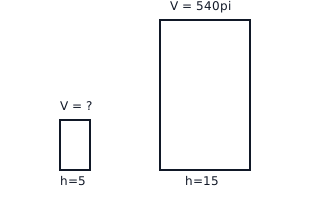
Two similar cylinders have heights of and . If the volume of the larger cylinder is , find the volume of the smaller cylinder.
Solution:
- Find the linear scale factor (larger to smaller):
- Find the volume scale factor:
- Calculate the volume of the smaller cylinder ():
Explanation:
Similarity in 3D objects requires using the cube of the linear scale factor to relate volumes.