
Review the key concepts, formulae, and examples before starting your quiz.
🔑Concepts
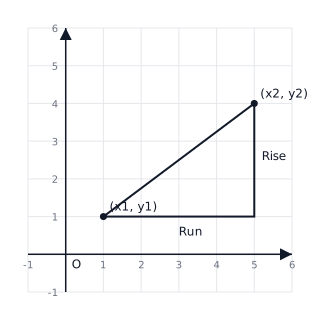
The gradient (or slope) represents the steepness of a line. It is calculated as the ratio of the vertical change (rise) to the horizontal change (run) between any two points and .
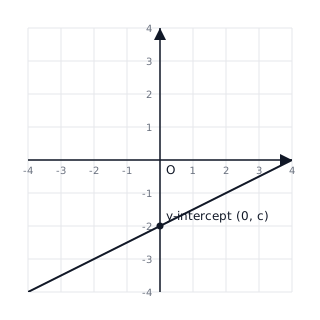
The -intercept is the point where the line crosses the -axis (). In the slope-intercept form , represents the value of at this intersection.
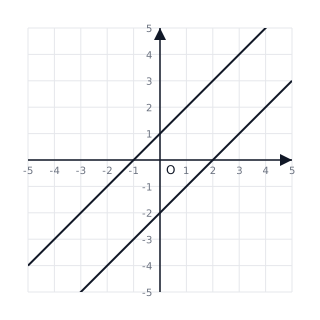
Parallel lines have the same gradient. For two lines and , if , the lines will never intersect.
A horizontal line has a gradient of and an equation of the form . A vertical line has an undefined gradient and an equation of the form .
📐Formulae
💡Examples
Problem 1:
Find the gradient of the line passing through the points and .
Solution:
Using the gradient formula:
Explanation:
Substitute the coordinates and into the formula to find the slope.
Problem 2:
Identify the gradient and the -intercept for the line given by the equation .
Solution:
First, rearrange the equation into the form : Divide every term by : Therefore, and .
Explanation:
To identify and , the equation must be isolated for . The coefficient of is the gradient, and the constant term is the -intercept.
Problem 3:
Find the equation of a line that has a gradient of and passes through the point .
Solution:
The -intercept is the value of when . Since the line passes through , . Given , substitute these into :
Explanation:
Because the point provided is the -intercept, we can directly plug the gradient and the -coordinate into the slope-intercept equation.
Problem 4:
Determine if the lines and are parallel.
Solution:
Line 1: , so . Line 2: Rearrange to : So, . Since , the lines are parallel.
Explanation:
Parallel lines must have identical gradients. By converting the second equation to slope-intercept form, we can compare its gradient to the first line.
Problem 5:
Convert the linear equation into slope-intercept form and find the gradient and -intercept.
Solution:
- Start with the given equation:
- Subtract from both sides:
- Divide every term by :
- The gradient and the -intercept .
Explanation:
To find the gradient and intercept easily, rearrange the standard form into by isolating .
Problem 6:
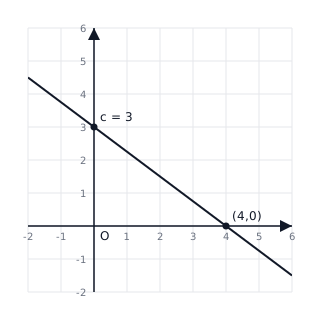
Determine the equation of the line shown in the graph below, which passes through the points and . Express the final answer in the form .
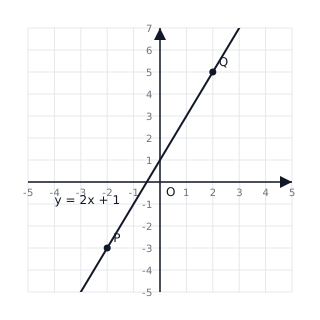
Solution:
- Identify the coordinates of the two points: and .
- Calculate the gradient ():
- Use the slope-intercept form and substitute one point, say , to find :
- Write the final equation:
Explanation:
To find the equation of a straight line, we first determine the gradient (steepness) by calculating the change in divided by the change in . Once the gradient is known, we substitute the coordinates of any point on the line into the general linear equation to solve for the -intercept ().