
Review the key concepts, formulae, and examples before starting your quiz.
🔑Concepts
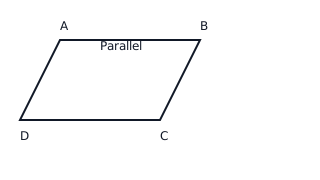
Quadrilaterals are classified by their properties including parallel sides, equal side lengths, and angle measures. A Trapezium (or Trapezoid) is a quadrilateral with at least one pair of parallel sides. A Parallelogram has two pairs of parallel sides, which implies opposite sides are equal and opposite angles are equal.
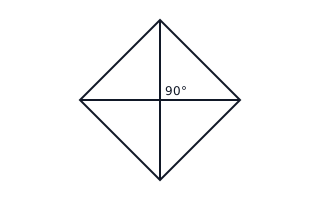
Special quadrilaterals like Rhombuses and Kites are defined by their diagonals. In a Rhombus, all four sides are equal and diagonals bisect each other at . In a Kite, there are two pairs of equal adjacent sides, and one diagonal is bisected by the other at a right angle.
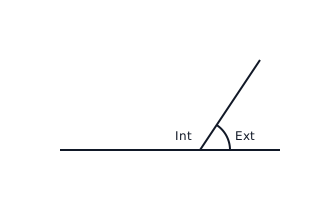
Interior and Exterior Angles: For any convex -sided polygon, the sum of exterior angles is always . The interior and exterior angles at any vertex are supplementary, meaning they sum to because they lie on a straight line.
A Regular Polygon is a polygon where all sides are of equal length and all interior angles are of equal measure. Common examples include equilateral triangles, squares, and regular pentagons.
📐Formulae
Sum of interior angles:
Individual interior angle of a regular polygon:
Sum of exterior angles:
Individual exterior angle of a regular polygon:
Relationship between interior and exterior angles:
Area of a trapezium:
Area of a kite or rhombus: (where are diagonals)
💡Examples
Problem 1:
Calculate the size of each interior angle in a regular hexagon.
Solution:
Step 1: Identify the number of sides for a hexagon, which is . Step 2: Use the interior angle sum formula: . Step 3: Since the hexagon is regular, divide the total sum by the number of angles: .
Explanation:
By dividing the hexagon into 4 triangles, we find the total degrees. Dividing by 6 gives the measure of one specific angle because all angles in a regular polygon are identical.
Problem 2:
A regular polygon has an exterior angle of . Determine how many sides this polygon has and name the polygon.
Solution:
Step 1: Use the sum of exterior angles property: . Step 2: Substitute the given exterior angle: . Step 3: Solve for : . Step 4: A polygon with 12 sides is called a dodecagon.
Explanation:
The sum of exterior angles is always regardless of the shape. Dividing this constant by the measure of one exterior angle gives the total number of vertices (sides).
Problem 3:
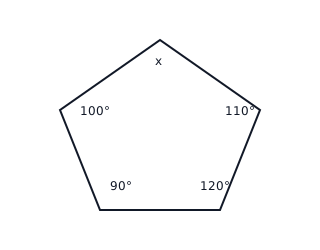
Calculate the value of in the given pentagon where four interior angles are , , , and .
Solution:
- Sum of interior angles for :
- Sum the given angles:
- Find :
Explanation:
To find a missing angle in a polygon, we first determine the total sum of all interior angles using the formula . Subtracting the sum of the known angles from this total gives the unknown value.
Problem 4:
Find the area of a kite where the diagonals measure cm and cm.
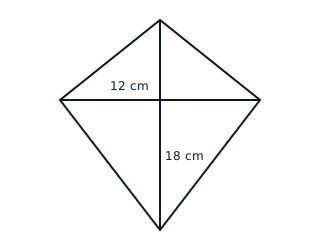
Solution:
- Use the formula for the area of a kite:
- Substitute the given diagonal lengths:
- Calculate the result:
Explanation:
The area of any quadrilateral whose diagonals are perpendicular (like a kite or rhombus) is half the product of the lengths of those diagonals.