
Review the key concepts, formulae, and examples before starting your quiz.
🔑Concepts
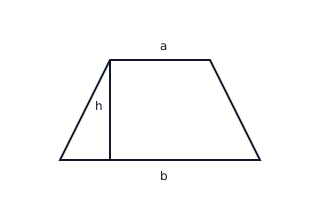
A trapezium (or trapezoid) is a quadrilateral with at least one pair of parallel sides. The area is found by multiplying the average of the parallel sides ( and ) by the perpendicular height ().
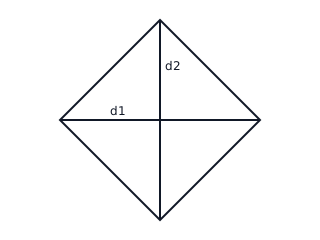
A rhombus is a special type of parallelogram where all four sides are equal. Its area can be calculated using the lengths of its diagonals ( and ), which bisect each other at .
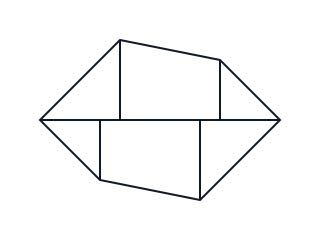
The area of a general polygon can be found by decomposing it into simpler shapes like triangles and rectangles, or by using the 'offset' method in a field book where distances are measured along a main diagonal (base line).
For a rhombus, if the base () and the vertical height () are known, the area is simply , the same as a parallelogram.
📐Formulae
Area of a Trapezium:
Area of a Rhombus (Diagonal Method):
Area of a Rhombus/Parallelogram (Base/Height Method):
Area of General Polygons:
💡Examples
Problem 1:
Calculate the area of a trapezium where the two parallel sides measure and , and the perpendicular distance between them is .
Solution:
- Identify the given dimensions: , , and .
- Write down the trapezium area formula: .
- Substitute the values into the formula: .
- Add the bases inside the parentheses: .
- Multiply: .
Explanation:
To find the area, we sum the parallel bases, multiply by the perpendicular height, and then take half of that product. The final area is .
Problem 2:
A rhombus has a side length of and its two diagonals measure and . Find the area of the rhombus.
Solution:
- Identify the relevant dimensions for the diagonal formula: and (the side length of is not needed for this formula).
- State the formula: .
- Substitute the values: .
- Perform the multiplication: .
- Final calculation: .
Explanation:
Using the diagonal method is the most direct way to find the area here. Note that the side length was extra information provided to test your ability to choose the correct dimensions. The area is .
Problem 3:
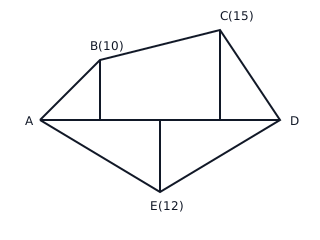
An irregular plot of land is shaped like a pentagon . A diagonal is drawn as a base line of length . Perpendiculars (offsets) are dropped from vertices , , and to the base line. is away from at a point from . is away from at a point from . is away from on the opposite side, at a point from . Calculate the total area of the plot.
Solution:
Explanation:
We split the polygon into four parts along the diagonal : two triangles and one trapezium on the top side, and one large triangle on the bottom side. We calculate the area of each and sum them up.
Problem 4:
A window frame is in the shape of a trapezium. The top width is and the bottom width is . The area of the glass required is . What is the height of the window frame?
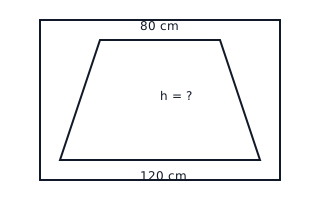
Solution:
Explanation:
Substitute the known values into the trapezium area formula and solve for the unknown height .