
Review the key concepts, formulae, and examples before starting your quiz.
🔑Concepts
A net is a 2D pattern that can be folded to form a 3D solid. It represents all the faces of the shape laid flat.
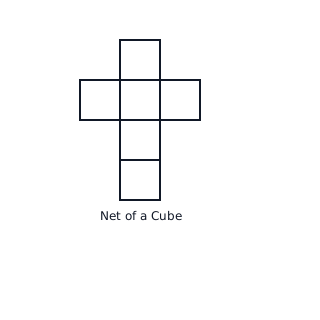
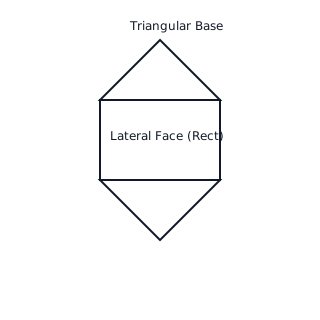
The Surface Area of a 3D shape is the sum of the areas of all individual shapes in its net. For a prism, this includes the two congruent bases and the rectangular lateral faces.
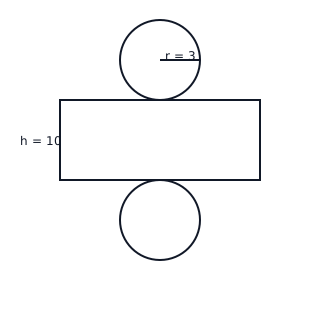
A Cylinder's net consists of a large rectangle and two identical circles. The length of the rectangle is equal to the circumference of the circle, .
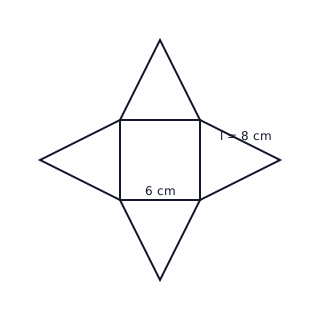
For a Square-Based Pyramid, the net consists of one square base and four congruent isosceles triangles that meet at a common apex when folded.
📐Formulae
💡Examples
Problem 1:
A cube has a side length of cm. Calculate its total surface area using the concept of its net.
Solution:
The net of a cube consists of identical squares. Area of one square face = . Total Surface Area = .
Explanation:
Since a cube has 6 faces that are all the same, we find the area of one face and multiply by 6.
Problem 2:
A cylinder has a radius of cm and a height of cm. Find the area of the rectangular part of its net. (Take )
Solution:
The length of the rectangle in the net is equal to the circumference of the base: . The width of the rectangle is equal to the height of the cylinder: . Area of rectangle = .
Explanation:
When a cylinder is 'unrolled', its lateral surface forms a rectangle where the length is the circumference of the base.
Problem 3:
Calculate the total surface area of a rectangular prism with length cm, width cm, and height cm by summing the areas of its faces.
Solution:
The net has three pairs of faces: Pair 1 (Base/Top): Pair 2 (Front/Back): Pair 3 (Sides): Total Surface Area calculation: Total Surface Area = .
Explanation:
We use the sum of the areas of all six rectangular faces represented in the net to find the total surface area.
Problem 4:
A square-based pyramid has a base side length of cm and a slant height (height of the triangular faces) of cm. Draw the net and calculate the total surface area.
Solution:
- Area of the square base:
- Area of one triangular face:
- Since there are 4 triangular faces:
- Total Surface Area:
Explanation:
The surface area is the sum of the base area and the lateral area (the four triangles). The slant height of the pyramid becomes the height of the triangles in the net.
Problem 5:
A closed cylinder has a radius cm and a height cm. Using its net, find the total surface area. (Use )
Solution:
- Area of the two circular bases:
- Length of the rectangular face (Circumference):
- Area of the rectangular face:
- Total Surface Area:
Explanation:
The net consists of two circles and one rectangle. The rectangle wraps around the circle, so its length must equal the circle's circumference.