
Review the key concepts, formulae, and examples before starting your quiz.
🔑Concepts
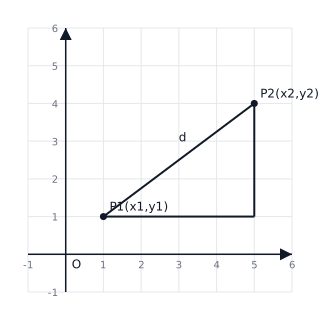
The Distance formula calculates the length of the straight line segment between two points and using the Pythagorean theorem where .
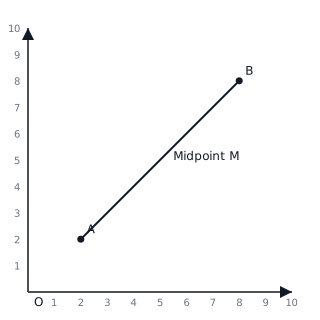
The Midpoint is the exact center point between two coordinates, found by averaging the -values and the -values of the endpoints.
The Gradient (slope) measures the steepness of a line as the ratio of 'rise' over 'run'. A positive gradient slopes upwards from left to right, while a negative gradient slopes downwards.
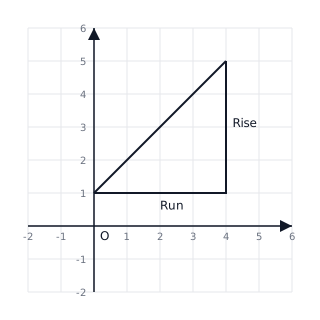
Horizontal lines have a gradient of because the change in is . Vertical lines have an undefined gradient because the change in is (division by zero).
📐Formulae
💡Examples
Problem 1:
Find the distance, midpoint, and gradient for the line segment joining points and .
Solution:
- Distance: units.
- Midpoint: .
- Gradient: .
Explanation:
Substitute into the coordinate geometry formulae. For distance, we use the square root of the sum of squares of the differences. For midpoint, we average the coordinates. For gradient, we divide the change in by the change in .
Problem 2:
A line passes through and . Calculate the gradient of the line.
Solution:
Explanation:
The gradient is negative, which means the line slopes downwards as it moves from left to right. Note how subtracting a negative number in the denominator becomes addition: .
Problem 3:
The midpoint of a line segment is . If point is , find the coordinates of point .
Solution:
Using the midpoint formula for each coordinate: For : For : Therefore, .
Explanation:
Since the midpoint is known, set up two separate algebraic equations (one for and one for ) to solve for the missing endpoint coordinates.
Problem 4:
Determine the distance between point and point .
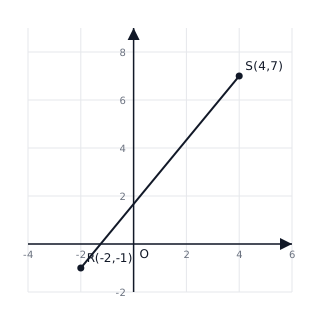
Solution:
units
Explanation:
Substitute the coordinates into the distance formula. The difference in is and the difference in is . Squaring these gives and . The square root of their sum () results in a distance of .
Problem 5:
A line segment connects and . Calculate the gradient of the line and the coordinates of the midpoint .
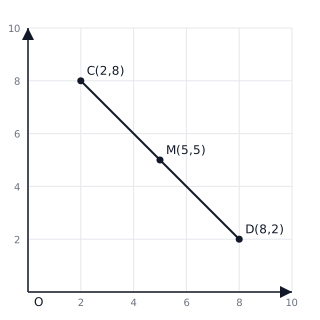
Solution:
Gradient:
Midpoint:
Explanation:
To find the gradient, divide the change in () by the change in (). For the midpoint, calculate the average of the -coordinates and the -coordinates separately.