
Review the key concepts, formulae, and examples before starting your quiz.
🔑Concepts
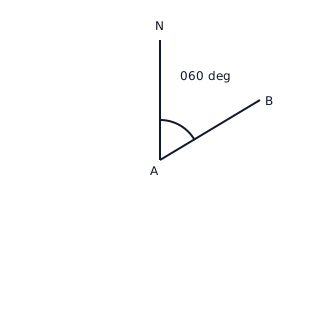
Bearings are always measured starting from North, moving in a clockwise direction, and are written as three-digit figures (e.g., instead of ).
Parallel line rules are essential for bearing problems. The North lines at two different points are always parallel to each other. Consequently, interior angles between these lines sum to , and alternate angles are equal.
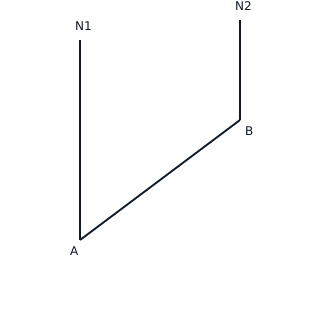
The back bearing is the bearing from the destination back to the starting point. It can be found by adding or subtracting from the original bearing, ensuring the result is between and .
Trigonometry (SOH CAH TOA) can be used to calculate bearings when horizontal and vertical distances between two points are known. Always draw a right-angled triangle relative to the North line.
📐Formulae
💡Examples
Problem 1:
The bearing of a lighthouse from a ship is . Find the bearing of the ship from the lighthouse .
Solution:
Explanation:
To find the back bearing from to , we add to the original bearing because is less than . This follows the rule for reverse directions on parallel North lines.
Problem 2:
A hiker walks due North from point to point , and then due East to point . Calculate the bearing of from .
Solution:
Explanation:
The movement forms a right-angled triangle with the North line. The angle from the North line at is found using the tangent ratio (Opposite/Adjacent). Since the angle is , we write it as a three-figure bearing: .
Problem 3:
If the bearing of from is , calculate the bearing of from .
Solution:
Explanation:
Since the original bearing is greater than , we subtract to find the back bearing. .
Problem 4:
A plane flies from Airport to Airport on a bearing of . Calculate the bearing of from .
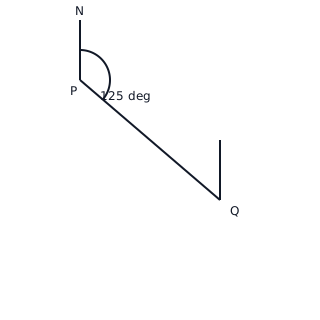
Solution:
The bearing of from is . Since , we calculate the back bearing as: Therefore, the bearing of from is .
Explanation:
Because the North lines at and are parallel, the angle from back to is found by considering the interior angles (which add to ) and the full circle at . Adding effectively reverses the direction.
Problem 5:
A ship sails due East from point and then due South to point . Calculate the bearing of from to the nearest degree.
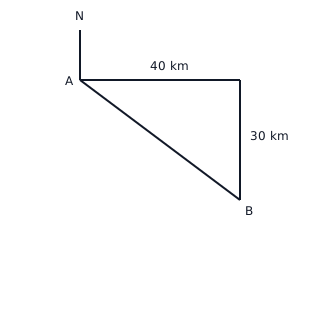
Solution:
- Let be the angle between the North line and the path .
- Since the ship goes East and then South, it forms a right-angled triangle.
- The angle from the East direction to can be found using:
- The bearing is measured from North. East is . To the nearest degree, the bearing is .
Explanation:
We use the tangent ratio in the right-angled triangle formed by the East and South displacements. Since bearings start from North (), we add the calculated angle to (East) to get the final clockwise bearing.