
Review the key concepts, formulae, and examples before starting your quiz.
🔑Concepts
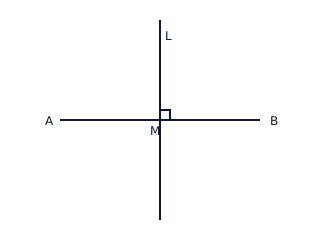
The perpendicular bisector of a line segment is a line that passes through the midpoint of the segment at a angle. Every point on the perpendicular bisector is equidistant from the segment's endpoints.
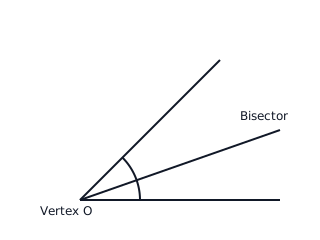
An angle bisector is a ray that divides an angle into two equal parts. To construct it, arcs are drawn from the vertex and the points where a primary arc intersects the angle's arms.
Constructing a angle involves drawing an equilateral triangle framework. By using the same compass width for the base and the intersecting arc, you create a vertex that naturally forms with the base.
A perpendicular from a point to a line is constructed by drawing an arc centered at the point that intersects the line twice, then finding the perpendicular bisector of the segment between those two intersections.
📐Formulae
💡Examples
Problem 1:
Describe how to construct a angle starting from a line segment .
Solution:
- Place the compass point at and draw a large arc that intersects segment at point .
- Keeping the same compass width, place the compass point at and draw an arc that intersects the first arc at point .
- Draw a ray from through . The angle is .
- Place the compass point at and draw an arc in the interior of .
- Place the compass point at and, with the same radius, draw an arc that intersects the arc from step 4 at point .
- Draw ray .
Explanation:
A angle is half of a angle. We first construct the angle using the equilateral triangle method and then bisect that angle to reach .
Problem 2:
Given a line segment of length cm, construct its perpendicular bisector and identify the length of the resulting segments.
Solution:
- Draw line segment cm using a ruler.
- Open the compass to a width greater than cm (e.g., cm).
- Place the compass at and draw arcs above and below the line.
- Place the compass at with the same width and draw arcs intersecting the first ones at points and .
- Draw a line through and , intersecting at point .
- Calculate the segments: .
Explanation:
The perpendicular bisector divides a segment into two equal parts. Since the original length was cm, the construction creates a midpoint such that the segments on either side are cm each, meeting at a angle.
Problem 3:
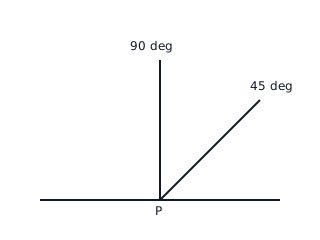
Construct a angle at point on a line segment and then bisect it to create a angle.
Solution:
- Draw a line and mark point .
- Use a compass to mark points and equidistant from on the line.
- Construct the perpendicular bisector of to get the line.
- Place the compass point at the intersection of the line and the arc, and at point , to draw intersecting arcs.
- Draw a line from through the intersection to get .
Explanation:
A angle is exactly half of a angle. The construction uses the property that the angle bisector of a right angle creates two equal angles.
Problem 4:
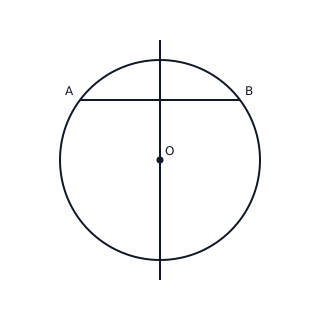
Given a circle with center and a chord , construct the perpendicular bisector of the chord and show that it passes through the center .
Solution:
- Place the compass on point and draw arcs above and below the chord .
- With the same radius, place the compass on point and draw arcs intersecting the first ones.
- Draw a line through the intersection points.
- Observe that this line passes through center .
Explanation:
In any circle, the perpendicular bisector of a chord always passes through the center of the circle because the center is equidistant from any two points on the circumference.