
Review the key concepts, formulae, and examples before starting your quiz.
🔑Concepts
A tessellation is a pattern of shapes that fits together perfectly without any gaps or overlaps, covering a flat surface indefinitely. This is also known as 'tiling'. For a tessellation to be possible, the sum of the interior angles of the shapes meeting at any vertex must be exactly .
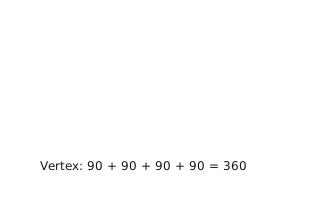
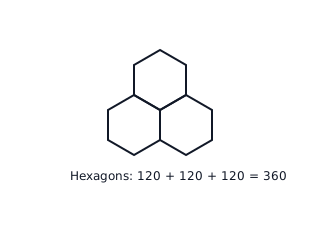
Regular tessellations are made using only one type of regular polygon. There are only three regular polygons that can form a regular tessellation: the equilateral triangle (6 shapes per vertex), the square (4 shapes per vertex), and the regular hexagon (3 shapes per vertex).
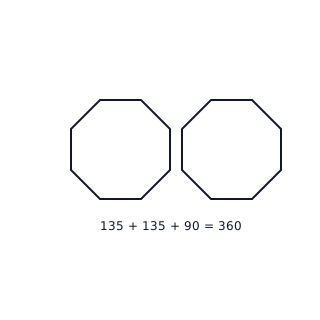
Semi-regular (or Archimedean) tessellations are made using two or more different regular polygons. The arrangement of polygons must be identical at every vertex point. For example, a common semi-regular tessellation uses regular octagons and squares.
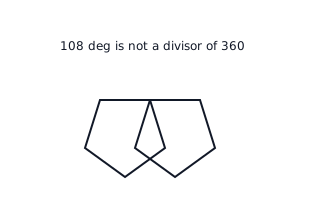
The Interior Angle Rule determines if a regular -gon can tessellate. The interior angle must be a divisor of . If the interior angle of a regular polygon is not a factor of , such as the regular pentagon (), it cannot form a regular tessellation because , leaving a gap.
Monohedral tessellations use only one shape, but the shape does not have to be a regular polygon. For example, any triangle or any quadrilateral (even irregular ones) can tile the plane because their internal angles can always be arranged to sum to at a vertex.
Vertex Notation (or Schläfli symbol variant) is used to describe tessellations. It lists the number of sides of the polygons that meet at a vertex, in order. For a regular hexagon tessellation, the notation is . For a semi-regular one with two octagons and a square, it is .
📐Formulae
💡Examples
Problem 1:
Explain why a regular pentagon cannot form a regular tessellation.
Solution:
- Calculate the interior angle of a regular pentagon ():
- Check if is a factor of :
Explanation:
Since divided by does not result in a whole number, the angles cannot meet at a vertex without leaving a gap or overlapping. Therefore, a regular pentagon cannot tessellate.
Problem 2:
Verify if a semi-regular tessellation can be formed by two regular octagons and one square meeting at a vertex.
Solution:
- Interior angle of a regular octagon ():
- Interior angle of a square ():
- Sum the angles at the vertex:
Explanation:
Because the sum of the interior angles of the two octagons and the square is exactly , they can meet at a vertex without gaps or overlaps, forming a semi-regular tessellation.
Problem 3:
Calculate the interior angle of a regular hexagon and determine how many hexagons meet at a single vertex in a regular tessellation.
Solution:
- Interior angle for :
- Number of hexagons at a vertex:
Explanation:
The interior angle of a regular hexagon is . Since , exactly three hexagons meet at each vertex to form a regular tessellation.
Problem 4:
Determine if a regular dodecagon (12-sided polygon) can form a regular tessellation by itself.
Solution:
- Calculate the interior angle of a regular dodecagon ():
- Check if is divisible by :
- Since 2.4 is not an integer, the angles cannot sum to at a vertex without leaving a gap or overlapping.
Explanation:
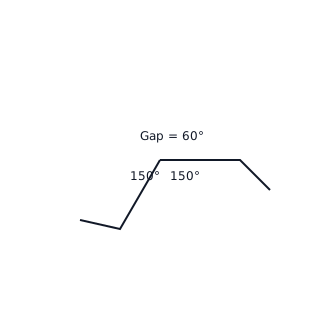
For a regular polygon to tessellate alone, its interior angle must be a factor of . A dodecagon's angle of results in a gap of , which is not enough space for a third dodecagon.
Problem 5:
A semi-regular tessellation is made using regular hexagons and equilateral triangles. If two hexagons meet at a vertex, how many equilateral triangles are required to complete the vertex?
Solution:
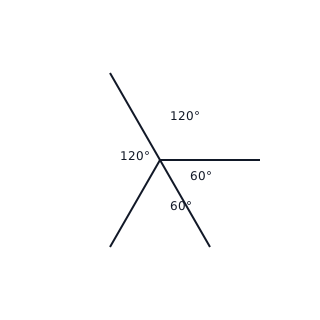
- Find the interior angle of a regular hexagon:
- Calculate the sum of the angles for two hexagons:
- Calculate the remaining angle needed to reach :
- Find the interior angle of an equilateral triangle:
- Divide the remaining angle by the triangle's angle: Therefore, 2 equilateral triangles are needed.
Explanation:
To fill the around a vertex, the combined angles of the hexagons () must be supplemented by worth of triangles. Since each triangle provides , two triangles are required.