
Geometry and Measurement - Surface Area and Volume of 3D Shapes (Cubes, Cuboids, Cylinders)
Review the key concepts, formulae, and examples before starting your quiz.
🔑Concepts
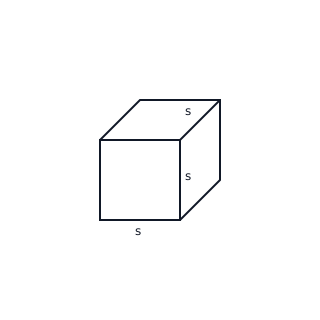
A cube is a 3D shape where all faces are equal squares. If the edge length is , the volume measures the space inside () and the total surface area is the sum of its six square faces ().
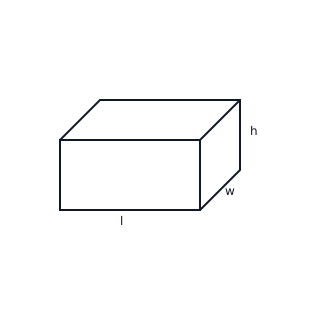
A cuboid (rectangular prism) has six rectangular faces. Its dimensions are defined by length (), width (), and height (). Volume is and Total Surface Area is .
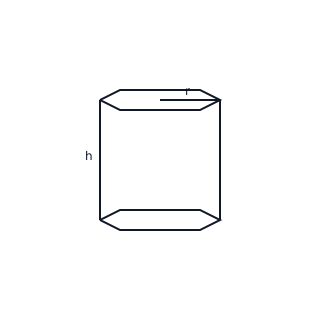
A cylinder consists of two congruent circular bases and a curved surface. The radius is the distance from the center to the edge of the base, and is the perpendicular distance between the bases.
Units of measurement are critical: Area is measured in square units (e.g., ) while Volume is measured in cubic units (e.g., ). Always ensure all dimensions are in the same unit before calculating.
📐Formulae
Volume of a Cube:
Total Surface Area of a Cube:
Volume of a Cuboid:
Total Surface Area of a Cuboid:
Volume of a Cylinder:
Curved Surface Area of a Cylinder:
Total Surface Area of a Cylinder:
Circumference of a Circle:
💡Examples
Problem 1:
A rectangular water tank (cuboid) has a length of m, a width of m, and a height of m. Calculate the volume of water it can hold and the total surface area of the tank's exterior.
Solution:
- Identify the dimensions: , , .
- Calculate Volume:
- Calculate Surface Area:
Explanation:
To find the volume, we multiply all three dimensions together. To find the surface area, we calculate the area of the three pairs of identical rectangular faces and sum them up.
Problem 2:
A cylindrical soda can has a radius of cm and a height of cm. Find the volume and the total surface area of the can. (Take )
Solution:
- Identify the dimensions: , .
- Calculate Volume:
- Calculate Total Surface Area:
Explanation:
The volume is found by multiplying the area of the circular base () by the height. The surface area is the sum of the two circular ends and the rectangular 'wrapped' side (circumference height).
Problem 3:
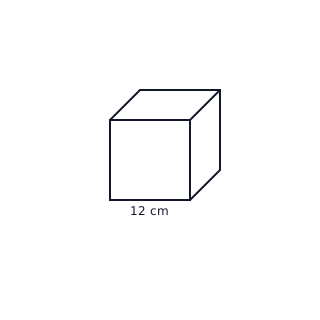
A wooden gift box is in the shape of a cube with an edge length of cm. Calculate the total surface area of the box and determine how many such boxes can be carved from a larger wooden block with a volume of .
Solution:
- Find Total Surface Area ():
- Find Volume () of one box:
- Find number of boxes: There are 6 boxes.
Explanation:
We first use the surface area formula for a cube to find the exterior area. To find how many fit in a larger volume, we calculate the volume of one cube and divide the total volume by this value.
Problem 4:
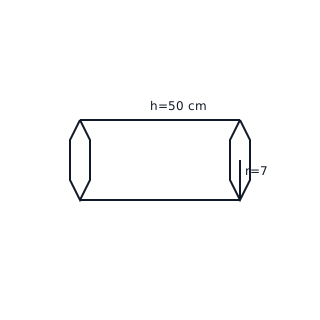
A cylindrical water pipe has an inner radius of cm and a length (height) of cm. Calculate the Curved Surface Area () of the inside of the pipe and the volume of water it holds when full. (Use )
Solution:
- Calculate Curved Surface Area ():
- Calculate Volume ():
Explanation:
The CSA of a cylinder only accounts for the side wall, not the top or bottom circles. The volume tells us the capacity of the pipe based on its cross-sectional area multiplied by its length.