
Review the key concepts, formulae, and examples before starting your quiz.
🔑Concepts
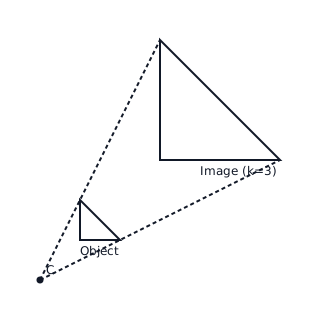
An enlargement is a transformation that changes the size of an object while preserving its shape. It is defined by a center of enlargement and a scale factor . If , the object expands; if , the object shrinks (reduction).
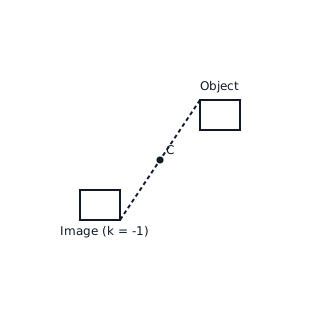
Negative scale factors () result in an image that is inverted and positioned on the opposite side of the center of enlargement. The distance from the center is still multiplied by .
When an object is enlarged by scale factor , its linear dimensions change by , its area changes by , and its volume changes by .
Center of enlargement from coordinates: If the center is , the image of is . If the center is , the image is .
📐Formulae
💡Examples
Problem 1:
A triangle with a base of is enlarged to a similar triangle with a base of . Calculate the scale factor .
Solution:
Explanation:
The scale factor is found by dividing the length of the image side by the corresponding length of the original object side.
Problem 2:
A square has an area of . It is enlarged by a scale factor of . What is the area of the new square?
Solution:
Explanation:
When a shape is enlarged, its area increases by the square of the scale factor ().
Problem 3:
A point is enlarged from the center of enlargement at the origin with a scale factor of . Find the coordinates of the image .
Solution:
Explanation:
To find the new coordinates when enlarging from the origin, multiply both the and coordinates of the original point by the scale factor.
Problem 4:
A model car has a volume of . The actual car is a enlargement of the model. Calculate the volume of the actual car in cubic meters.
Solution:
Explanation:
The volume changes by the cube of the scale factor (). To convert to , we divide by ().
Problem 5:
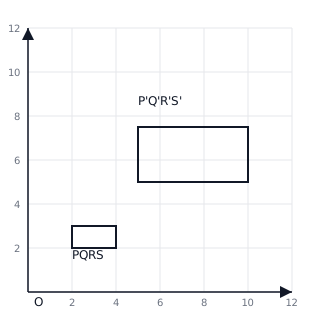
A rectangle with vertices , , , and is enlarged with a scale factor from the origin . Determine the coordinates of the enlarged rectangle and calculate the ratio of the area of the image to the area of the object.
Solution:
-
Multiply each coordinate by :
-
The ratio of areas is :
Explanation:
Since the enlargement is from the origin, we apply the scale factor directly to the coordinates. The area scale factor is always the square of the linear scale factor.
Problem 6:
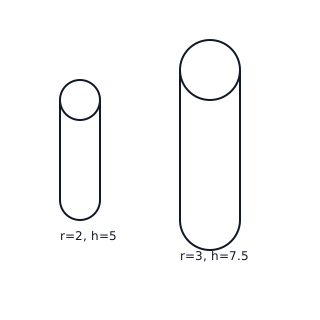
A cylindrical water tank has a radius of and a height of . A geometrically similar larger tank is built using a scale factor of . Calculate the volume of the larger tank.
Solution:
-
Calculate the volume of the original tank ():
-
Use the volume scale factor to find the new volume ():
Explanation:
When all linear dimensions (radius and height) are increased by , the total volume increases by . Multiplying the initial volume by gives the volume of the enlarged tank.