
Review the key concepts, formulae, and examples before starting your quiz.
🔑Concepts
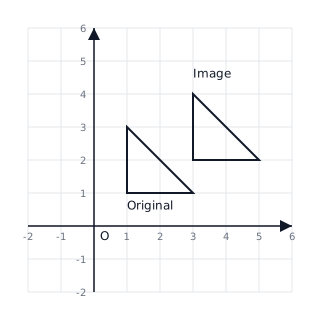
A translation moves every point of a figure the same distance in the same direction. It is often described by a vector \begin{pmatrix} a \\ b \\end{pmatrix}, where is the horizontal shift and is the vertical shift. The mapping is . Orientation and size remain unchanged.
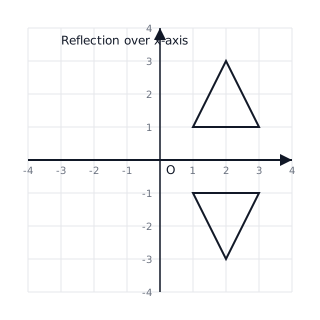
A reflection creates a mirror image of a figure across a line of reflection. Points on the line remain fixed (invariant), while all other points are 'flipped' such that the line is the perpendicular bisector of the segment connecting a point and its image.
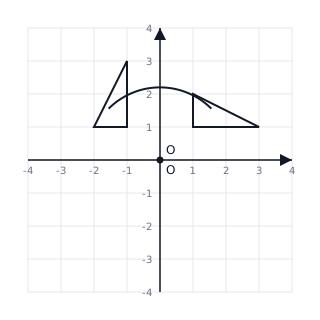
A rotation turns a figure about a fixed point called the center of rotation. A positive angle indicates counter-clockwise (CCW) rotation, while a negative angle indicates clockwise (CW) rotation. The distance from the center to any point remains constant.
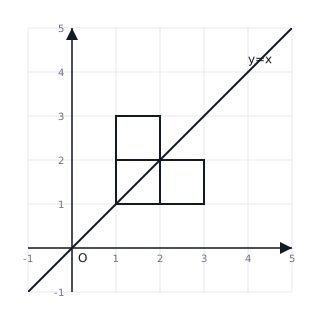
Invariant points are points that do not move during a transformation. For example, during a reflection, any point on the line of reflection is invariant. During a rotation, the center of rotation is invariant.
📐Formulae
Translation rule:
Reflection over the x-axis:
Reflection over the y-axis:
Reflection over the line :
Reflection over the line :
Rotation clockwise about origin:
Rotation counter-clockwise about origin:
Rotation about origin:
💡Examples
Problem 1:
Triangle has vertices , , and . Apply a translation using the vector and then reflect the resulting image over the x-axis. Find the final coordinates of vertex .
Solution:
Step 1: Apply the translation to point . Using the rule , we get . Step 2: Apply the reflection over the x-axis to . Using the rule , we get . The final coordinates of are .
Explanation:
To find the final position, we apply the transformations sequentially. The translation shifts the point 3 units left and 1 unit up. The reflection over the x-axis then negates the y-coordinate while keeping the x-coordinate the same.
Problem 2:
A square has a vertex at . If the square is rotated counter-clockwise about the origin, what are the coordinates of the image ?
Solution:
Step 1: Identify the starting coordinates . Step 2: Apply the rotation rule for counter-clockwise, which is . Step 3: Substitute the values: and . The coordinate of is .
Explanation:
A counter-clockwise rotation swaps the x and y values and changes the sign of the original y-coordinate. Visually, the point moves from Quadrant IV to Quadrant I.
Problem 3:
Rectangle has vertices , , , and . Reflect the rectangle across the line . Determine the coordinates of the image .
Solution:
The rule for reflection across the line is . Applying this to each vertex:
The new coordinates are , , , and .
Explanation:
In a reflection over , the x-coordinates and y-coordinates of every point are swapped. Notice that point lies on the line , so it is an invariant point and does not change its position.
Problem 4:
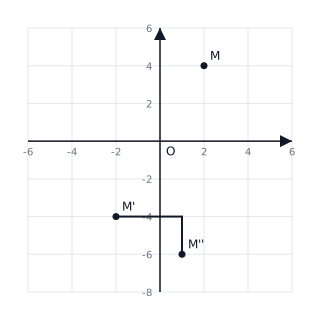
Point is rotated about the origin to , and then is translated by the vector \begin{pmatrix} 3 \\ -2 \\end{pmatrix} to reach point . Find the coordinates of .
Solution:
Step 1: Rotate about the origin. The rule is .
Step 2: Translate by \begin{pmatrix} 3 \\ -2 \\end{pmatrix}. The rule is .
The final coordinates are .
Explanation:
A rotation negates both coordinates. The subsequent translation adds the vector components to the results of the rotation.