krit.club logo

Geometry and Trigonometry - Vectors: Geometric representation (HL)

Grade 11IB_AA

Review the key concepts, formulae, and examples before starting your quiz.

🔑Concepts

•

A vector represents a quantity with both magnitude and direction, geometrically shown as a directed line segment. The arrow indicates direction, while the length represents the magnitude.
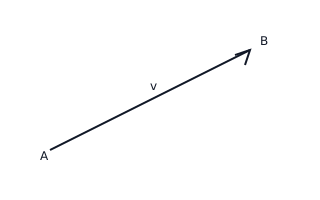
A directed line segment from point A to point B labeled as vector v.
•

The Triangle Law of Addition states that if two vectors a⃗\vec{a} and b⃗\vec{b} are represented by two sides of a triangle in order, their sum (resultant) is the third side.
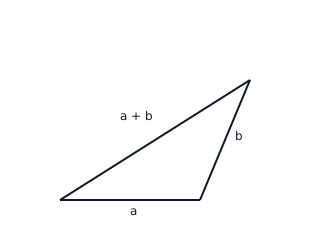
Triangle law showing vector a followed by b results in the vector a plus b.
•

Vector subtraction a−b\mathbf{a} - \mathbf{b} is geometrically equivalent to a+(−b)\mathbf{a} + (-\mathbf{b}), where −b-\mathbf{b} has the same magnitude as b\mathbf{b} but the opposite direction.

•

The Parallelogram Law of Addition states that if two vectors originate from the same point, the resultant vector is the diagonal of the parallelogram they form.
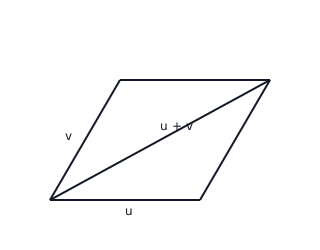
Parallelogram showing vectors u and v with their sum u + v as the diagonal.
•

Two vectors are parallel if one is a scalar multiple of the other: u⃗=kv⃗\vec{u} = k\vec{v}. If k>0k > 0, they have the same direction; if k<0k < 0, they have opposite directions.

📐Formulae

AB⃗=OB⃗−OA⃗=b−a\vec{AB} = \vec{OB} - \vec{OA} = \mathbf{b} - \mathbf{a}

AC⃗=AB⃗+BC⃗\vec{AC} = \vec{AB} + \vec{BC}

BA⃗=−AB⃗\vec{BA} = -\vec{AB}

OM⃗=12(a+b) (where M is the midpoint of AB)\vec{OM} = \frac{1}{2}(\mathbf{a} + \mathbf{b}) \text{ (where } M \text{ is the midpoint of } AB\text{)}

OP⃗=na+mbm+n (Section formula: P divides AB in ratio m:n)\vec{OP} = \frac{n\mathbf{a} + m\mathbf{b}}{m + n} \text{ (Section formula: } P \text{ divides } AB \text{ in ratio } m:n\text{)}

💡Examples

Problem 1:

In a parallelogram ABCDABCD, let AB⃗=u\vec{AB} = \mathbf{u} and AD⃗=v\vec{AD} = \mathbf{v}. Express the diagonals AC⃗\vec{AC} and BD⃗\vec{BD} in terms of u\mathbf{u} and v\mathbf{v}.

Solution:

  1. In a parallelogram, opposite sides are equal in magnitude and parallel, so BC⃗=AD⃗=v\vec{BC} = \vec{AD} = \mathbf{v} and DC⃗=AB⃗=u\vec{DC} = \vec{AB} = \mathbf{u}.
  2. Using the triangle law for AC⃗\vec{AC}: AC⃗=AB⃗+BC⃗=u+v\vec{AC} = \vec{AB} + \vec{BC} = \mathbf{u} + \mathbf{v}
  3. Using the triangle law for BD⃗\vec{BD}: BD⃗=BA⃗+AD⃗=−AB⃗+AD⃗=−u+v\vec{BD} = \vec{BA} + \vec{AD} = -\vec{AB} + \vec{AD} = -\mathbf{u} + \mathbf{v} Therefore, AC⃗=u+v\vec{AC} = \mathbf{u} + \mathbf{v} and BD⃗=v−u\vec{BD} = \mathbf{v} - \mathbf{u}.

Explanation:

This demonstrates the geometric application of vector addition and the property that BA⃗=−AB⃗\vec{BA} = -\vec{AB}.

Problem 2:

Given points AA and BB with position vectors a\mathbf{a} and b\mathbf{b} respectively, find the position vector of point MM such that MM is the midpoint of the line segment ABAB.

Solution:

  1. The vector AB⃗\vec{AB} is given by b−a\mathbf{b} - \mathbf{a}.
  2. Since MM is the midpoint, AM⃗=12AB⃗=12(b−a)\vec{AM} = \frac{1}{2}\vec{AB} = \frac{1}{2}(\mathbf{b} - \mathbf{a}).
  3. The position vector OM⃗\vec{OM} is found by: OM⃗=OA⃗+AM⃗\vec{OM} = \vec{OA} + \vec{AM} OM⃗=a+12(b−a)\vec{OM} = \mathbf{a} + \frac{1}{2}(\mathbf{b} - \mathbf{a}) OM⃗=a+12b−12a\vec{OM} = \mathbf{a} + \frac{1}{2}\mathbf{b} - \frac{1}{2}\mathbf{a} OM⃗=12a+12b=12(a+b)\vec{OM} = \frac{1}{2}\mathbf{a} + \frac{1}{2}\mathbf{b} = \frac{1}{2}(\mathbf{a} + \mathbf{b})

Explanation:

This example uses the relationship between displacement vectors and position vectors to derive the midpoint formula in vector form.

Problem 3:

If p⃗=2x⃗−3y⃗\vec{p} = 2\vec{x} - 3\vec{y} and q⃗=x⃗+ky⃗\vec{q} = \vec{x} + k\vec{y}, find the value of the scalar kk such that p⃗\vec{p} and q⃗\vec{q} are parallel.

Solution:

  1. For two vectors to be parallel, one must be a scalar multiple of the other: p⃗=mq⃗\vec{p} = m\vec{q} for some m∈Rm \in \mathbb{R}.
  2. Substitute the expressions: 2x⃗−3y⃗=m(x⃗+ky⃗)2\vec{x} - 3\vec{y} = m(\vec{x} + k\vec{y}) 2x⃗−3y⃗=mx⃗+mky⃗2\vec{x} - 3\vec{y} = m\vec{x} + mk\vec{y}
  3. Compare the coefficients of x⃗\vec{x} and y⃗\vec{y}: For x⃗\vec{x}: 2=m2 = m For y⃗\vec{y}: −3=mk-3 = mk
  4. Substitute m=2m=2 into the second equation: −3=2k  ⟹  k=−32-3 = 2k \implies k = -\frac{3}{2}

Explanation:

Two vectors are parallel if their components (or their geometric representations in terms of base vectors x⃗\vec{x} and y⃗\vec{y}) are proportional.

Problem 4:

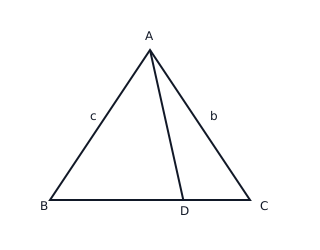
In the triangle ABCABC, point DD lies on BCBC such that BD:DC=2:1BD:DC = 2:1. Given AB⃗=c\vec{AB} = \mathbf{c} and AC⃗=b\vec{AC} = \mathbf{b}, find the vector AD⃗\vec{AD} in terms of b\mathbf{b} and c\mathbf{c}.

Triangle ABC with point D on BC dividing it 2:1.

Solution:

  1. First, express BC⃗\vec{BC} in terms of b\mathbf{b} and c\mathbf{c}: BC⃗=AC⃗−AB⃗=b−c\vec{BC} = \vec{AC} - \vec{AB} = \mathbf{b} - \mathbf{c}
  2. Since DD divides BCBC in the ratio 2:12:1, BD⃗=23BC⃗=23(b−c)\vec{BD} = \frac{2}{3} \vec{BC} = \frac{2}{3}(\mathbf{b} - \mathbf{c})
  3. Now, find AD⃗\vec{AD} using the triangle law: AD⃗=AB⃗+BD⃗=c+23(b−c)\vec{AD} = \vec{AB} + \vec{BD} = \mathbf{c} + \frac{2}{3}(\mathbf{b} - \mathbf{c})
  4. Simplify the expression: AD⃗=c+23b−23c=13c+23b\vec{AD} = \mathbf{c} + \frac{2}{3}\mathbf{b} - \frac{2}{3}\mathbf{c} = \frac{1}{3}\mathbf{c} + \frac{2}{3}\mathbf{b}

Explanation:

This problem uses the vector addition law and the ratio property of line segments. By expressing the segment BCBC as a vector difference, we can find any point along that line by applying a scalar fraction.

Problem 5:

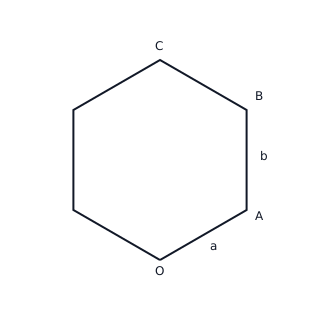
Given a hexagon OABCDEOABCDE where OO is the origin. Let OA⃗=a\vec{OA} = \mathbf{a} and AB⃗=b\vec{AB} = \mathbf{b}. If the hexagon is regular, express the vector OC⃗\vec{OC} in terms of a\mathbf{a} and b\mathbf{b}.

Regular hexagon OABCDE starting at origin O.

Solution:

  1. In a regular hexagon, the vector from the center MM to a vertex is equal to the side vector. Let MM be the center. OM⃗=AB⃗=b\vec{OM} = \vec{AB} = \mathbf{b}.
  2. Due to symmetry and properties of regular hexagons, BC⃗\vec{BC} is parallel and equal to OM⃗−OA⃗=b−a\vec{OM} - \vec{OA} = \mathbf{b} - \mathbf{a} is incorrect; rather, in a regular hexagon, BC⃗=AO⃗+AB⃗=b−a\vec{BC} = \vec{AO} + \vec{AB} = \mathbf{b} - \mathbf{a}.
  3. Therefore, OC⃗=OA⃗+AB⃗+BC⃗=a+b+(b−a)=2b\vec{OC} = \vec{OA} + \vec{AB} + \vec{BC} = \mathbf{a} + \mathbf{b} + (\mathbf{b} - \mathbf{a}) = 2\mathbf{b}.

Explanation:

A regular hexagon can be divided into six equilateral triangles. Using the center of the hexagon as a reference point helps identify parallel and equal vectors.