
Review the key concepts, formulae, and examples before starting your quiz.
🔑Concepts
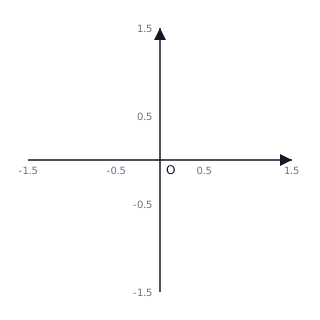
The Pythagorean identity is derived from the unit circle, where any point on the circumference satisfies and . This identity allows us to transform equations involving mixed terms of and into a single trigonometric ratio.
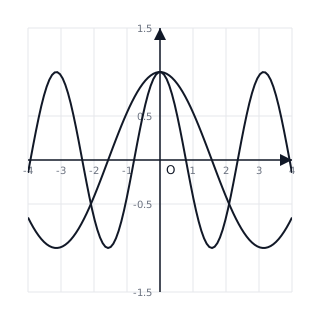
Double angle identities for provide three forms: , , and . Selecting the correct form is crucial for solving equations. For example, if the equation also contains a term, use to create a quadratic in terms of cosine.
Solving trigonometric equations often requires recognizing a quadratic structure. For an equation like , we substitute to solve for first, then determine the values of within the specified domain.

Compound angle identities such as allow us to expand or contract expressions. These are particularly useful when solving equations where the argument of the function is a sum or difference, or when finding exact values for non-standard angles.
📐Formulae
💡Examples
Problem 1:
Solve the equation for .
Solution:
For , . For , . The solution set is .
Explanation:
First, the double angle identity is used to express the entire equation in terms of . The resulting quadratic equation is factored. Then, the basic trigonometric equations are solved within the given domain.
Problem 2:
Solve for .
Solution:
Explanation:
The Pythagorean identity is substituted into the equation to create a quadratic in terms of . After simplifying and factoring, the values for are found in degrees.
Problem 3:
Given that and is obtuse, find the exact value of .
Solution:
Since : Since is obtuse (Quadrant II), must be negative: Now use the double angle formula:
Explanation:
To find , we need both and . We find using the Pythagorean identity, being careful to choose the negative root because the angle is in the second quadrant. Finally, we apply the double angle identity.
Problem 4:
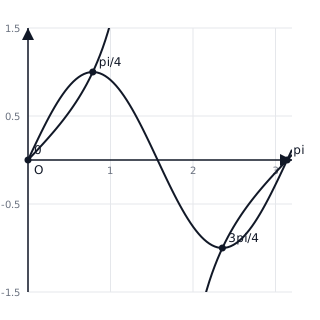
Solve the equation for .
Solution:
- Use the double angle identity and the identity :
- Rearrange the equation (multiply by , noting ):
- Factor out :
- Set each factor to zero:
- Solve for in the interval : For , For , Final solutions: .
Explanation:
This example uses the substitution of both a double angle identity and the tangent identity to factorize the equation. It is important to factorize rather than divide by to avoid losing solutions.
Problem 5:
Solve for .
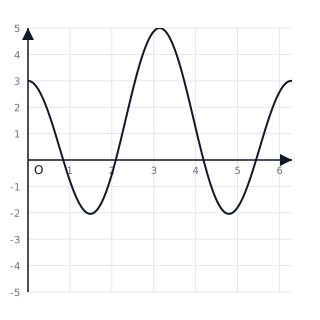
Solution:
- Replace with the form that involves only :
- Expand and simplify to form a quadratic equation:
- Let . Factor the quadratic :
- Solve for : or
- Find values of for : (using calculator)
- Find values of for : () Final solution set: .
Explanation:
By choosing the identity, we transform the equation into a standard quadratic form which can be factored.