
Review the key concepts, formulae, and examples before starting your quiz.
🔑Concepts
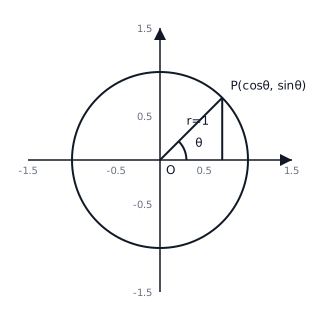
The Unit Circle is a circle with a radius of 1 centered at the origin in the Cartesian plane. For any angle measured counter-clockwise from the positive -axis, the terminal side intersects the circle at point , where and .
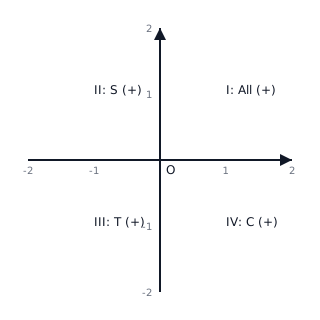
The signs of the trigonometric functions depend on the quadrant in which the angle terminates. In Quadrant I, all are positive; in Quadrant II, only (and its reciprocal) is positive; in Quadrant III, only is positive; and in Quadrant IV, only is positive. This is often remembered by the acronym 'CAST' or 'ASTC'.
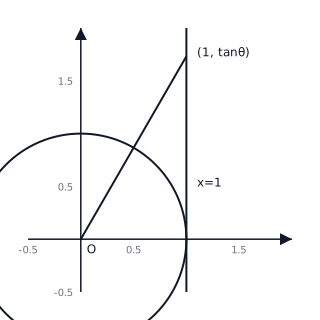
The tangent function represents the slope of the terminal ray passing through the origin. Geometrically, it is the -coordinate of the point where the terminal ray intersects the vertical line .
The Pythagorean Identity is derived directly from the equation of the unit circle by substituting and .
📐Formulae
💡Examples
Problem 1:
Given that and , find the exact value of and .
Solution:
Since is in the second quadrant (), must be negative:
Explanation:
We use the Pythagorean identity to find the magnitude of . The quadrant information () tells us the angle is in the second quadrant, where cosine and tangent are negative.
Problem 2:
Find the exact coordinates of the point on the unit circle corresponding to an angle of .
Solution:
The angle is in the third quadrant (). The reference angle is: The coordinates are . In , both and are negative. The coordinates are .
Explanation:
To find exact values for angles outside the first quadrant, identify the reference angle and apply the appropriate signs based on the quadrant (Quadrant III for ).
Problem 3:
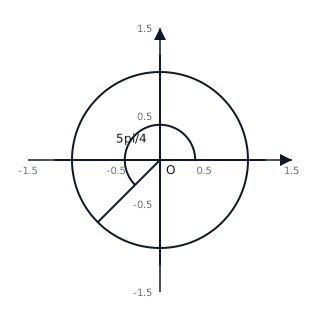
Determine the exact value of .
Solution:
- The angle lies in the third quadrant because .
- Calculate the reference angle .
- In the third quadrant, the cosine value is negative.
- .
Explanation:
We identify the quadrant and the reference angle to apply the correct sign and known trigonometric ratio.
Problem 4:
Determine the exact value of and identify the quadrant in which the terminal side of the angle lies.
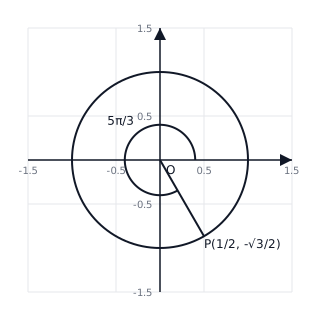
Solution:
- Identify the quadrant: is between () and (), so it lies in Quadrant IV.
- Find the reference angle: ().
- Determine the sine value for the reference angle: .
- Apply the sign for Quadrant IV: In Quadrant IV, sine is negative. Therefore, .
Explanation:
The value is found by identifying the reference angle in the first quadrant and then applying the appropriate sign based on the ASTC rule (Quadrant IV: only Cosine is positive).