krit.club logo

Geometry and Trigonometry - Vector equation of a line in 3D (HL)

Grade 11IB_AA

Review the key concepts, formulae, and examples before starting your quiz.

🔑Concepts

•

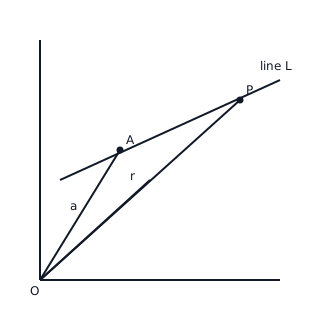
The vector equation of a line in 3D is given by r=a+λb\mathbf{r} = \mathbf{a} + \lambda \mathbf{b}, where a\mathbf{a} is a position vector of a known point on the line and b\mathbf{b} is the direction vector. The parameter λ\lambda determines the position of any point PP along the line's infinite path.

A 3D coordinate system showing origin O, position vector a to point A, and general position vector r to point P on line L.
•

The direction vector b\mathbf{b} can be derived from two points AA and BB on the line using b=AB⃗=b−a\mathbf{b} = \vec{AB} = \mathbf{b} - \mathbf{a}. Any scalar multiple of b\mathbf{b} serves as a valid direction vector for the same line.
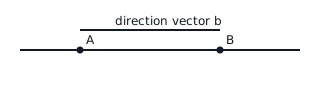
A line segment AB representing the direction vector b of a line.
•

In 3D space, two lines can be parallel, intersecting, or skew. Skew lines are lines that are not parallel and do not intersect because they lie in different parallel planes.
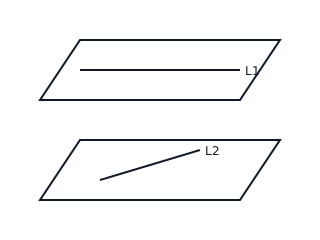
Two parallel planes containing two non-parallel lines that never intersect, illustrating skew lines.
•

The angle θ\theta between two lines is defined as the angle between their direction vectors b1\mathbf{b}_1 and b2\mathbf{b}_2. If b1⋅b2=0\mathbf{b}_1 \cdot \mathbf{b}_2 = 0, the lines are perpendicular.

📐Formulae

r=a+λb\mathbf{r} = \mathbf{a} + \lambda \mathbf{b}

(xyz)=\begin{pmatrix} x \\ y \\ z \end{pmatrix} = \begin{pmatrix} x_0 \ y_0 \ z_0 \end{pmatrix}+λ(lmn) + \lambda \begin{pmatrix} l \\ m \\ n \end{pmatrix}

x−x0l=y−y0m=z−z0n\frac{x - x_0}{l} = \frac{y - y_0}{m} = \frac{z - z_0}{n}

cos⁡θ=∣b1⋅b2∣∣b1∣∣b2∣\cos \theta = \frac{|\mathbf{b}_1 \cdot \mathbf{b}_2|}{|\mathbf{b}_1| |\mathbf{b}_2|}

💡Examples

Problem 1:

Find the vector equation of the line passing through points A(1,−2,3)A(1, -2, 3) and B(4,0,−1)B(4, 0, -1).

Solution:

  1. Find the direction vector b=AB⃗=b−a\mathbf{b} = \vec{AB} = \mathbf{b} - \mathbf{a} = (4−10−(−2)−1−3)\begin{pmatrix} 4 - 1 \\ 0 - (-2) \\ -1 - 3 \end{pmatrix} = (32−4)\begin{pmatrix} 3 \\ 2 \\ -4 \end{pmatrix}.
  2. Use point AA as the position vector a=(1−23)\mathbf{a} = \begin{pmatrix} 1 \\ -2 \\ 3 \end{pmatrix}.
  3. The equation is r=\mathbf{r} = (1−23)\begin{pmatrix} 1 \\ -2 \\ 3 \end{pmatrix} + λ(32−4)\lambda \begin{pmatrix} 3 \\ 2 \\ -4 \end{pmatrix}.

Explanation:

To find the equation of a line, we need a point on the line and a direction vector. The direction vector is found by subtracting the coordinates of the two given points.

Problem 2:

Find the acute angle between the lines L1:r1L_1: \mathbf{r}_1 = (201)\begin{pmatrix} 2 \\ 0 \\ 1 \end{pmatrix} + λ\lambda (122)\begin{pmatrix} 1 \\ 2 \\ 2 \end{pmatrix} and L2:r2L_2: \mathbf{r}_2 = (111)\begin{pmatrix} 1 \\ 1 \\ 1 \end{pmatrix} + μ(304)\mu \begin{pmatrix} 3 \\ 0 \\ 4 \end{pmatrix}.

Solution:

  1. Identify direction vectors: b1=(122)\mathbf{b}_1 = \begin{pmatrix} 1 \\ 2 \\ 2 \end{pmatrix} and b2=(304)\mathbf{b}_2 = \begin{pmatrix} 3 \\ 0 \\ 4 \end{pmatrix}.
  2. Calculate dot product: b1⋅b2=(1)(3)+(2)(0)+(2)(4)=3+0+8=11\mathbf{b}_1 \cdot \mathbf{b}_2 = (1)(3) + (2)(0) + (2)(4) = 3 + 0 + 8 = 11.
  3. Calculate magnitudes: ∣b1∣=12+22+22=3|\mathbf{b}_1| = \sqrt{1^2 + 2^2 + 2^2} = 3 and ∣b2∣=32+02+42=5|\mathbf{b}_2| = \sqrt{3^2 + 0^2 + 4^2} = 5.
  4. Calculate cos⁡θ=113×5=1115\cos \theta = \frac{11}{3 \times 5} = \frac{11}{15}.
  5. θ=arccos⁡(1115)≈42.8∘\theta = \arccos(\frac{11}{15}) \approx 42.8^\circ.

Explanation:

The angle between two lines is determined solely by the dot product of their direction vectors.

Problem 3:

Determine if the following two lines intersect: L1:r=L_1: \mathbf{r} = (110)\begin{pmatrix} 1 \\ 1 \\ 0 \end{pmatrix} +λ+ \lambda (212)\begin{pmatrix} 2 \\ 1 \\ 2 \end{pmatrix} L2:rL_2: \mathbf{r} = (212)\begin{pmatrix} 2 \\ 1 \\ 2 \end{pmatrix} + μ(1−10)\mu \begin{pmatrix} 1 \\ -1 \\ 0 \end{pmatrix}

Solution:

  1. Equate components: 1+2λ=2+μ1 + 2\lambda = 2 + \mu (i) 1+λ=1−μ1 + \lambda = 1 - \mu (ii) 2λ=22\lambda = 2 (iii)
  2. From (iii), 2λ=2  ⟹  λ=12\lambda = 2 \implies \lambda = 1.
  3. Substitute λ=1\lambda = 1 into (ii): 1+1=1−μ  ⟹  μ=−11 + 1 = 1 - \mu \implies \mu = -1.
  4. Check if these values satisfy (i): 1+2(1)=31 + 2(1) = 3; 2+(−1)=12 + (-1) = 1. Since 3≠13 \neq 1, the lines do not intersect.
  5. Since direction vectors are not proportional, the lines are skew.

Explanation:

To check for intersection, we set the x,y,zx, y, z components of both lines equal and solve for the parameters. If a consistent set of parameters exists for all three equations, they intersect; otherwise, they are skew or parallel.

Problem 4:

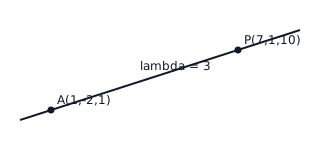
Determine if the point P(7,1,10)P(7, 1, 10) lies on the line given by the equation r=(1−21)+λ(213)\mathbf{r} = \begin{pmatrix} 1 \\ -2 \\ 1 \end{pmatrix} + \lambda \begin{pmatrix} 2 \\ 1 \\ 3 \end{pmatrix}.

A line containing point A and point P, showing that P is reached when the parameter lambda equals 3.

Solution:

(7110)=(1−21)+λ(213)\begin{pmatrix} 7 \\ 1 \\ 10 \end{pmatrix} = \begin{pmatrix} 1 \\ -2 \\ 1 \end{pmatrix} + \lambda \begin{pmatrix} 2 \\ 1 \\ 3 \end{pmatrix}

Equate the components to find λ\lambda:

  1. 7=1+2λ  ⟹  6=2λ  ⟹  λ=37 = 1 + 2\lambda \implies 6 = 2\lambda \implies \lambda = 3
  2. 1=−2+λ  ⟹  3=λ1 = -2 + \lambda \implies 3 = \lambda
  3. 10=1+3λ  ⟹  9=3λ  ⟹  λ=310 = 1 + 3\lambda \implies 9 = 3\lambda \implies \lambda = 3

Since the value of λ=3\lambda = 3 is consistent for all three coordinates, the point PP lies on the line.

Explanation:

To check if a point lies on a vector line, substitute the point's coordinates for r\mathbf{r} and solve for the parameter λ\lambda. If all three components yield the same λ\lambda, the point is on the line.

Problem 5:

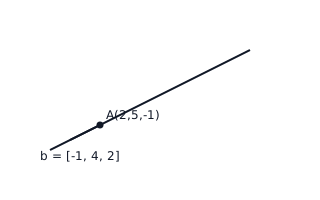
Find the Cartesian equation of the line passing through A(2,5,−1)A(2, 5, -1) with direction vector b=(−142)\mathbf{b} = \begin{pmatrix} -1 \\ 4 \\ 2 \end{pmatrix}.

Diagram of a line in 3D space passing through point A with a specific direction vector b.

Solution:

The vector equation is r=(25−1)+λ(−142)\mathbf{r} = \begin{pmatrix} 2 \\ 5 \\ -1 \end{pmatrix} + \lambda \begin{pmatrix} -1 \\ 4 \\ 2 \end{pmatrix}.

This gives parametric equations: x=2−λ  ⟹  λ=x−2−1x = 2 - \lambda \implies \lambda = \frac{x - 2}{-1} y=5+4λ  ⟹  λ=y−54y = 5 + 4\lambda \implies \lambda = \frac{y - 5}{4} z=−1+2λ  ⟹  λ=z+12z = -1 + 2\lambda \implies \lambda = \frac{z + 1}{2}

Equating the expressions for λ\lambda: x−2−1=y−54=z+12\frac{x - 2}{-1} = \frac{y - 5}{4} = \frac{z + 1}{2}

Explanation:

The Cartesian equation is derived by expressing the parameter λ\lambda in terms of x,y,x, y, and zz and setting the resulting expressions equal to each other.