
Review the key concepts, formulae, and examples before starting your quiz.
🔑Concepts
The Pythagorean Identity is derived from the Unit Circle, where any point on the circle satisfies with and .
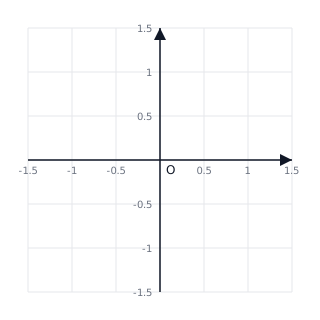
Trigonometric equations of the form or often result in multiple solutions within a given domain. These can be visualized as intersections between the horizontal line and the periodic trigonometric function.
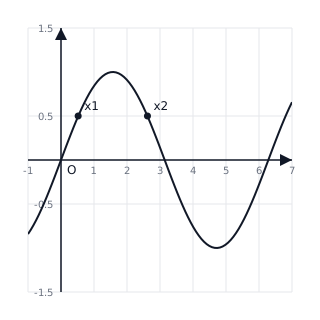
Double angle identities allow for the simplification of expressions where the argument is doubled (). has three useful forms which can be selected based on the other terms in the equation to facilitate factoring.

The ASTC (All Students Take Calculus) rule or CAST diagram identifies the quadrants where sine, cosine, and tangent are positive, helping to find principal and secondary solutions for in the range .
📐Formulae
💡Examples
Problem 1:
Solve the equation for .
Solution:
- Use the identity :
- Expand and simplify:
- Factor the quadratic:
- Solve for :
- Find in the domain : For , For ,
Explanation:
We first convert the equation into a single trigonometric ratio (sine) using the Pythagorean identity. Then, we treat it as a quadratic equation to find the values of before identifying the specific angles.
Problem 2:
Solve for .
Solution:
- Use the double angle identity for :
- Rearrange the equation to one side:
- Factor out :
- Set each factor to zero:
- The solution set is .
Explanation:
It is critical not to divide both sides by , as this would result in losing solutions where . Instead, factor the equation to find all possible roots.
Problem 3:
Given and , find the value of .
Solution:
- Identify the quadrant: is the 4th quadrant, where is negative.
- Find using :
- Use the double angle formula:
Explanation:
The quadrant is used to determine the sign of the sine value. Once both and are known, the double angle identity provides the final result.
Problem 4:
Solve the equation for .
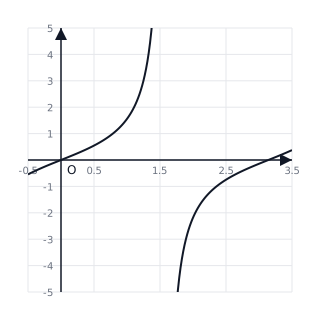
Solution:
- Isolate the trigonometric term:
- Take the square root of both sides:
- Case 1:
- Case 2:
- The solutions in the interval are .
Explanation:
Since the equation involves , we obtain two possible values for . We then find the angles in the first and second quadrants that correspond to these values within the restricted domain.
Problem 5:
Show that .
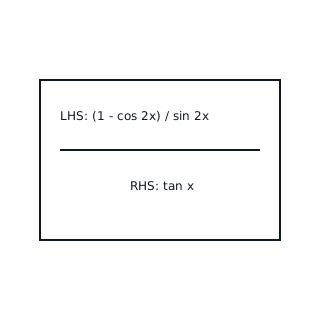
Solution:
- Substitute the double angle identities:
- Substitute the denominator:
- Form the fraction:
- Simplify by cancelling :
- Use the identity to conclude the proof.
Explanation:
By choosing the form of that eliminates the constant , the expression simplifies into a single trigonometric ratio.