krit.club logo

Geometry and Trigonometry - Trigonometric functions

Grade 11IB_AA

Review the key concepts, formulae, and examples before starting your quiz.

🔑Concepts

•

The Unit Circle defines the trigonometric functions for all real numbers. A point (x,y)(x, y) on a circle with radius r=1r = 1 centered at the origin has coordinates x=cos⁡θx = \cos \theta and y=sin⁡θy = \sin \theta. This allows us to extend trigonometry beyond right-angled triangles into all four quadrants.
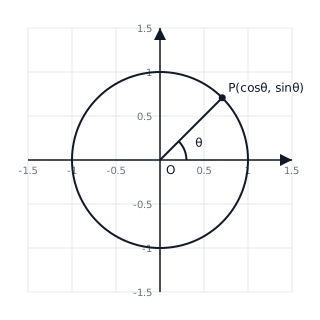
Unit circle showing coordinates (cos theta, sin theta) for a point P.
•

Trigonometric graphs of the form y=asin⁡(b(x−c))+dy = a \sin(b(x - c)) + d describe periodic behavior. The parameter aa represents the amplitude, bb determines the period where Period=2πb\text{Period} = \frac{2\pi}{b}, cc is the horizontal phase shift, and dd is the vertical translation (the principal axis).
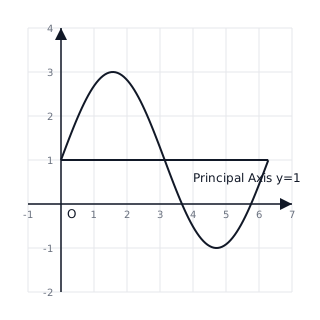
Graph of a sine function showing amplitude and vertical shift.
•

The CAST diagram (or unit circle quadrants) identifies where each trig function is positive: All are positive in Quadrant I, Sine in II, Tangent in III, and Cosine in IV.
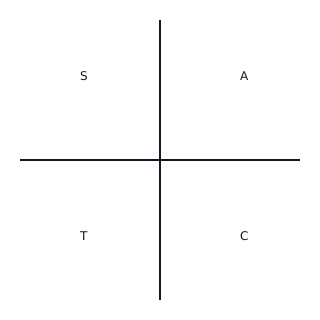
CAST diagram showing positive regions for trigonometric functions.
•

For any sector of a circle with radius rr and angle θ\theta in radians, the arc length ll and area AA are directly proportional to the angle.
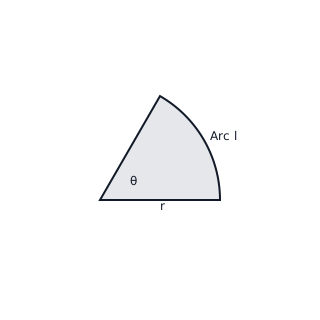
A circle sector showing radius, angle theta, and arc length l.

📐Formulae

θrad=π180∘×θdeg\theta_{\text{rad}} = \frac{\pi}{180^{\circ}} \times \theta_{\text{deg}}

l=rθl = r\theta

A=12r2θA = \frac{1}{2}r^{2}\theta

tan⁡θ=sin⁡θcos⁡θ\tan \theta = \frac{\sin \theta}{\cos \theta}

sin⁡2θ+cos⁡2θ=1\sin^{2}\theta + \cos^{2}\theta = 1

sin⁡2θ=2sin⁡θcos⁡θ\sin 2\theta = 2\sin \theta \cos \theta

cos⁡2θ=cos⁡2θ−sin⁡2θ=2cos⁡2θ−1=1−2sin⁡2θ\cos 2\theta = \cos^{2}\theta - \sin^{2}\theta = 2\cos^{2}\theta - 1 = 1 - 2\sin^{2}\theta

Period=2πb\text{Period} = \frac{2\pi}{b}

💡Examples

Problem 1:

Given that sin⁡θ=35\sin \theta = \frac{3}{5} and π2<θ<π\frac{\pi}{2} < \theta < \pi, find the exact value of cos⁡2θ\cos 2\theta.

Solution:

We use the double angle formula for cosine: cos⁡2θ=1−2sin⁡2θ\cos 2\theta = 1 - 2\sin^{2}\theta Substitute the given value: cos⁡2θ=1−2(35)2\cos 2\theta = 1 - 2\left(\frac{3}{5}\right)^{2} cos⁡2θ=1−2(925)\cos 2\theta = 1 - 2\left(\frac{9}{25}\right) cos⁡2θ=1−1825\cos 2\theta = 1 - \frac{18}{25} cos⁡2θ=725\cos 2\theta = \frac{7}{25}

Explanation:

Since we are given sin⁡θ\sin \theta, the most direct formula to use is cos⁡2θ=1−2sin⁡2θ\cos 2\theta = 1 - 2\sin^{2}\theta. The interval π2<θ<π\frac{\pi}{2} < \theta < \pi indicates θ\theta is in the second quadrant, but for the double angle cosine formula involving only sin⁡2θ\sin^{2}\theta, the quadrant of θ\theta does not change the result because the sine value is squared.

Problem 2:

Solve the equation 2cos⁡2x+sin⁡x−1=02\cos^{2}x + \sin x - 1 = 0 for 0≤x≤2π0 \le x \le 2\pi.

Solution:

First, use the identity cos⁡2x=1−sin⁡2x\cos^{2}x = 1 - \sin^{2}x to get the equation in terms of sine: 2(1−sin⁡2x)+sin⁡x−1=02(1 - \sin^{2}x) + \sin x - 1 = 0 2−2sin⁡2x+sin⁡x−1=02 - 2\sin^{2}x + \sin x - 1 = 0 −2sin⁡2x+sin⁡x+1=0-2\sin^{2}x + \sin x + 1 = 0 2sin⁡2x−sin⁡x−1=02\sin^{2}x - \sin x - 1 = 0 Factorizing the quadratic: (2sin⁡x+1)(sin⁡x−1)=0(2\sin x + 1)(\sin x - 1) = 0 This gives sin⁡x=−12\sin x = -\frac{1}{2} or sin⁡x=1\sin x = 1. For sin⁡x=1\sin x = 1 in the domain: x=π2x = \frac{\pi}{2}. For sin⁡x=−12\sin x = -\frac{1}{2} in the domain: x=π+π6=7π6x = \pi + \frac{\pi}{6} = \frac{7\pi}{6} and x=2π−π6=11π6x = 2\pi - \frac{\pi}{6} = \frac{11\pi}{6}. Final solutions: x∈{π2,7π6,11π6}x \in \left\{\frac{\pi}{2}, \frac{7\pi}{6}, \frac{11\pi}{6}\right\}.

Explanation:

To solve an equation with both cos⁡2x\cos^{2}x and sin⁡x\sin x, we convert everything to sin⁡x\sin x using the Pythagorean identity. This creates a quadratic equation in terms of sin⁡x\sin x, which can be solved by factoring or the quadratic formula.

Problem 3:

A sector of a circle has a radius of 88 cm and an arc length of 1212 cm. Find the area of the sector.

Solution:

First, find the angle θ\theta in radians using l=rθl = r\theta: 12=8θ  ⟹  θ=128=1.5 radians12 = 8\theta \implies \theta = \frac{12}{8} = 1.5 \text{ radians} Now, use the area formula A=12r2θA = \frac{1}{2}r^{2}\theta: A=12(8)2(1.5)A = \frac{1}{2}(8)^{2}(1.5) A=12(64)(1.5)=32×1.5=48A = \frac{1}{2}(64)(1.5) = 32 \times 1.5 = 48 The area is 48 cm248 \text{ cm}^{2}.

Explanation:

The problem provides the radius and arc length. By using the arc length formula, we determine the central angle in radians, which is then plugged into the sector area formula.

Problem 4:

The height hh meters of a seat on a Ferris wheel at time tt minutes is modeled by the function h(t)=15−12cos⁡(π10t)h(t) = 15 - 12 \cos\left(\frac{\pi}{10}t\right). Find the time it takes for the wheel to complete one full revolution and the maximum height of the seat.
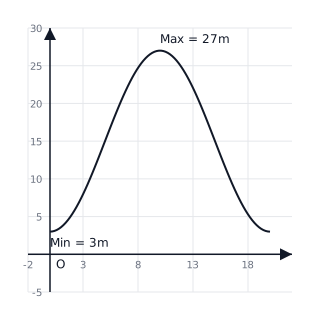
Graph of the height of a Ferris wheel seat over 20 minutes.

Solution:

  1. The period of the function h(t)h(t) is given by T=2πbT = \frac{2\pi}{b}.
  2. Here, b=π10b = \frac{\pi}{10}, so T=2ππ10=2π×10π=20T = \frac{2\pi}{\frac{\pi}{10}} = 2\pi \times \frac{10}{\pi} = 20 minutes.
  3. The maximum height occurs when cos⁡(π10t)=−1\cos\left(\frac{\pi}{10}t\right) = -1.
  4. hmax=15−12(−1)=15+12=27h_{\text{max}} = 15 - 12(-1) = 15 + 12 = 27 meters.

Explanation:

The period TT represents the time for one cycle. In cosine functions of the form d−acos⁡(bt)d - a \cos(bt), the maximum value is d+ad + a and the minimum is d−ad - a.

Problem 5:

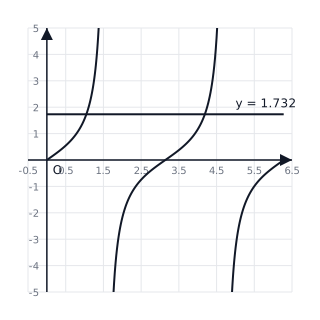
Solve the equation tan⁡x=3\tan x = \sqrt{3} for 0≤x≤2π0 \le x \le 2\pi.

Graph of y = tan(x) intersecting with y = sqrt(3) at two points.

Solution:

  1. The reference angle (in the first quadrant) where tan⁡x=3\tan x = \sqrt{3} is x=π3x = \frac{\pi}{3}.
  2. Since tan⁡x\tan x is positive in Quadrants I and III, we find the second solution.
  3. In Quadrant III, x=π+π3=4π3x = \pi + \frac{\pi}{3} = \frac{4\pi}{3}.
  4. Thus, the solutions in the given range are x=π3x = \frac{\pi}{3} and x=4π3x = \frac{4\pi}{3}.

Explanation:

Tangent is positive in the first and third quadrants. We use the period of π\pi for tangent to find additional solutions within the domain.