krit.club logo

Geometry and Trigonometry - Vector (Cross) product (HL)

Grade 11IB_AA

Review the key concepts, formulae, and examples before starting your quiz.

🔑Concepts

•

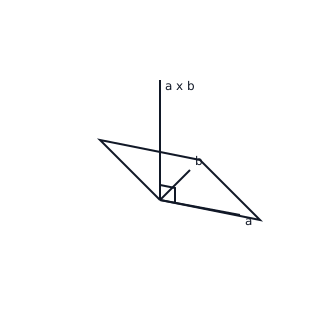
The vector (cross) product a⃗×b⃗\vec{a} \times \vec{b} results in a vector that is perpendicular to both a⃗\vec{a} and b⃗\vec{b}, satisfying the right-hand rule. If a⃗\vec{a} and b⃗\vec{b} are parallel, their cross product is the zero vector 0⃗\vec{0}.

Diagram showing vectors a and b in a plane with their cross product vector perpendicular to that plane.
•

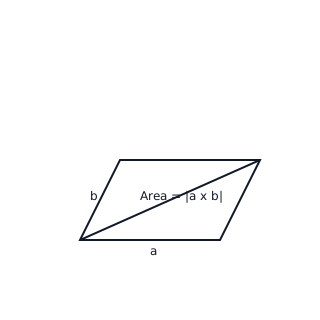
The magnitude of the cross product, ∣a⃗×b⃗∣|\vec{a} \times \vec{b}|, represents the area of the parallelogram formed by the two vectors. Consequently, the area of a triangle formed by these vectors is 12∣a⃗×b⃗∣\frac{1}{2}|\vec{a} \times \vec{b}|.

A parallelogram defined by vectors a and b showing the area calculation.
•

The cross product is anti-commutative, meaning a⃗×b⃗=−(b⃗×a⃗)\vec{a} \times \vec{b} = -(\vec{b} \times \vec{a}). It is also distributive over addition: a⃗×(b⃗+c⃗)=a⃗×b⃗+a⃗×c⃗\vec{a} \times (\vec{b} + \vec{c}) = \vec{a} \times \vec{b} + \vec{a} \times \vec{c}.

•

Algebraically, the cross product is calculated using the determinant of a 3×33 \times 3 matrix with unit vectors i,j,k\mathbf{i}, \mathbf{j}, \mathbf{k} in the first row.

📐Formulae

a⃗×b⃗=(a2b3−a3b2a3b1−a1b3a1b2−a2b1)\vec{a} \times \vec{b} = \begin{pmatrix} a_2b_3 - a_3b_2 \\ a_3b_1 - a_1b_3 \\ a_1b_2 - a_2b_1 \end{pmatrix}

a⃗×b⃗=∣ijka1a2a3b1b2b3∣\vec{a} \times \vec{b} = \begin{vmatrix} \mathbf{i} & \mathbf{j} & \mathbf{k} \\ a_1 & a_2 & a_3 \\ b_1 & b_2 & b_3 \end{vmatrix}

∣a⃗×b⃗∣=∣a⃗∣∣b⃗∣sin⁡θ|\vec{a} \times \vec{b}| = |\vec{a}| |\vec{b}| \sin \theta

Area of a parallelogram=∣a⃗×b⃗∣\text{Area of a parallelogram} = |\vec{a} \times \vec{b}|

Area of a triangle=12∣a⃗×b⃗∣\text{Area of a triangle} = \frac{1}{2} |\vec{a} \times \vec{b}|

💡Examples

Problem 1:

Given vectors a⃗=(12−1)\vec{a} = \begin{pmatrix} 1 \\ 2 \\ -1 \end{pmatrix} and b⃗=(302)\vec{b} = \begin{pmatrix} 3 \\ 0 \\ 2 \end{pmatrix}, calculate a⃗×b⃗\vec{a} \times \vec{b}.

Solution:

We use the determinant method: a⃗×b⃗=∣ijk12−1302∣\vec{a} \times \vec{b} = \begin{vmatrix} \mathbf{i} & \mathbf{j} & \mathbf{k} \\ 1 & 2 & -1 \\ 3 & 0 & 2 \end{vmatrix} =i(2×2−(−1)×0)−j(1×2−(−1)×3)+k(1×0−2×3)= \mathbf{i}(2 \times 2 - (-1) \times 0) - \mathbf{j}(1 \times 2 - (-1) \times 3) + \mathbf{k}(1 \times 0 - 2 \times 3) =i(4)−j(2+3)+k(−6)= \mathbf{i}(4) - \mathbf{j}(2 + 3) + \mathbf{k}(-6) =4i−5j−6k= 4\mathbf{i} - 5\mathbf{j} - 6\mathbf{k} So, a⃗×b⃗=(4−5−6)\vec{a} \times \vec{b} = \begin{pmatrix} 4 \\ -5 \\ -6 \end{pmatrix}.

Explanation:

To find the cross product, we set up a 3×33 \times 3 determinant with unit vectors i,j,k\mathbf{i}, \mathbf{j}, \mathbf{k} in the first row and the components of a⃗\vec{a} and b⃗\vec{b} in the subsequent rows.

Problem 2:

Find the area of the triangle with vertices A(1,3,2)A(1, 3, 2), B(2,−1,0)B(2, -1, 0), and C(−1,2,3)C(-1, 2, 3).

Solution:

First, find two vectors forming the sides of the triangle: \vec{AB} = $$\begin{pmatrix} 2-1 \\ -1-3 \\ 0-2 \end{pmatrix}$$ = $$\begin{pmatrix} 1 \\ -4 \\ -2 \end{pmatrix}$$ \vec{AC} = \begin{pmatrix} -1-1 \ 2-3 \ 3-2 \end{pmatrix}==\begin{pmatrix} -2 \ -1 \ 1 \end{pmatrix}$$

Next, calculate the cross product AB⃗×AC⃗\vec{AB} \times \vec{AC}: AB⃗×AC⃗=∣ijk1−4−2−2−11∣=((−4)(1)−(−2)(−1)−[(1)(1)−(−2)(−2)](1)(−1)−(−4)(−2))\vec{AB} \times \vec{AC} = \begin{vmatrix} \mathbf{i} & \mathbf{j} & \mathbf{k} \\ 1 & -4 & -2 \\ -2 & -1 & 1 \end{vmatrix} = \begin{pmatrix} (-4)(1) - (-2)(-1) \\ -[(1)(1) - (-2)(-2)] \\ (1)(-1) - (-4)(-2) \end{pmatrix} = \begin{pmatrix} -6 \ 3 \ -9 \end{pmatrix}$$

Now, find the magnitude of this vector: ∣AB⃗×AC⃗∣=(−6)2+32+(−9)2=36+9+81=126|\vec{AB} \times \vec{AC}| = \sqrt{(-6)^2 + 3^2 + (-9)^2} = \sqrt{36 + 9 + 81} = \sqrt{126}

The area of the triangle is 12∣AB⃗×AC⃗∣\frac{1}{2} |\vec{AB} \times \vec{AC}|: Area=12126=129×14=3142\text{Area} = \frac{1}{2} \sqrt{126} = \frac{1}{2} \sqrt{9 \times 14} = \frac{3\sqrt{14}}{2}

Explanation:

The area of a triangle formed by two vectors is half the magnitude of their cross product. We first determine the vectors relative to a common vertex, then compute the cross product and its magnitude.

Problem 3:

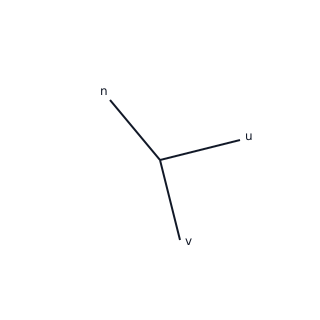
Find a unit vector that is perpendicular to both u⃗=2i+j−2k\vec{u} = 2\mathbf{i} + \mathbf{j} - 2\mathbf{k} and v⃗=3i−2j+k\vec{v} = 3\mathbf{i} - 2\mathbf{j} + \mathbf{k}.

Illustration of two vectors u and v and the resulting perpendicular unit vector n.

Solution:

Step 1: Calculate the cross product u⃗×v⃗\vec{u} \times \vec{v}. u⃗×v⃗=∣ijk21−23−21∣\vec{u} \times \vec{v} = \begin{vmatrix} \mathbf{i} & \mathbf{j} & \mathbf{k} \\ 2 & 1 & -2 \\ 3 & -2 & 1 \end{vmatrix} u⃗×v⃗=i(1−4)−j(2−(−6))+k(−4−3)\vec{u} \times \vec{v} = \mathbf{i}(1 - 4) - \mathbf{j}(2 - (-6)) + \mathbf{k}(-4 - 3) u⃗×v⃗=−3i−8j−7k\vec{u} \times \vec{v} = -3\mathbf{i} - 8\mathbf{j} - 7\mathbf{k} Step 2: Find the magnitude of the resulting vector. ∣u⃗×v⃗∣=(−3)2+(−8)2+(−7)2=9+64+49=122|\vec{u} \times \vec{v}| = \sqrt{(-3)^2 + (-8)^2 + (-7)^2} = \sqrt{9 + 64 + 49} = \sqrt{122} Step 3: Normalize the vector to find the unit vector n^\hat{n}. n^=±1122(−3−8−7)\hat{n} = \pm \frac{1}{\sqrt{122}} \begin{pmatrix} -3 \\ -8 \\ -7 \end{pmatrix}

Explanation:

To find a vector perpendicular to two given vectors, use the cross product. Normalizing the resulting vector (dividing by its magnitude) produces the unit vector.

Problem 4:

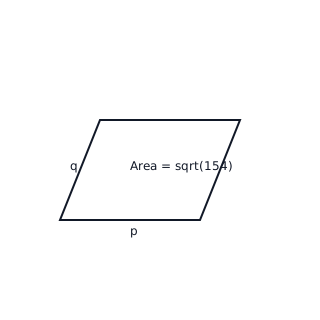
Calculate the area of a parallelogram where two adjacent sides are defined by the vectors p⃗=(401)\vec{p} = \begin{pmatrix} 4 \\ 0 \\ 1 \end{pmatrix} and q⃗=(130)\vec{q} = \begin{pmatrix} 1 \\ 3 \\ 0 \end{pmatrix}.

Parallelogram with base vector p and side vector q.

Solution:

Step 1: Calculate the cross product p⃗×q⃗\vec{p} \times \vec{q}. p⃗×q⃗=∣ijk401130∣\vec{p} \times \vec{q} = \begin{vmatrix} \mathbf{i} & \mathbf{j} & \mathbf{k} \\ 4 & 0 & 1 \\ 1 & 3 & 0 \end{vmatrix} p⃗×q⃗=i(0−3)−j(0−1)+k(12−0)\vec{p} \times \vec{q} = \mathbf{i}(0 - 3) - \mathbf{j}(0 - 1) + \mathbf{k}(12 - 0) p⃗×q⃗=−3i+j+12k\vec{p} \times \vec{q} = -3\mathbf{i} + \mathbf{j} + 12\mathbf{k} Step 2: Calculate the magnitude of the cross product vector to find the area. Area=∣p⃗×q⃗∣=(−3)2+12+122\text{Area} = |\vec{p} \times \vec{q}| = \sqrt{(-3)^2 + 1^2 + 12^2} Area=9+1+144=154≈12.41 units2\text{Area} = \sqrt{9 + 1 + 144} = \sqrt{154} \approx 12.41 \text{ units}^2

Explanation:

The magnitude of the cross product of two vectors originating from the same point gives the area of the parallelogram they span.